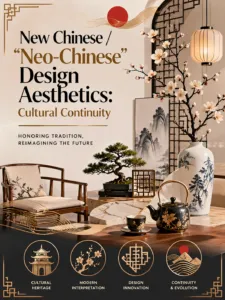
Introduction: The Emergence of Neo-Chinese Design
New Chinese, often referred to as “Neo-Chinese,” design aesthetics represent a defining shift in contemporary visual culture. Rather than functioning as a revivalist or nostalgic movement, Neo-Chinese design emerges from a critical reassessment of tradition under conditions of globalization, urbanization, and cultural rearticulation. It seeks to reinterpret inherited philosophies, symbols, and craft systems through contemporary design thinking, positioning Chinese cultural identity within a modern, global framework.
As China’s creative industries gain international visibility, Neo-Chinese aesthetics have become increasingly prominent across architecture, interior design, product design, fashion, branding, and graphic communication. This design language reflects not only visual transformation but also a broader cultural confidence—one that prioritizes authorship over imitation and continuity over rupture.
Philosophical and Historical Foundations
Classical Chinese Aesthetic Thought
The intellectual foundation of Neo-Chinese design can be traced to classical Chinese aesthetics, particularly those articulated through Confucian, Daoist, and Buddhist philosophies. These traditions emphasize harmony, balance, restraint, and symbolic abstraction, principles extensively examined in Li Zehou’s The Path of Beauty: A Study of Chinese Aesthetics (Oxford University Press), which outlines how Chinese visual culture privileges emotional resonance and moral meaning over formal realism
(https://global.oup.com).
Complementing this framework, Yu-lan Fung’s A Short History of Chinese Philosophy provides essential context for understanding how ideas such as moderation (中庸), emptiness (虚), and unity between humans and nature (天人合一) informed traditional spatial organization, material choice, and compositional logic
(https://www.simonandschuster.com).
These philosophical foundations remain central to Neo-Chinese design, not as stylistic references but as conceptual frameworks guiding form, proportion, and atmosphere.
Modernization and Cultural Reassessment
During the 20th century, rapid industrialization and the influence of Western modernism disrupted traditional Chinese design systems. Functionalism, international style architecture, and mass production marginalized indigenous aesthetics in favor of perceived universality. The Neo-Chinese movement emerged as a response to this imbalance, seeking to reassert cultural specificity within modern design practices.
Duanfang Lu’s Third World Modernism: Architecture, Development and Identity (Routledge) offers a critical lens through which Neo-Chinese design can be understood—as part of a broader negotiation between modernization and cultural identity in non-Western contexts
(https://www.routledge.com).
Core Principles of Neo-Chinese Design Aesthetics
Cultural Abstraction Over Literal Representation
A defining characteristic of Neo-Chinese design is its reliance on abstraction rather than direct imitation. Traditional motifs are rarely reproduced in their original form. Instead, designers distill their underlying logic—rhythm, proportion, symbolism—and reinterpret them through contemporary geometries and materials.
This approach aligns with broader design discourse on cultural translation, where meaning is preserved without aesthetic rigidity. It avoids decorative excess while maintaining cultural legibility.
Minimalism with Philosophical Depth
While often associated with minimalism, Neo-Chinese design differs significantly from Western minimalist traditions. Rather than emphasizing neutrality or reduction for its own sake, it uses restraint as a means of emotional and spatial expression.
Negative space, inspired by ink painting and calligraphy, plays a crucial role. This concept of visual “emptiness” creates room for contemplation and sensory engagement, reinforcing the experiential quality of design.
Materiality, Craft, and Authenticity
Reinterpreting Traditional Materials
Material selection in Neo-Chinese design reflects both continuity and innovation. Designers frequently employ materials with deep cultural associations—wood, bamboo, stone, ceramics, silk—while applying contemporary fabrication techniques and finishes.
The importance of material authenticity and cultural continuity is reinforced by UNESCO’s work on intangible cultural heritage and traditional craftsmanship, which emphasizes the role of craft in sustaining cultural identity in modern contexts
(https://ich.unesco.org).
Craftsmanship in Contemporary Practice
Rather than viewing craftsmanship as incompatible with modern production, Neo-Chinese design integrates traditional techniques into contemporary systems. This approach supports sustainability, longevity, and cultural preservation, aligning with global movements advocating slow design and ethical production.
Phaidon’s China Design Now documents numerous designers who successfully bridge craft traditions with modern aesthetics, particularly in product, furniture, and fashion design
(https://www.phaidon.com).
Color Systems and Visual Language
Symbolic Yet Restrained Color Palettes
Color in Neo-Chinese design is culturally symbolic but visually restrained. Instead of saturated contrasts, designers favor tonal harmony—ink black, porcelain white, stone gray, muted reds, jade green, and indigo blues.
These palettes draw from historical symbolism while adapting to contemporary spatial and digital environments, ensuring versatility across disciplines.
Typography and Graphic Expression
In graphic design and branding, Neo-Chinese aesthetics manifest through typographic innovation. Designers often reinterpret the structural logic of Chinese calligraphy—stroke weight, rhythm, balance—within modern grid systems.
Publications such as New China Style Graphic Design by Victionary provide extensive documentation of how contemporary designers apply these principles across branding and editorial design
(https://www.victionary.com).
Applications Across Design Disciplines
Architecture and Interior Design
Neo-Chinese architecture emphasizes spatial sequencing, material tactility, and environmental integration over visual spectacle. Courtyard typologies, framed views, layered thresholds, and human-scaled proportions are adapted to contemporary urban contexts.
Architectural discourse on this subject is widely documented in Architectural Design (Wiley), including essays by practitioners such as Wang Shu that explore the reinterpretation of tradition within modern architectural practice
(https://onlinelibrary.wiley.com).
Platforms such as ArchDaily further illustrate how Neo-Chinese principles are applied in contemporary projects, particularly in cultural, residential, and hospitality architecture
(https://www.archdaily.com).
Product, Fashion, and Lifestyle Design
In product and fashion design, Neo-Chinese aesthetics emphasize refined silhouettes, functional clarity, and cultural storytelling. Traditional garment structures, symbolic patterns, and craft techniques are translated into modern forms suited to contemporary lifestyles.
Design Anthology Asia provides coverage of this cross-disciplinary application, highlighting how Neo-Chinese design resonates with younger, globally aware consumers
(https://www.designanthologyasia.com).
Global Influence and Cultural Significance
Neo-Chinese Design in Global Discourse
As Chinese brands and designers expand internationally, Neo-Chinese aesthetics offer a distinctive alternative to homogenized global design trends. Rather than conforming to Western norms, they introduce a culturally grounded visual language that enriches global design discourse.
Dezeen has extensively documented this shift, showcasing how contemporary Chinese designers redefine modern aesthetics through culturally embedded approaches
(https://www.dezeen.com).
Similarly, Domus situates Neo-Chinese design within broader architectural and cultural narratives, emphasizing its theoretical and spatial contributions
(https://www.domusweb.it).
Identity, Soft Power, and Design Authorship
Beyond aesthetics, Neo-Chinese design plays a role in cultural branding and soft power. It reflects a growing confidence in cultural authorship, positioning Chinese design as a source of innovation rather than adaptation.
Academic discussions in journals such as Design Issues (MIT Press) and the Journal of Design History (Oxford Academic) provide critical frameworks for understanding this shift within global design theory
(https://www.mitpressjournals.org)
(https://academic.oup.com/jdh).
Critical Perspectives and Future Directions
Challenges of Superficial Application
Despite its growing popularity, Neo-Chinese design faces risks of superficiality. Overreliance on symbolic motifs without philosophical or cultural grounding can lead to aesthetic dilution. Authentic Neo-Chinese design requires research, cultural literacy, and conceptual rigor.
Future Trajectories
Looking forward, Neo-Chinese aesthetics are likely to evolve through deeper engagement with technology, sustainability, and interdisciplinary practice. Digital fabrication, smart materials, and ecological design principles offer new opportunities to extend traditional philosophies into future-oriented contexts.
Conclusion
Neo-Chinese design aesthetics represent a dynamic cultural dialogue rather than a fixed style. Rooted in philosophical tradition yet responsive to contemporary realities, this design language demonstrates how heritage can inform innovation without constraint. Through abstraction, material intelligence, spatial sensitivity, and cultural confidence, Neo-Chinese design offers a compelling model for culturally grounded modernity.
As global design increasingly values authenticity, meaning, and sustainability, Neo-Chinese aesthetics stand not as a regional trend, but as a significant contribution to contemporary design thinking worldwide.


One thought on “New Chinese / “Neo-Chinese” Design Aesthetics: Cultural Continuity in a Contemporary Visual Language”