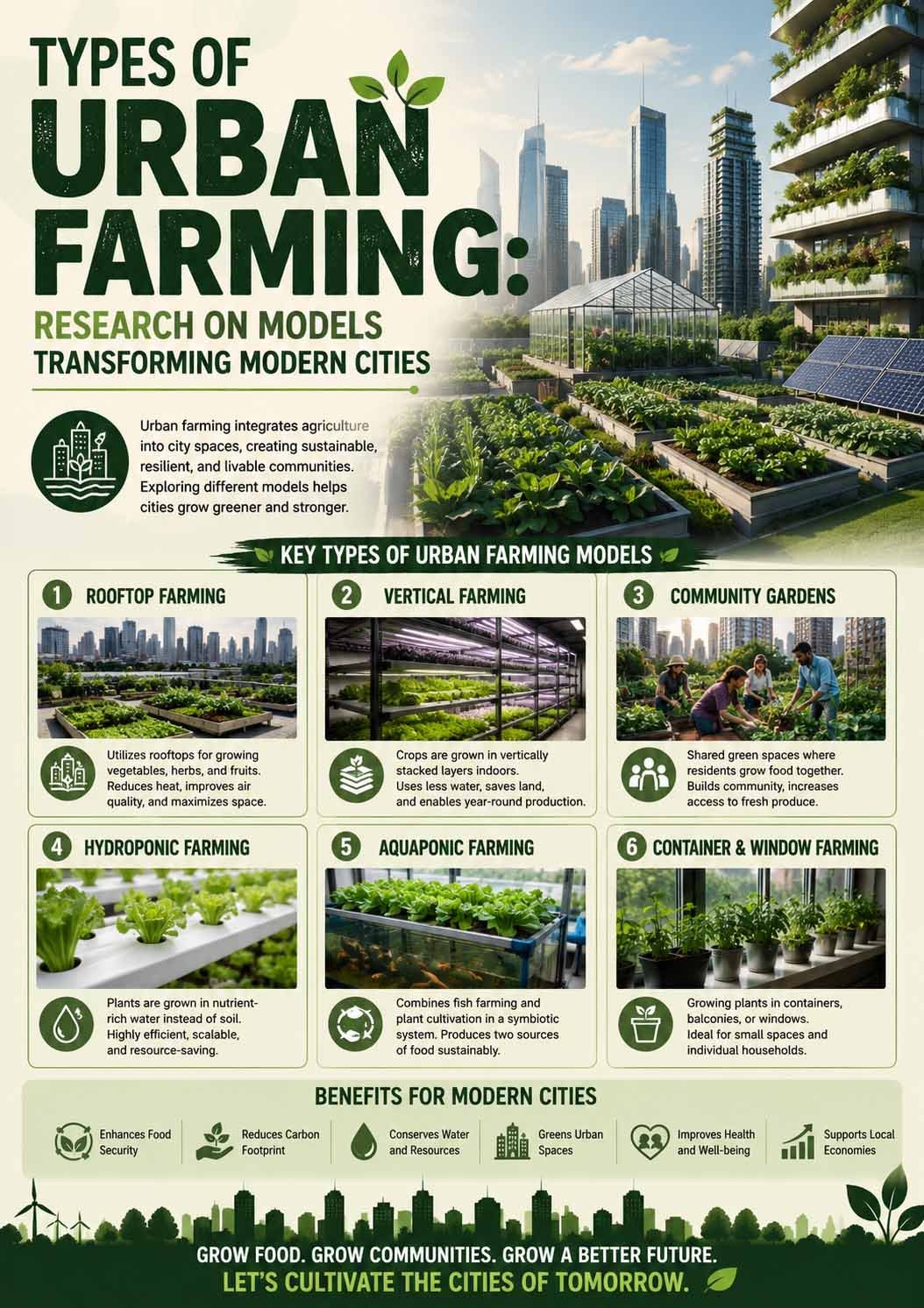
Urban farming is becoming increasingly important as cities face limited land, water scarcity, food-security challenges, and rising transportation emissions. Three advanced soilless farming systems—hydroponics, aquaponics, and aeroponics—offer ways to grow fresh food in small urban spaces.
But which system is the most sustainable urban farming solution?
1. Hydroponics
Hydroponics grows plants without soil by delivering a nutrient-rich water solution directly to plant roots. It can be used in rooftops, balconies, vertical farms, greenhouses, and indoor farms.
Advantages:
- Efficient use of water
- High crop productivity
- Suitable for vertical farming
- Precise nutrient management
- Requires relatively little land
Limitations: It depends on manufactured nutrients and generally requires electricity for pumps, lighting, and climate control.
2. Aquaponics
Aquaponics combines fish farming and hydroponic plant production. Fish waste provides nutrients for plants, while plants help filter and clean the water before it returns to the fish tank.
Advantages:
- Integrates fish and vegetable production
- Recycles nutrients and water
- Reduces dependence on synthetic fertilizers
- Suitable for circular urban food systems
Limitations: The system is more complex to manage and requires maintaining healthy conditions for both fish and plants.
3. Aeroponics
Aeroponics grows plants with their roots suspended in air while nutrient-rich water is sprayed as a fine mist.
Advantages:
- Extremely efficient water delivery
- Very high space efficiency
- Excellent for vertical farming
- Fast plant growth under controlled conditions
- Roots receive high levels of oxygen
Limitations: It can require sophisticated equipment, reliable electricity, and careful monitoring. A pump or misting failure can rapidly affect plants.
How the Systems Work
While all three methods eliminate soil, their approach to delivering water and nutrients varies significantly:
- Hydroponics: Plant roots are suspended in or flooded with a water-based, synthetic nutrient solution. It is the most common and accessible urban farming method.
- Aquaponics: A closed-loop ecosystem combining hydroponics with aquaculture (fish farming). Fish waste provides organic nutrients for the plants, and the plants naturally filter the water before it returns to the fish tanks.
- Aeroponics: Plant roots hang in the open air and are intermittently sprayed with a fine mist of nutrient solution. This maximizes oxygen exposure to the root zone for rapid growth.
Hydroponic vs Aquaponic vs Aeroponic
| Factor | Hydroponics | Aquaponics | Aeroponics |
|---|---|---|---|
| Water efficiency | High | Very high | Very high |
| Land efficiency | High | High | Very high |
| Nutrient | Added nutrients | Fish waste | Added nutrients |
| Fish production | No | Yes | No |
| System complexity | Medium | High | High |
| Energy dependence | Medium–High | Medium–High | High |
| Circularity | Medium | Very high | Medium |
| Urban suitability | Excellent | Excellent | Excellent |
| Maintenance | Medium | High | High |
| Feature | Hydroponics | Aquaponics | Aeroponics |
| Water Savings (vs. Soil) | 80% – 90% | ~90% | 95% – 98% |
| Nutrient Source | Synthetic chemical solutions | Organic fish waste | Synthetic chemical solutions |
| Energy Reliance | Medium (water pumps) | Medium (water and air pumps) | High (high-pressure misting pumps) |
| Waste Output | Occasional reservoir flushing | Near zero (circular system) | Very low (highly targeted misting) |
Conclusion
1. Water Conservation: Aeroponics Wins
All three systems drastically outperform traditional agriculture, but aeroponics is the undisputed champion of water efficiency. By delivering targeted micro-bursts of moisture directly to the roots, aeroponic systems use up to 50% less water than standard hydroponic setups and up to 98% less than soil farming.
2. Biological Circularity: Aquaponics Wins
If your definition of sustainability centers on avoiding synthetic chemicals and mimicking nature, aquaponics takes the lead. Because it relies on a symbiotic relationship between fish and plants, it requires zero synthetic fertilizers. It is a true closed-loop system that produces two food sources (produce and protein) simultaneously.
3. Space and Scalability: Aeroponics Wins
For vertical urban farming, weight and space are critical constraints. Because aeroponics doesn’t require heavy vats of water or heavy grow media, systems can be stacked much higher in vertical farms, yielding more food per square foot of urban real estate.