1. Introduction: Water Security in a Water-Scarce City-State
Singapore is globally recognised as a benchmark case in urban water security despite having no significant natural aquifers, limited land area, and high population density. Annual rainfall averages around 2,400 mm, yet spatial constraints and rapid urbanisation historically limited the country’s capacity to capture and store freshwater. In the 1960s, Singapore relied heavily on imported water, exposing national survival to external hydropolitical risks.
Today, Singapore is widely cited by the World Bank, OECD, and UN agencies as one of the most water-secure nations in the world. This transformation is not accidental; it is the result of deliberate long-term planning, robust institutions, technological innovation, and evidence-based policy design. This examines Singapore’s water security strategy using verified data, policy milestones, and institutional mechanisms, highlighting how the country achieved resilience across supply, demand, quality, and governance dimensions.
2. Conceptual Framework: Defining Water Security
Water security is commonly defined as the capacity of a population to safeguard sustainable access to adequate quantities of acceptable quality water for sustaining livelihoods, human well-being, socio-economic development, and protection against water-related hazards. Singapore operationalises this concept through four measurable pillars:
- Diversified water supply sources
- Demand-side efficiency and conservation
- Water quality and public health protection
- Institutional and financial sustainability
This framework allows Singapore to quantify risks, model future demand, and align infrastructure investments with national development objectives.
3. The Four National Taps: Supply-Side Diversification
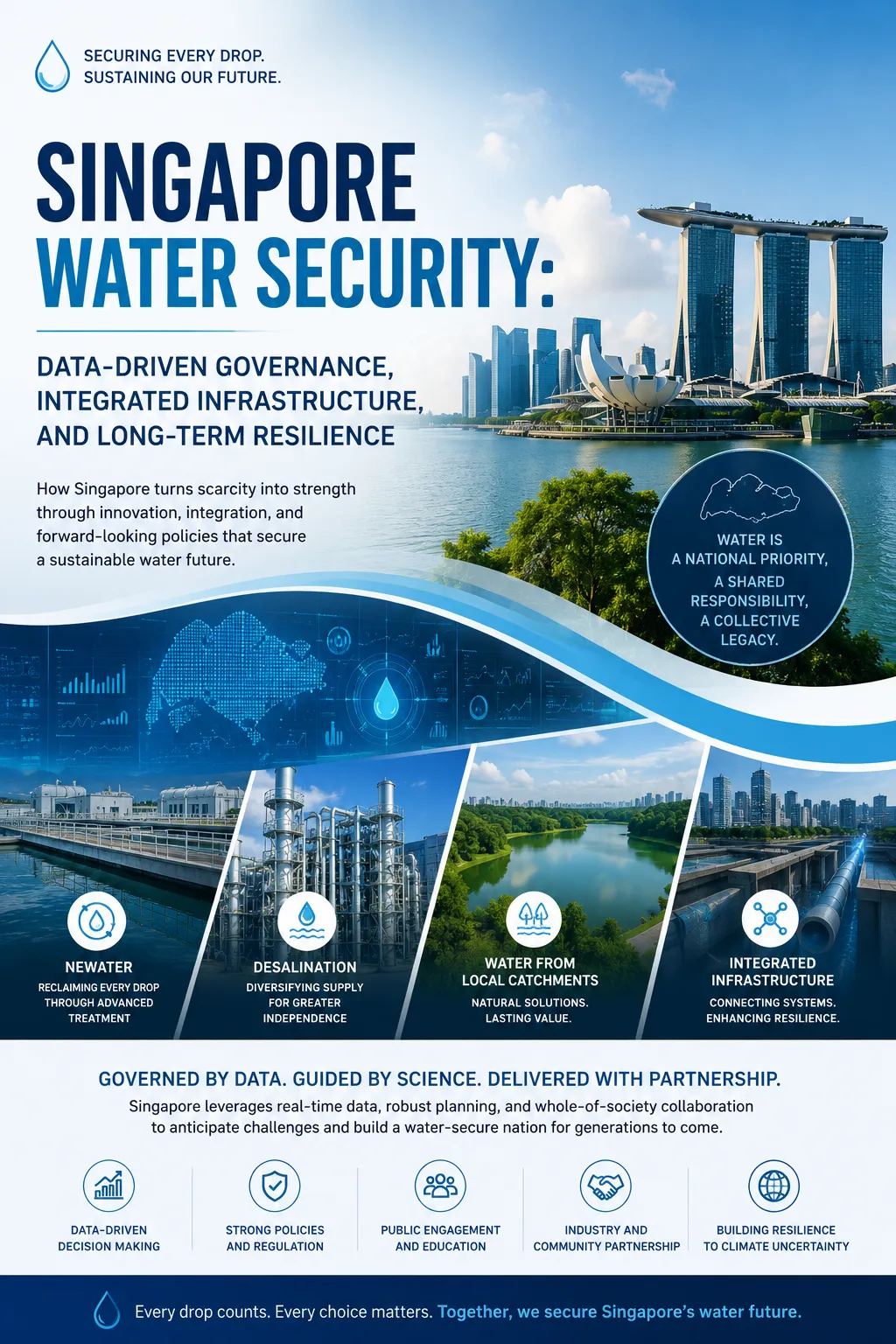
Singapore’s water security strategy is anchored in its “Four National Taps,” an integrated supply portfolio designed to minimise dependence on any single source.
3.1 Local Catchment Water
Rainwater harvested from reservoirs and urban catchments currently meets about 20–25% of national demand. Through extensive land-use planning, Singapore has expanded its water catchment area to nearly two-thirds of its total land surface. Iconic projects such as Marina Barrage demonstrate how urban drainage, flood control, and water storage can be integrated into dense city environments.
The local catchment system reduces climate vulnerability by maximising rainfall capture and minimising runoff losses, a critical factor under increasing rainfall variability linked to climate change.
3.2 Imported Water
Historically, water imported from Malaysia was a dominant supply source. However, imports have been strategically reduced over time. Long-term bilateral agreements ensured short- to medium-term security, while domestic capacity expansion allowed Singapore to progressively delink water security from geopolitical exposure. By the 2020s, imported water contributed less than 40% of total supply, with further reductions planned.
3.3 NEWater: High-Grade Reclaimed Water
NEWater represents one of Singapore’s most internationally studied innovations. Produced through microfiltration, reverse osmosis, and ultraviolet disinfection, NEWater meets World Health Organization drinking water standards. It currently supplies up to 40% of Singapore’s water demand, primarily for industrial and commercial use, with indirect potable use during dry periods.
Data from PUB indicates that NEWater production capacity is expected to reach 55% of total demand by 2060. This significantly decouples water availability from rainfall uncertainty and positions Singapore at the forefront of circular water economy models.
3.4 Desalinated Water
Desalination provides climate-resilient supply independent of hydrological cycles. Singapore operates multiple large-scale desalination plants, contributing around 30% of current demand. Advances in membrane technology and energy efficiency have reduced desalination costs from over SGD 2.50/m³ in the early 2000s to near SGD 1.00/m³ in recent plants.
By integrating desalination with renewable energy research, Singapore mitigates the carbon intensity traditionally associated with seawater desalination.
4. Demand Management: Data-Driven Water Efficiency
Water security in Singapore is as much about reducing demand as increasing supply. Per capita domestic water consumption declined from 165 litres/day in 2003 to around 141 litres/day by 2022. The national target is 130 litres/day by 2030.
This reduction has been achieved through:
- Progressive water pricing reflecting scarcity value
- Mandatory water-efficient fittings under the Water Efficiency Labelling Scheme
- Smart metering and real-time consumption feedback
- Behavioural nudges through sustained public education campaigns
Empirical studies published by the World Bank identify Singapore’s pricing strategy as a critical success factor, as tariffs fully recover production and environmental costs while incentivising conservation without compromising affordability.
5. Institutional Governance and Regulatory Coherence
A defining feature of Singapore’s water security model is institutional integration. PUB functions as a single national water authority responsible for the entire water cycle—from catchment management and supply to wastewater treatment and drainage. This eliminates fragmentation common in other jurisdictions and enables system-wide optimisation.
Long-term planning is institutionalised through scenario modelling extending 50–100 years, incorporating climate projections, population growth, and economic structure shifts. Water infrastructure is treated as strategic national capital rather than short-term public works.
6. Financing, Pricing, and Economic Sustainability
Singapore adopts full-cost water pricing, including operational, capital, and environmental externalities. This approach ensures fiscal sustainability and shields water infrastructure investment from political cycles. Subsidies are targeted at low-income households rather than applied universally, preserving price signals while maintaining social equity.
According to OECD analyses, Singapore’s water sector consistently generates sufficient revenue to fund reinvestment, research, and technological upgrading—an uncommon achievement in global urban water management.
7. Technology, Innovation, and Research Ecosystem
Singapore invests heavily in water research through initiatives such as the Environment and Water Industry Programme Office. Partnerships with universities, multinational firms, and research institutes have positioned Singapore as a global testbed for advanced water technologies.
Breakthroughs in membrane durability, energy-efficient desalination, and digital water management have not only enhanced domestic resilience but also created exportable expertise, reinforcing water security through economic diversification.
8. Climate Change Adaptation and Risk Management
Climate change introduces compound risks including sea-level rise, extreme rainfall, and prolonged droughts. Singapore addresses these through integrated drainage-reservoir systems, coastal protection planning, and redundancy across all four national taps.
Quantitative risk assessments indicate that even under worst-case climate scenarios, Singapore maintains sufficient adaptive capacity due to supply diversification and demand elasticity.
9. Global Significance and Policy Transferability
Singapore’s water security model is frequently referenced by UN-Water and international development agencies as a best-practice case. While its scale and governance context are unique, core principles—integrated management, long-term planning, full-cost pricing, and technology-enabled reuse—are transferable to other water-stressed cities.
Academic literature increasingly frames Singapore as evidence that water scarcity is not purely a physical constraint but a governance and investment challenge.
10. Conclusion: Strategic Foresight as the Foundation of Water Security
Singapore’s achievement in water security is the result of sustained political commitment, data-driven decision-making, and institutional coherence over six decades. By transforming vulnerability into strategic advantage, Singapore demonstrates how small, resource-constrained states can achieve high levels of resilience through innovation and disciplined governance.
For researchers and policymakers, Singapore’s experience provides a robust empirical case that long-term water security is achievable when infrastructure, institutions, and incentives are aligned within a coherent national strategy.
Key Reference
- PUB Singapore – https://www.pub.gov.sg
- World Bank Water Global Practice – https://www.worldbank.org/water
- OECD Water Governance Programme – https://www.oecd.org/water
- UN-Water – https://www.unwater.org
- Singapore Ministry of Sustainability and the Environment – https://www.mse.gov.sg