As global cities accelerate toward carbon neutrality, Building-Integrated Photovoltaics (BIPV) has emerged as one of the most transformative technologies in sustainable architecture. Unlike conventional rooftop solar systems, BIPV integrates photovoltaic materials directly into the structural envelope of buildings — including façades, roofs, skylights, curtain walls, and glazing systems.
The technology is rapidly moving from niche architectural experimentation into mainstream urban infrastructure, driven by stricter climate regulations, net-zero building mandates, rising electricity prices, and smart city expansion. According to multiple market analyses, the global BIPV market is expected to grow aggressively over the next decade, with projections ranging between USD 89 billion and USD 150 billion by the early 2030s.
Understanding Building-Integrated Photovoltaics (BIPV)
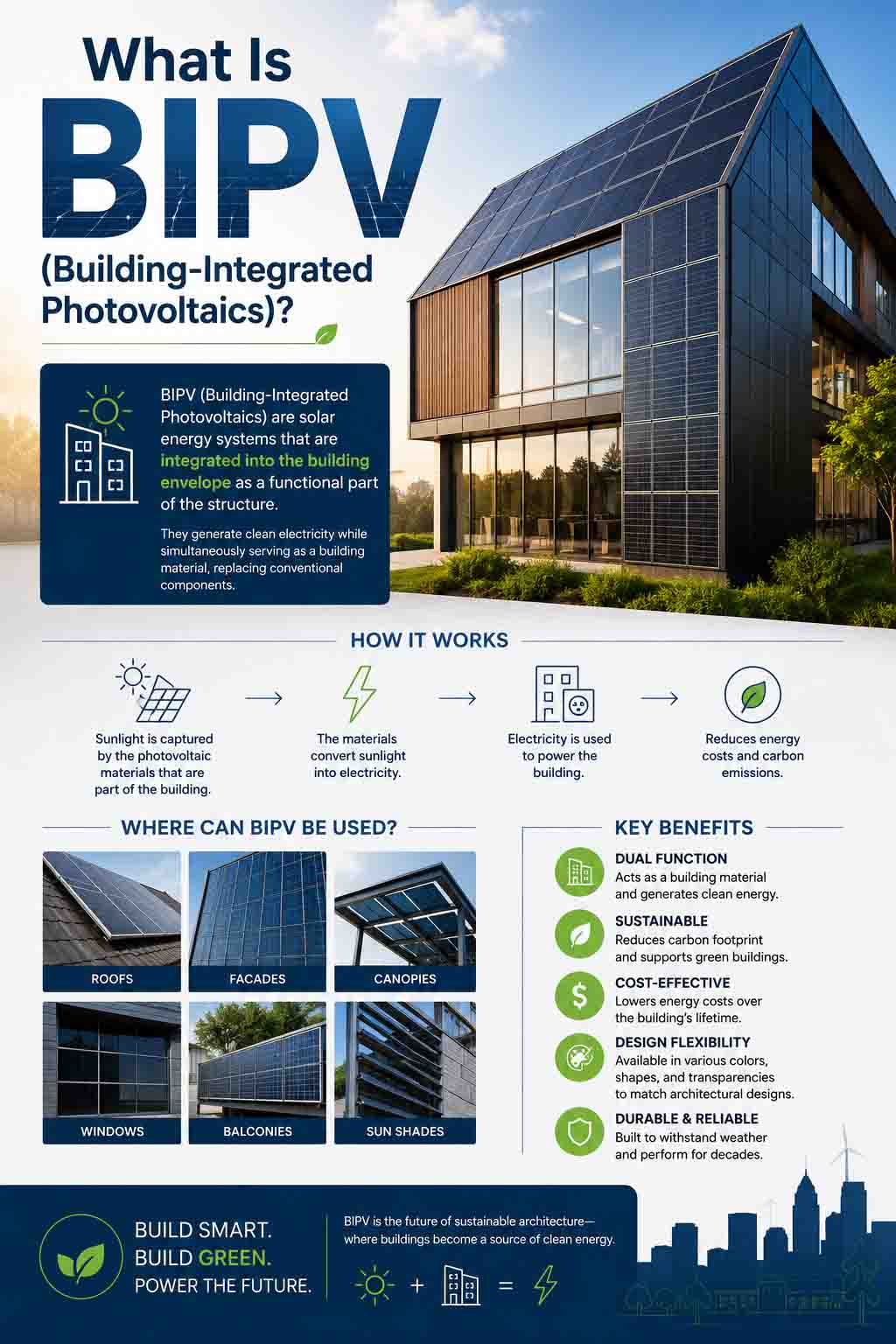
Building-Integrated Photovoltaics refers to solar photovoltaic components that simultaneously function as:
- Building envelope materials
- Architectural elements
- Renewable electricity generators
Unlike traditional solar panels mounted onto buildings, BIPV systems replace conventional construction materials such as:
- Roof tiles
- Glass façades
- Cladding systems
- Skylights
- Balconies
- Curtain walls
This dual-functionality dramatically improves land-use efficiency and architectural aesthetics while reducing operational energy costs.
Research published in advanced photovoltaic studies highlights that BIPV systems are especially critical for dense urban environments where rooftop area alone is insufficient for renewable energy generation.
Why BIPV Is Becoming a Global Urban Development Priority
The building sector contributes nearly 37% of global energy-related CO₂ emissions. Governments and urban planners increasingly view BIPV as essential to decarbonizing cities because it transforms buildings from passive energy consumers into active energy producers.
Key factors driving adoption include:
1. Net-Zero Building Regulations
Countries across Europe, Asia, and North America are introducing stringent energy efficiency regulations that require new buildings to produce part of their own energy demand.
The European Union’s Green Deal and renewable energy mandates are among the strongest catalysts for BIPV growth. Europe currently represents the largest global BIPV market share.
2. Urban Land Scarcity
Mega cities face severe land constraints for ground-mounted solar farms. BIPV enables energy generation without consuming additional urban land.
A 2024 global urban photovoltaic assessment found that façade-integrated PV systems can contribute up to 68.2% of rooftop generation capacity in dense city environments, while 17.5% of analyzed cities demonstrated even greater façade potential than rooftops.
3. Smart City Infrastructure Development
Smart city initiatives increasingly integrate BIPV into transportation hubs, airports, commercial districts, and public infrastructure.
China, Singapore, the UAE, and several Scandinavian countries have accelerated BIPV deployment within smart urban planning frameworks.
Major Types of BIPV Systems
Roof-Integrated Photovoltaics
Solar modules embedded directly into roofing systems.
Common applications:
- Residential homes
- Warehouses
- Commercial buildings
- Industrial facilities
Roof-based systems currently dominate the BIPV market, accounting for nearly 67% of installations globally.
Façade-Integrated Photovoltaics
Vertical photovoltaic systems embedded into building exteriors.
Key advantages:
- Higher energy generation in dense cities
- Reduced thermal load
- Enhanced architectural aesthetics
- Improved insulation
Façade-integrated systems are gaining rapid momentum in Europe and Asia due to increasing urban density.
Solar Glass and Transparent PV
Advanced photovoltaic glazing allows windows and skylights to generate electricity while transmitting daylight.
This segment is increasingly used in:
- Airports
- Corporate headquarters
- Luxury commercial complexes
- Green-certified skyscrapers
Advantages of BIPV Over Conventional Solar Systems
| Parameter | Conventional Solar Panels | BIPV Systems |
|---|---|---|
| Installation Type | Mounted on structures | Embedded into structures |
| Aesthetic Integration | Limited | High |
| Land Requirement | Additional surface required | No extra land needed |
| Material Replacement | No | Yes |
| Urban Suitability | Moderate | Excellent |
| Energy Efficiency Potential | High | High + thermal benefits |
| Long-Term Building Value | Moderate | Significant |
Global BIPV Market Growth Analysis
The BIPV industry is experiencing strong multi-region expansion.
Key Market Statistics
- Global BIPV market size in 2023: approximately USD 23.67 billion
- Projected 2030 market value: approximately USD 89.8 billion
- Expected CAGR through 2030: over 21%
- Europe remains the largest regional market
- Asia-Pacific is the fastest-growing BIPV region
The growth trajectory is being fueled by:
- Decentralized energy systems
- Carbon reduction mandates
- Green building certifications
- Rising energy prices
- Improvements in thin-film photovoltaic efficiency
Cities and Countries Leading BIPV Adoption
1. Singapore — Tropical High-Rise Solar Integration
Singapore has become one of the world’s most advanced urban laboratories for BIPV implementation.
Key Developments:
- Solar façades integrated into public housing towers
- Photovoltaic shading systems in commercial districts
- Smart nation sustainability initiatives
- Aggressive solar deployment targets despite limited land area
Singapore’s strategy focuses heavily on vertical solar generation because rooftop space is insufficient for national renewable energy goals.
The city-state has also pioneered solar-integrated glass technologies for high-rise buildings.
2. Germany — Freiburg’s Solar Urbanism Model
Freiburg is globally recognized as a benchmark for solar urban planning.
Why Freiburg Matters:
- Early adoption of solar façades
- Net-positive energy districts
- Mandatory renewable integration in urban planning
- Extensive passive solar architecture
Germany remains one of Europe’s largest BIPV innovation hubs, supported by strong renewable subsidies and building efficiency mandates.
3. Denmark — Copenhagen’s Carbon-Neutral Architecture
Copenhagen has integrated BIPV into:
- Municipal buildings
- Public infrastructure
- Mixed-use commercial developments
The city’s carbon neutrality roadmap strongly emphasizes energy-generating architecture.
Scandinavian countries increasingly deploy BIPV systems combined with district heating and smart energy grids.
4. China — Large-Scale BIPV Urban Deployment
China is rapidly scaling BIPV through:
- Airport infrastructure
- Railway stations
- Smart industrial parks
- Commercial mega-projects
China’s urbanization and manufacturing dominance have significantly reduced photovoltaic costs globally.
Research indicates that emerging Chinese cities could theoretically generate electricity exceeding local consumption through large-scale BIPV deployment.
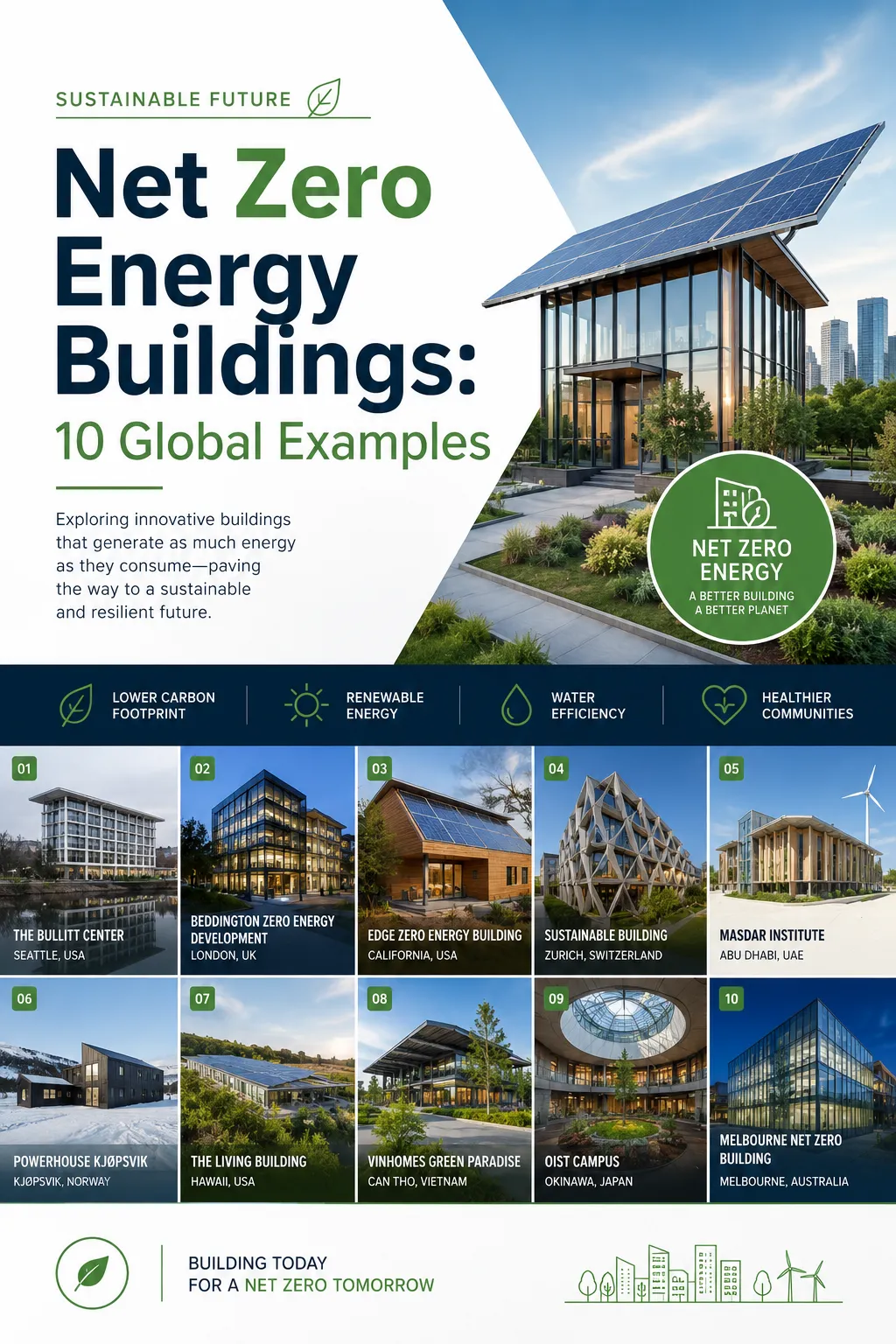
5. United Arab Emirates — Masdar City
Masdar City represents one of the world’s most ambitious sustainable urban development projects.
BIPV Integration Includes:
- Solar façades
- Energy-positive buildings
- Smart shading systems
- High-performance photovoltaic architecture
The UAE’s extreme climate conditions have accelerated innovation in heat-resistant photovoltaic materials.
See also: Masdar City, Abu Dhabi: Example of a Sustainable Urban Model?
6. Switzerland — Advanced Architectural BIPV Design
Switzerland has become a major innovation center for aesthetically integrated solar architecture.
Swiss projects emphasize:
- Colored photovoltaic façades
- High-end architectural integration
- Precision façade engineering
- Heritage-compatible solar systems
Swiss research institutions continue leading global BIPV façade innovation.
The Rise of BIPV Façades in High-Density Cities
Modern skyscrapers are increasingly adopting photovoltaic curtain walls.
This trend is especially important because:
- Rooftop area becomes proportionally smaller in taller buildings
- Façades offer significantly larger surface area
- Vertical installations improve winter solar capture in northern regions
Emerging studies on façade segmentation and AI-based solar mapping are improving urban photovoltaic optimization dramatically.
Technological Innovations Accelerating BIPV Growth
Thin-Film Photovoltaics
Thin-film technologies are increasingly favored for BIPV because they offer:
- Flexibility
- Lightweight integration
- Semi-transparency
- Better aesthetic adaptability
Bifacial Solar Systems
Bifacial photovoltaic systems generate electricity from both sides of the panel.
Research demonstrates that optimized bifacial installations can increase energy gains by up to 30% under certain conditions.
AI and Remote-Sensing Solar Mapping
Artificial intelligence and satellite imagery are now used to:
- Identify façade suitability
- Predict solar yield
- Optimize urban energy systems
- Improve city-scale BIPV planning
These technologies are becoming essential for future smart cities.
Economic Challenges Slowing BIPV Adoption
Despite rapid growth, several barriers remain:
High Initial Capital Costs
BIPV systems remain more expensive than conventional rooftop solar due to:
- Specialized installation
- Architectural customization
- Engineering complexity
Regulatory Fragmentation
Building codes and renewable regulations vary significantly across countries, slowing standardization.
Performance Variability
Urban shading, orientation, and climate conditions heavily influence photovoltaic efficiency.
Advanced AI-based planning tools are increasingly solving these optimization challenges.
Future Outlook: BIPV as Core Urban Infrastructure
BIPV is no longer viewed merely as an architectural enhancement. It is rapidly evolving into a foundational technology for net-zero cities.
Over the next decade, the convergence of:
- Smart grids
- AI-driven energy optimization
- Net-zero regulations
- Advanced photovoltaic materials
- Urban electrification
will likely position BIPV at the center of sustainable urban development.
Industry forecasts consistently indicate double-digit annual growth rates through 2030 and beyond.
Conclusion
Building-Integrated Photovoltaics represents a structural transformation in how cities generate and consume energy. By embedding renewable electricity generation directly into architecture, BIPV addresses multiple urban challenges simultaneously — including land scarcity, carbon emissions, energy security, and sustainable infrastructure development.
From Singapore and Freiburg to Masdar City and Copenhagen, cities worldwide are demonstrating that future buildings will not simply consume energy — they will produce it.
As urban populations continue rising and climate targets become more aggressive, BIPV is positioned to become one of the defining technologies of 21st-century architecture and sustainable urbanism.