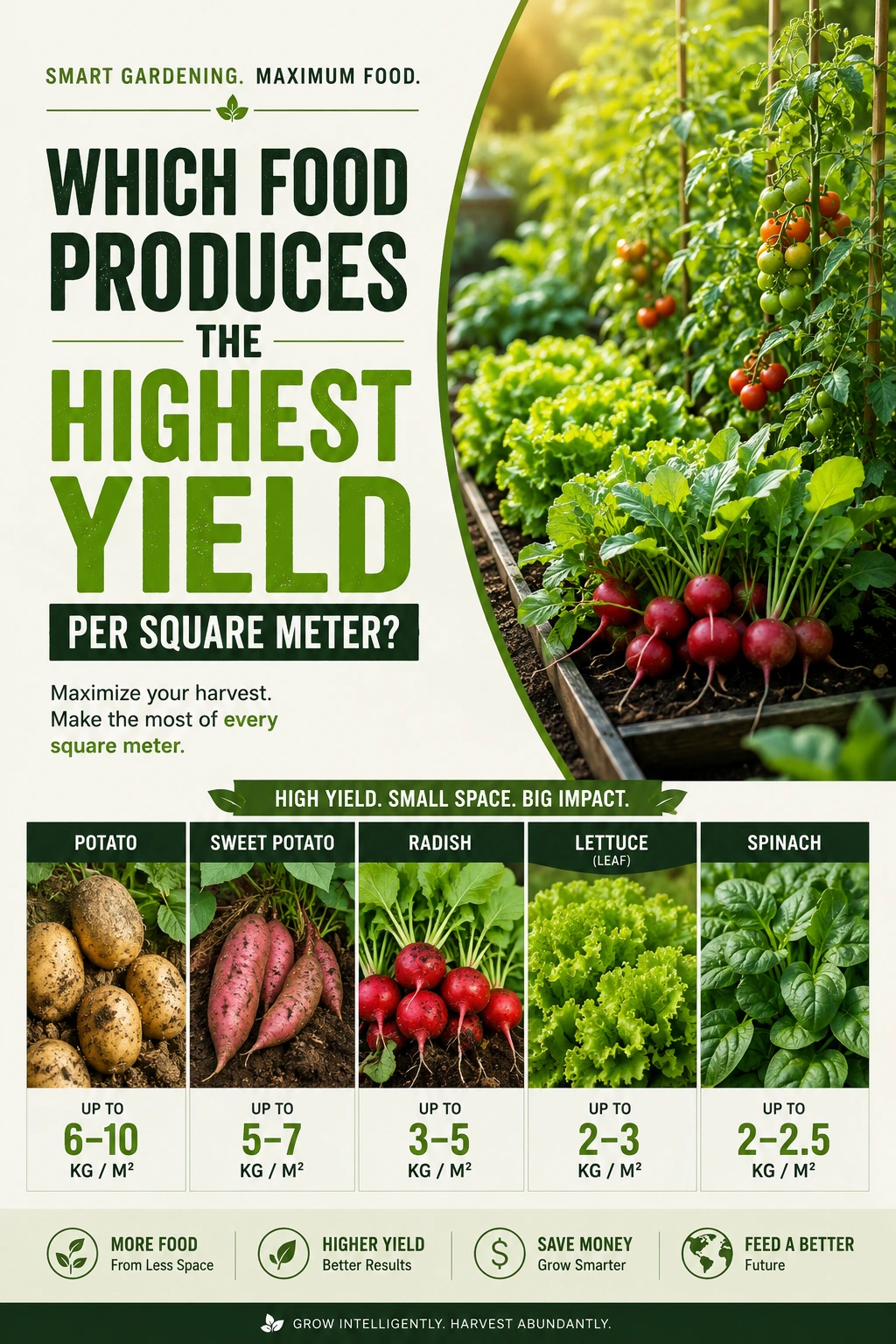
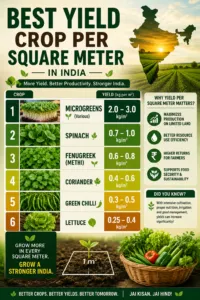
India’s agricultural economy is rapidly shifting from acreage-focused cultivation to productivity-focused cultivation. With rising land prices, shrinking farm holdings, water scarcity, urban farming adoption, and demand for premium vegetables, the question modern farmers increasingly ask is simple: Which crop generates the highest yield per square meter in India?
The answer is no longer limited to traditional staples such as rice or wheat. Advanced cultivation systems including hydroponics, vertical farming, controlled-environment agriculture, greenhouse cultivation, and precision nutrient management have dramatically changed yield metrics across Indian states and cities.
This research-driven analysis evaluates the highest yielding crops per square meter in India, compares traditional and modern farming systems, examines profitability density, and highlights city-specific agricultural models delivering exceptional productivity.
Understanding Yield Per Square Meter
Yield per square meter is among the most important agricultural efficiency indicators. It measures:
- Crop output from limited land
- Water productivity
- Revenue density
- Urban farming viability
- Commercial scalability
For India, where average landholding size continues to decline, maximizing output per square meter is becoming economically essential.
Traditional farming often measures productivity in tonnes per hectare. However, modern farming systems increasingly rely on:
- kg/m²/year
- Revenue/m²
- Water-use efficiency
- Crop cycles per year
This shift has transformed horticulture and protected cultivation into some of India’s fastest-growing agricultural sectors.
According to research on hydroponic and controlled-environment agriculture, crops grown in optimized systems can produce significantly higher yields compared to conventional farming.
Why Hydroponic and Vertical Farming Dominate Yield Metrics
Hydroponic cultivation has emerged as the leading method for maximizing crop output per square meter in India.
Key reasons include:
1. Vertical Space Utilization
Traditional farms use horizontal land only. Vertical systems multiply productive area using stacked growing layers.
2. Controlled Nutrient Delivery
Plants receive exact nutrient concentrations required for rapid growth.
3. Year-Round Cultivation
Climate independence allows continuous harvest cycles.
4. Water Savings
Hydroponic systems can reduce water use by up to 90%.
5. Faster Growth Cycles
Leafy greens mature rapidly under controlled conditions.
Cities including Bengaluru, Pune, Hyderabad, Delhi NCR, Chennai, and Mumbai are increasingly adopting rooftop hydroponics and commercial vertical farms due to land limitations and premium market demand.
Highest Yield Crop Per Square Meter in India
1. Hydroponic Cucumber — The Highest Yield Performer
Among commercially cultivated crops in India, hydroponic cucumber currently ranks among the highest-yielding crops per square meter.
Research and industry data indicate production levels reaching:
- 20–25 kg per square meter per month
- Potential annualized production exceeding 200 kg/m² in optimized greenhouse systems
Why Cucumbers Perform Exceptionally Well
Vertical Growth
Cucumbers naturally climb trellises, maximizing vertical production.
Rapid Harvesting
Continuous fruiting allows repeated harvest cycles.
High Urban Demand
Hotels, restaurants, supermarkets, and export markets maintain stable demand.
Greenhouse Compatibility
Protected cultivation minimizes pest pressure and climate stress.
Cities Excelling in Hydroponic Cucumber Farming
Bengaluru
Bengaluru’s startup ecosystem has accelerated hydroponic greenhouse adoption.
Reasons for success:
- Tech-enabled farming
- Strong premium retail network
- Health-conscious consumers
- Startup investment ecosystem
Urban farms around Whitefield and Sarjapur have demonstrated strong returns from cucumber-based NFT and drip hydroponic systems.
Useful reference:
Pune
Pune has become a major protected cultivation hub because of:
- Moderate climate
- Availability of polyhouse infrastructure
- Strong institutional support
Commercial greenhouse operators around Talegaon and Pimpri-Chinchwad increasingly focus on cucumbers for export-quality production.
Reference:
Hyderabad
Hyderabad’s rapidly expanding urban population has created strong demand for:
- Residue-free vegetables
- Hydroponic produce
- Fresh premium cucumbers
The city’s peri-urban zones are becoming important greenhouse clusters.
2. Lettuce — India’s Most Efficient Urban Crop
Hydroponic lettuce is among the most space-efficient crops in Indian urban farming.
Industry estimates indicate:
- 3–4 kg/m²/month
- Harvest cycle of 30–35 days
While cucumber delivers greater raw mass yield, lettuce offers superior advantages in:
- Fast turnover
- Premium pricing
- Urban retail demand
- Restaurant supply chains
Why Lettuce Dominates Urban Farming
Fast Crop Rotation
Lettuce matures quickly, allowing multiple annual cycles.
Compact Root System
Ideal for NFT systems and vertical racks.
High Margin Potential
Premium hydroponic lettuce sells at significantly higher prices than traditional greens.
Low Pest Exposure
Indoor cultivation dramatically reduces contamination risks.
City Case Study: Delhi NCR
Delhi NCR has become one of India’s largest hydroponic lettuce markets.
Driving factors include:
- Luxury hospitality sector
- Gourmet restaurants
- Organic food delivery platforms
- Health-focused consumers
Commercial farms around Gurugram and Noida increasingly specialize in:
- Romaine lettuce
- Iceberg lettuce
- Butterhead lettuce
Useful links:
- https://soilfreefarms.com/most-profitable-hydroponic-crops-to-grow/
- https://www.entrepreneurindia.co/blogs/hydroponic-crops/
3. Microgreens — Highest Revenue Per Square Meter
When measured by revenue density rather than raw biomass, microgreens may be India’s most profitable crop per square meter.
Production cycles:
- 7–14 days
- Multiple harvests monthly
Market prices can reach:
- ₹500–₹1000/kg
Why Microgreens Are Revolutionizing Urban Agriculture
Extremely Short Growth Cycle
Microgreens mature faster than almost any commercial crop.
Minimal Space Requirement
They thrive in tray systems with stacked production.
Premium Urban Demand
Popular among:
- Fine-dining restaurants
- Nutrition-focused consumers
- Organic grocery chains
Low Water Requirement
Microgreens consume very little water relative to output value.
City Example: Mumbai
Mumbai’s premium food ecosystem has driven explosive growth in microgreen farming.
Drivers include:
- Luxury restaurants
- High-end supermarkets
- Compact urban farming
- Rooftop agriculture
Areas such as Navi Mumbai and Thane have seen rising adoption of compact hydroponic microgreen units.
4. Tomatoes — High Yield with Strong Commercial Stability
Hydroponic tomatoes remain one of India’s most commercially reliable high-yield crops.
Reported production:
- 15–20 kg per plant per season
Tomatoes are highly scalable because of:
- Universal demand
- Strong wholesale markets
- Greenhouse suitability
- Export opportunities
Why Tomatoes Remain Dominant
Year-Round Demand
Tomatoes maintain stable consumption across India.
Controlled Quality
Greenhouse systems improve:
- Shape consistency
- Shelf life
- Disease resistance
Strong Price Premium
Residue-free tomatoes command higher retail pricing.
City Example: Nashik
Nashik has become one of India’s strongest greenhouse tomato clusters.
Advantages include:
- Agro-climatic suitability
- Proximity to Mumbai markets
- Established greenhouse infrastructure
Commercial polyhouse tomato farming has expanded significantly in the Nashik belt.
5. Spinach and Leafy Greens
Hydroponic spinach production can achieve:
- 2–3 kg/m² per cycle
Although lower in raw yield than cucumbers, spinach offers:
- Faster harvest cycles
- Consistent urban demand
- Lower operational complexity
Chennai’s Controlled Farming Growth
Chennai’s climate challenges have encouraged indoor hydroponic farming expansion.
Leafy greens perform particularly well because:
- Climate control reduces heat stress
- Urban premium markets support pricing
- Rooftop farming adoption is increasing
Reference:
Traditional High Yield Crops in India
While hydroponics dominates yield-per-square-meter discussions, traditional agriculture still plays a major role.
Rice
High-yield rice varieties remain critical to Indian food security.
Improved rice strains significantly outperform conventional seeds.
Kerala’s Ezhome rice varieties demonstrate how scientific breeding improves productivity even in saline conditions.
Wheat
Punjab and Haryana continue to lead wheat productivity due to:
- Irrigation
- Mechanization
- HYV seed adoption
- Fertilizer optimization
Millets
Millets are increasingly important due to:
- Climate resilience
- Low water usage
- Strong nutritional positioning
Enhanced millet varieties can substantially improve productivity under irrigated conditions.
Cities and states promoting millet production include:
- Bengaluru
- Hyderabad
- Rajasthan
- Karnataka
Revenue Per Square Meter vs Yield Per Square Meter
Many farmers incorrectly assume maximum biomass equals maximum profitability.
In reality, the best crop depends on:
- Local market demand
- Crop cycle duration
- Retail pricing
- Water efficiency
- Labor intensity
For example:
| Crop | Yield Density | Revenue Density | Urban Suitability |
|---|---|---|---|
| Hydroponic cucumber | Extremely high | High | Excellent |
| Lettuce | Moderate | Very high | Excellent |
| Microgreens | Lower mass | Exceptional | Outstanding |
| Tomatoes | High | Stable | Excellent |
| Rice | Moderate | Lower | Rural dominant |
| Wheat | Moderate | Lower | Rural dominant |
The Rise of Urban Agriculture in India
Urban agriculture is becoming a major contributor to high-yield farming systems.
Vertical farming allows:
- Multi-layer cultivation
- Indoor crop management
- Maximum output from minimal land
Indian cities witnessing rapid urban agriculture adoption include:
- Bengaluru
- Pune
- Hyderabad
- Mumbai
- Delhi NCR
- Chennai
Technologies Driving High Yield Farming
NFT Systems (Nutrient Film Technique)
Ideal for:
- Lettuce
- Spinach
- Herbs
Drip Hydroponics
Best suited for:
- Tomatoes
- Cucumbers
- Capsicum
Vertical Farming
Maximizes:
- Production density
- Urban land utilization
Controlled Environment Agriculture
Improves:
- Temperature stability
- Humidity management
- Pest control
Reference:
Best Crop by Farming Objective
Maximum Biomass Yield
Winner:
Hydroponic Cucumber
Maximum Revenue Per Square Meter
Winner:
Microgreens
Best Urban Farming Crop
Winner:
Lettuce
Best Traditional Crop
Winner:
High-Yield Rice Varieties
Best Climate-Resilient Crop
Winner:
Millets
Future Outlook for India
India’s future agricultural productivity will increasingly depend on:
- Precision farming
- Urban agriculture
- Protected cultivation
- Hydroponics
- Climate-smart agriculture
Traditional land expansion is becoming economically unsustainable. The next phase of Indian agriculture focuses on extracting maximum productivity from limited space.
Government support, startup funding, rooftop farming adoption, and growing consumer demand for pesticide-free produce are expected to accelerate the transition toward high-density farming systems.
Hydroponic cucumbers, lettuce, tomatoes, microgreens, and leafy greens are likely to dominate India’s future yield-per-square-meter rankings over the next decade.
Final Conclusion
After analyzing productivity data, urban farming trends, hydroponic performance metrics, crop rotation efficiency, and commercial demand patterns across India, one conclusion becomes clear:
Hydroponic cucumber currently stands as the highest yielding crop per square meter in India in terms of raw output.
However:
- Microgreens generate the highest revenue density
- Lettuce remains the best urban commercial farming crop
- Tomatoes offer the strongest large-scale commercial balance
- Millets provide superior climate resilience
- Rice remains India’s most strategically important traditional high-yield crop
Cities such as Bengaluru, Pune, Hyderabad, Mumbai, Delhi NCR, Chennai, and Nashik are leading India’s transition toward high-density, technology-driven agriculture.
As land availability shrinks and demand for premium produce rises, the future of Indian farming will increasingly belong to crops capable of producing maximum value from every square meter of cultivated space.
Sources & References:
https://inhydro.in/top-hydroponic-crops-for-indian-farm-profits/
https://soilfreefarms.com/most-profitable-hydroponic-crops-to-grow/
https://royalgreenhouse.co.in/top10-hydroponic-plants-for-india
https://www.entrepreneurindia.co/blogs/hydroponic-crops/
https://epubs.icar.org.in/index.php/IndHort/article/view/177201
https://www.iari.res.in/files/Publication/Others/Smart_Urban_Farming_Technology_Dr_M_hasan_21032023.pdf