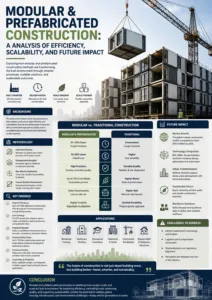
Modular and prefabricated construction is rapidly transforming the global building industry by introducing efficiency, cost predictability, and sustainability at scale. Unlike traditional construction methods, which rely heavily on on-site processes, modular construction shifts a significant portion of work to controlled factory environments. This shift is not merely operational—it is supported by measurable improvements in productivity, waste reduction, and project timelines.
1. Defining Modular & Prefabricated Construction
Modular construction refers to the process where building components—called modules—are manufactured off-site and then assembled on-site. Prefabrication is a broader term encompassing various pre-made components such as panels, frames, and volumetric units.
- According to industry analysis by McKinsey, modular construction can accelerate project timelines by up to 50% while reducing costs by 20% (https://www.mckinsey.com/industries/capital-projects-and-infrastructure/our-insights/modular-construction-from-projects-to-products)
- The global modular construction market is projected to exceed $130 billion by 2030, driven by urbanization and labor shortages (https://www.grandviewresearch.com/industry-analysis/modular-construction-market)
This model shifts construction from a fragmented, weather-dependent activity to a standardized, manufacturing-driven process.
2. Time Efficiency and Project Acceleration
Time savings represent one of the most quantifiable advantages of modular construction.
- Parallel workflows allow site preparation and module fabrication to occur simultaneously
- Factory-controlled production minimizes delays due to weather or labor shortages
- Studies show project delivery can be 30–50% faster than traditional methods (https://www.bcg.com/publications/2019/future-of-construction-through-modularization)
For developers, this translates into earlier revenue generation and reduced financing costs. For infrastructure projects, it enables faster deployment of essential facilities such as hospitals and housing units.
3. Cost Optimization Through Industrialization
Cost efficiency in modular construction is driven by repeatability, reduced waste, and optimized labor use.
- Bulk procurement of materials reduces input costs
- Automation and standardized processes lower labor dependency
- Rework and errors are significantly minimized due to precision manufacturing
Research indicates that cost savings typically range between 10–20%, particularly in large-scale projects (https://www.kpmg.com/xx/en/home/insights/2017/05/modular-construction.html)
However, cost benefits are most pronounced when projects are designed specifically for modular execution rather than adapted mid-way.
4. Sustainability and Environmental Impact
Sustainability metrics strongly favor modular construction when evaluated across lifecycle emissions and material efficiency.
- Factory production reduces material waste by up to 90%
- Controlled environments enable precise material usage and recycling
- Reduced on-site activity lowers carbon emissions and noise pollution
According to the World Green Building Council, construction accounts for nearly 39% of global carbon emissions, making efficiency improvements critical (https://www.worldgbc.org/climate-change)
Modular construction directly addresses this by optimizing resource utilization and enabling integration of sustainable materials and systems.
5. Quality Control and Structural Performance
Factory-based construction allows for superior quality assurance compared to conventional methods.
- Standardized processes ensure consistent quality across modules
- Automated inspections and testing reduce structural defects
- Enhanced precision improves energy efficiency and durability
A report by Dodge Data & Analytics highlights that 84% of contractors observed improved quality outcomes with prefabrication (https://www.construction.com/toolkit/reports/prefabrication-and-modular-construction-2020-smartmarket-report)
This consistency is particularly critical in sectors like healthcare, education, and high-density residential developments.
6. Labor Productivity and Workforce Transformation
Labor shortages in construction have been a persistent global issue. Modular construction addresses this through industrialized workflows.
- Requires fewer on-site workers
- Shifts labor demand toward skilled manufacturing roles
- Improves worker safety by reducing exposure to hazardous site conditions
Productivity gains are significant. Traditional construction productivity has grown at less than 1% annually, while manufacturing-based approaches show much higher efficiency growth (https://www.oecd.org/industry/productivity-in-construction.htm)
This shift also enables better workforce training, standardization, and scalability.
7. Design Flexibility and Technological Integration
Contrary to early perceptions, modular construction does not limit architectural creativity. Advances in digital tools have expanded design possibilities.
- Building Information Modeling (BIM) enables precise module planning
- Parametric design allows customization within standardized frameworks
- Integration with IoT and smart building systems is streamlined
Digital construction technologies are playing a central role in scaling modular adoption (https://www.autodesk.com/solutions/bim)
This convergence of design and manufacturing ensures both flexibility and efficiency.
8. Risk Mitigation and Predictability
Construction projects are often plagued by cost overruns and delays. Modular construction reduces these risks through predictability.
- Fixed manufacturing timelines improve scheduling accuracy
- Reduced site dependency minimizes external disruptions
- Early-stage design finalization lowers change-order risks
A study by FMI Corporation found that nearly 70% of projects exceed budgets, highlighting the need for more predictable methods (https://www.fmicorp.com/insights/reports/construction-industry-market-overview)
Modular construction addresses this by introducing manufacturing discipline into project execution.
9. Applications Across Sectors
Modular construction is gaining traction across multiple sectors due to its scalability and efficiency.
- Residential Housing: Rapid urban housing solutions and affordable housing initiatives
- Healthcare: Quick deployment of hospitals and clinics, especially during emergencies
- Education: Scalable classroom infrastructure
- Hospitality: Standardized hotel room modules
For instance, modular methods were widely used during the COVID-19 pandemic to rapidly construct healthcare facilities (https://www.weforum.org/agenda/2020/04/modular-construction-coronavirus-hospitals/)
10. Challenges and Limitations
Despite its advantages, modular construction faces several barriers:
- High initial capital investment in manufacturing facilities
- Transportation constraints for large modules
- Regulatory and code compliance challenges in certain regions
- Limited awareness and resistance to change in traditional markets
Addressing these challenges requires policy support, standardization, and increased industry collaboration.
11. Future Outlook and Market Evolution
The future of modular construction is closely tied to broader trends in urbanization, digitalization, and sustainability.
- Increasing adoption of automation and robotics in manufacturing
- Integration with circular economy principles
- Expansion into high-rise and complex structures
- Government incentives promoting off-site construction
According to the World Economic Forum, modular construction could deliver $1 trillion in annual cost savings globally (https://www.weforum.org/reports/shaping-the-future-of-construction-a-breakthrough-in-mindset-and-technology)
Conclusion
Modular and prefabricated construction represents a fundamental shift from traditional building practices toward a more industrialized, data-driven model. The evidence strongly supports its advantages in cost efficiency, speed, sustainability, and quality control. While challenges remain, the trajectory of adoption indicates a growing alignment with global construction needs.
As urban populations expand and infrastructure demands intensify, modular construction is not just an alternative—it is increasingly becoming a necessity for scalable, efficient, and sustainable development.