What Is Urban Farming?
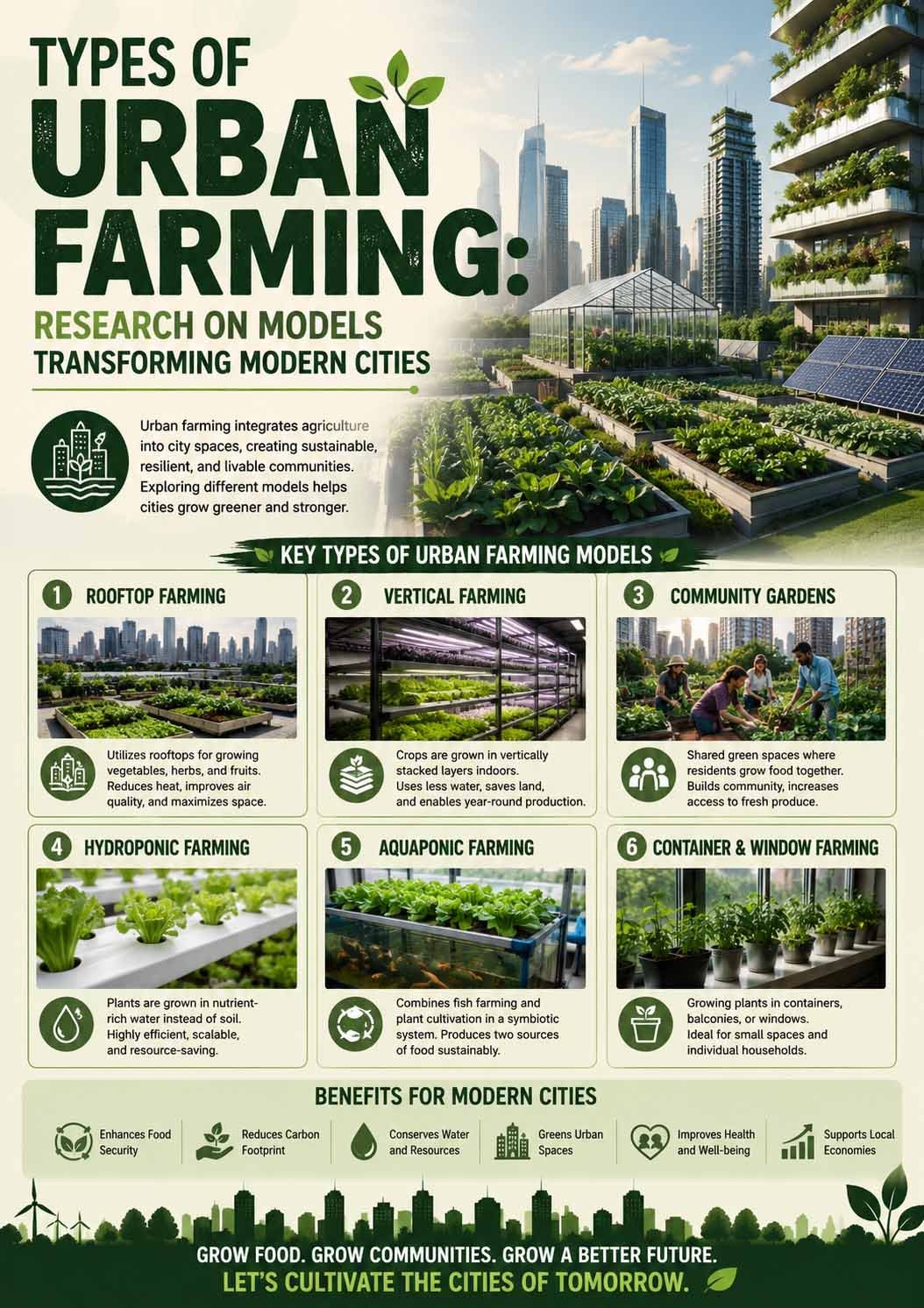
Urban farming, also referred to as urban agriculture, involves cultivating, processing, and distributing food within or around urban areas. Unlike traditional agriculture, urban farming utilizes compact spaces, advanced technologies, vertical infrastructure, and community-oriented systems to optimize food production in densely populated regions.
Urban farming systems can include:
- Rooftop farming
- Vertical farming
- Hydroponic farming
- Aquaponic farming
- Community gardens
- Indoor controlled-environment agriculture
- Container farming
- Urban livestock systems
- Guerrilla gardening
- Smart greenhouse farming
Learn more about sustainable urban agriculture frameworks from the Food and Agriculture Organization.
1. Rooftop Farming
Definition
Rooftop farming involves cultivating crops on the roofs of residential, commercial, or industrial buildings. It utilizes otherwise unused vertical urban space while reducing thermal absorption in dense metropolitan regions.
Advantages
- Reduces urban heat island effect
- Enhances rainwater retention
- Decreases transportation-related emissions
- Creates hyperlocal food systems
- Improves building insulation efficiency
Studies conducted by the Food and Agriculture Organization indicate that rooftop farms can reduce rooftop temperatures by 30–40%, significantly lowering cooling energy demand in dense cities.
City Example: New York City, USA
New York City has become one of the leading adopters of commercial rooftop agriculture.
Notable Projects
- Brooklyn Grange
- Gotham Greens
- Eagle Street Rooftop Farm
Brooklyn Grange operates across multiple rooftops and produces tens of thousands of pounds of vegetables annually while supporting pollinator ecosystems.
links
- Brooklyn Grange: https://www.brooklyngrangefarm.com/
- Gotham Greens: https://www.gothamgreens.com/
2. Vertical Farming
Definition
Vertical farming is the practice of growing crops in vertically stacked layers using controlled environment agriculture (CEA), often integrated with hydroponics, aeroponics, and LED lighting systems.
Technological Characteristics
- Artificial intelligence monitoring
- Precision nutrient delivery
- Climate-controlled systems
- Water recirculation technology
- Automated harvesting
Research from the World Economic Forum highlights that vertical farms can use up to 95% less water than traditional agriculture.
City Example: Singapore
Singapore has aggressively expanded vertical farming due to limited land availability.
Key Companies
- Sky Greens
- Sustenir Agriculture
- ComCrop
Sky Greens introduced one of the world’s first hydraulic-driven vertical farm systems.
links
- Sky Greens: https://www.skygreens.com/
- Sustenir Agriculture: https://www.susteniragriculture.com/
Economic Analysis
Singapore’s “30 by 30” initiative aims to produce 30% of nutritional needs domestically by 2030, positioning vertical farming as a national food-security investment rather than merely a sustainability initiative.
3. Hydroponic Farming
Definition
Hydroponics is a soil-less cultivation technique where plants grow in nutrient-rich water solutions.
Benefits
- Faster crop cycles
- Lower pest exposure
- Higher yield per square meter
- Efficient nutrient control
- Reduced water consumption
Hydroponic systems are now central to commercial urban agriculture because they maximize productivity in constrained spaces.
City Example: Dubai
Dubai has integrated hydroponic farming into desert food resilience programs.
Major Initiative
- Emirates Hydroponics Farms
- Badia Farms
Badia Farms specializes in premium leafy greens for hospitality and retail sectors.
links
- Badia Farms: https://www.badiafarms.com/
- Emirates Hydroponics Farms: https://ehf.ae/
Market Insight
Hydroponic urban farming is expanding rapidly in regions facing:
- water scarcity
- import dependency
- extreme climatic conditions
The Middle East urban agriculture market has seen strong investment growth due to food import vulnerability.
4. Aquaponics Farming
Definition
Aquaponics combines aquaculture (fish farming) with hydroponics in a symbiotic ecosystem where fish waste provides nutrients for plants.
Operational Advantages
- Closed-loop ecosystem
- Dual income streams
- Organic nutrient recycling
- Minimal wastewater generation
This model aligns strongly with circular economy principles.
City Example: Berlin, Germany
Berlin has implemented commercial aquaponics projects emphasizing sustainability innovation.
Key Example
- ECF Farmsystems
The project integrates fish production with vegetable cultivation in urban industrial spaces.
Backlinks
- ECF Farmsystems: https://ecf-farmsystems.com/
Environmental Analysis
Aquaponics significantly reduces fertilizer dependency and wastewater discharge, making it suitable for highly regulated urban sustainability environments.
5. Community Farming
Definition
Community farming refers to collectively managed urban agricultural spaces where residents participate in food cultivation.
Social and Economic Impact
- Strengthens community engagement
- Improves neighborhood food access
- Enhances urban biodiversity
- Supports mental health outcomes
- Encourages localized economic activity
City Example: Detroit, USA
Detroit transformed vacant land into productive community agricultural zones following industrial decline.
Notable Organizations
- Detroit Black Community Food Security Network
- Keep Growing Detroit
links
- Keep Growing Detroit: https://www.keepgrowingdetroit.org/
- Detroit Black Community Food Security Network: https://dbcfsn.org/
Urban Regeneration Analysis
Detroit demonstrates how urban farming can support:
- land rehabilitation
- food justice
- employment creation
- neighborhood stabilization
The city is often cited in urban planning studies as a benchmark for post-industrial agricultural transformation.
6. Indoor Controlled Environment Farming
Definition
Indoor farming uses fully enclosed environments with automated climate controls, artificial lighting, and sensor-driven cultivation systems.
Core Technologies
- Internet of Things (IoT)
- AI-based crop analytics
- Robotic harvesting
- Environmental optimization algorithms
City Example: Tokyo, Japan
Tokyo hosts some of the most technologically advanced indoor farms globally.
Leading Example
- Spread Co.
Its automated lettuce production facilities can produce thousands of heads daily with minimal human labor.
links
- Spread Co.: https://spread.co.jp/en/
Economic Perspective
Japan’s aging agricultural workforce and limited arable land accelerated investment into robotics-driven urban farming systems.
7. Container Farming
Definition
Container farming utilizes repurposed shipping containers equipped with climate-control systems for year-round crop production.
Strategic Benefits
- Portable deployment
- Modular scalability
- Weather-independent production
- Rapid urban installation
City Example: London, UK
London has adopted container farms for local food supply initiatives.
Example
- GrowUp Farms
links
- GrowUp Farms: https://www.growupfarms.com/
Observation
Container farming is particularly effective for:
- educational institutions
- restaurants
- disaster-prone regions
- military bases
- urban food deserts
8. Guerrilla Urban Farming
Definition
Guerrilla farming involves cultivating unused or abandoned urban land without formal ownership structures.
Key Objectives
- Reclaim neglected spaces
- Promote environmental activism
- Improve urban aesthetics
- Encourage food accessibility
City Example: Los Angeles, USA
Los Angeles has witnessed multiple community-led guerrilla farming initiatives in underutilized neighborhoods.
Policy Analysis
Although often informal, guerrilla urban farming has influenced municipal policies on:
- land-use flexibility
- green corridor development
- community sustainability planning
Comparative Analysis of Urban Farming Models
| Type of Urban Farming | Land Efficiency | Water Efficiency | Technology Dependence | Commercial Scalability |
|---|---|---|---|---|
| Rooftop Farming | Medium | Medium | Medium | High |
| Vertical Farming | Very High | Very High | Very High | Very High |
| Hydroponics | High | Very High | High | High |
| Aquaponics | High | High | High | Medium |
| Community Farming | Medium | Medium | Low | Low |
| Indoor Farming | Very High | Very High | Very High | Very High |
| Container Farming | High | High | High | Medium |
| Guerrilla Farming | Low | Low | Very Low | Low |
Economic Impact of Urban Farming
Urban farming is increasingly recognized as a strategic economic sector rather than solely an environmental initiative.
Key Economic Drivers
1. Food Supply Localization
Urban agriculture reduces long-distance logistics dependency and transportation volatility.
2. Employment Generation
Commercial vertical farms and hydroponic systems create specialized jobs in:
- agritech
- engineering
- plant science
- logistics
- urban planning
3. Real Estate Optimization
Unused rooftops, warehouses, and industrial zones gain productive economic value.
4. Sustainability Investment
ESG-focused investors increasingly support urban agriculture ventures aligned with carbon reduction targets.
Environmental Implications
Urban farming contributes significantly to climate adaptation strategies.
Measurable Environmental Benefits
- Reduced food transportation emissions
- Lower freshwater usage
- Urban cooling effects
- Organic waste recycling
- Improved air quality
- Pollinator habitat restoration
Cities implementing integrated urban agriculture policies are increasingly linking food systems with climate resilience planning.
Future Trends in Urban Farming
AI-Driven Crop Optimization
Artificial intelligence systems are improving:
- nutrient prediction
- disease detection
- yield forecasting
- energy efficiency
Renewable Energy Integration
Urban farms are increasingly integrating:
- solar energy
- rainwater harvesting
- waste heat recycling
Smart City Integration
Future smart cities are expected to integrate agriculture directly into:
- mixed-use buildings
- transportation infrastructure
- residential complexes
- commercial real estate projects
Conclusion
Urban farming has transitioned from a niche sustainability experiment into a globally significant urban infrastructure strategy. Different farming models address different urban challenges, including land scarcity, water limitations, food insecurity, and environmental degradation.
Cities such as Singapore, New York City, Tokyo, and Dubai demonstrate that urban agriculture can become economically scalable, technologically advanced, and environmentally transformative when integrated into long-term planning frameworks.
As climate pressures and urban populations continue to rise, urban farming will likely become a central component of resilient metropolitan development worldwide.