| Topic | Summary |
|---|---|
| Overview | Singapore imports over 90% of its food yet ranks among the world’s leaders in food security through diversification, innovation, and strategic planning. |
| Main Challenge | Severe land scarcity—less than 1% of land is available for agriculture—limits domestic food production. |
| Importance of Food Security | Food security is treated as a national security issue due to dependence on imports, climate change, geopolitical risks, and supply chain disruptions. |
| Food Import Strategy | Imports food from around 187 countries and regions, reducing reliance on any single supplier and improving resilience. |
| COVID-19 Impact | The pandemic exposed vulnerabilities in global food supply chains, leading Singapore to strengthen local production and food resilience policies. |
| “30 by 30” Strategy (2019) | Aimed to produce 30% of Singapore’s nutritional needs locally by 2030 through technology-driven agriculture rather than complete self-sufficiency. |
| Priority Production Areas | Focused on leafy vegetables, fish (aquaculture), and eggs as key nutritional products. |
| Government Support | Introduced grants such as the 30×30 Express Grant to support vertical farming, AI-based agriculture, automated irrigation, and controlled-environment farming. |
| Economic Challenges | Urban farming faces high costs due to expensive land, labour, energy, and infrastructure, making large-scale local production economically difficult. |
| Policy Shift (2025) | Singapore revised its strategy, shifting from broad nutritional targets to more targeted production goals, especially for protein and fibre, reflecting a pragmatic approach. |
| Import Diversification | Expanded food sourcing to countries such as Portugal, Poland, Türkiye, and Brunei to reduce geopolitical and climate-related risks. |
| Benefits of Diversification | Helps reduce dependence on individual suppliers, stabilizes prices, improves resilience against trade restrictions, and minimizes disruption risks. |
| Agricultural Technology | Singapore promotes vertical farming, hydroponics, aeroponics, AI-driven crop monitoring, robotics, and precision aquaculture to maximize productivity. |
| Food Innovation | Invests in cultivated meat, plant-based proteins, and biotechnology. Singapore became the first country to approve commercial sales of cultivated meat. |
| Climate Change Risks | Extreme weather in exporting countries threatens Singapore’s food imports, making climate resilience a major policy priority. |
| Climate Adaptation Measures | Strengthening cold-chain logistics, strategic food reserves, agricultural R&D, supply-chain analytics, and regional trade partnerships. |
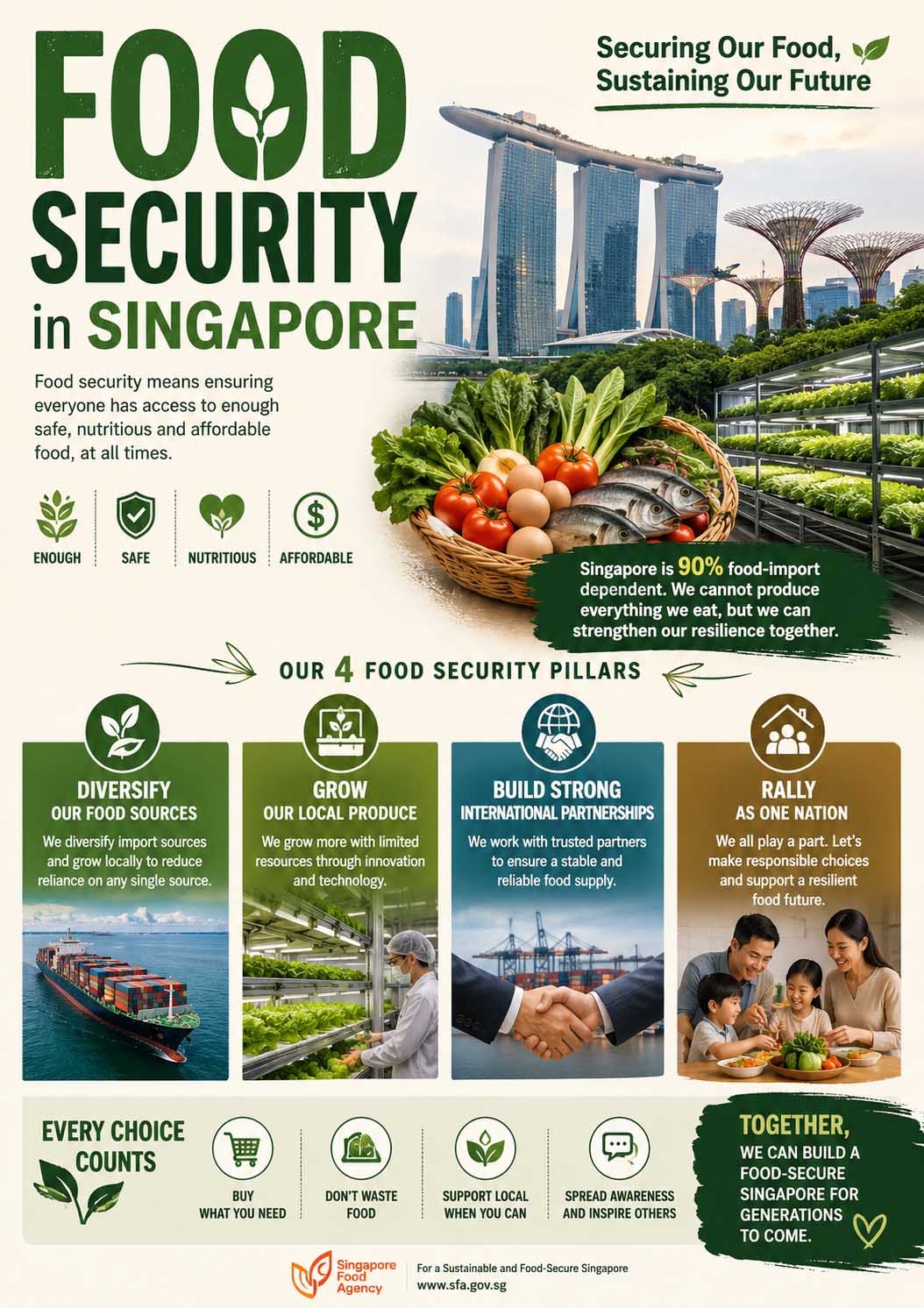
| Future Food Security Model | Based on four pillars: diversified imports, efficient local production, strategic reserves, and international partnerships. |
| Governance Approach | Singapore emphasizes pragmatic, evidence-based policymaking, adapting strategies based on economic feasibility rather than symbolic self-sufficiency goals. |
| Key Lesson | Food security is no longer just about agriculture; it requires integration of technology, trade, climate policy, infrastructure, geopolitics, and resilience planning. |
| Conclusion | Singapore demonstrates that an import-dependent nation can achieve strong food security through diversification, innovation, adaptive policies, and international cooperation, making it a global model for urban food resilience. |
Food Security in Singapore has emerged as one of the world’s most closely watched case studies in food security management. Despite importing more than 90% of its food supply, the island nation consistently ranks among the global leaders in food resilience, supply-chain diversification, and agricultural innovation. In a world increasingly shaped by climate disruptions, geopolitical instability, export restrictions, and inflationary pressure, Singapore’s food security model offers valuable lessons for densely populated urban economies.
According to the Singapore Food Agency, Singapore’s heavy reliance on imported food creates structural vulnerabilities that require constant policy adaptation. The country’s food security framework therefore focuses on diversification, technological agriculture, strategic reserves, and international supply-chain partnerships.
Why Food Security Matters in Singapore
Singapore’s land scarcity is the central challenge behind its food vulnerability. Less than 1% of the country’s land is allocated for agriculture, making large-scale conventional farming nearly impossible. At the same time, rising global food nationalism and climate volatility are increasing pressure on import-dependent nations.
Research from Singapore Food Statistics 2024 shows that Singapore currently imports food from approximately 187 countries and regions. This diversified sourcing strategy reduces dependency on any single nation and minimizes disruption risks from trade restrictions or climate-related crop failures.
Food Security in Singapore became a particularly urgent issue during the COVID-19 pandemic, when panic buying and export controls disrupted global food logistics. Singapore responded by accelerating local food production policies and investing heavily in agri-tech infrastructure. The pandemic effectively transformed food resilience from an economic discussion into a national security priority.
Singapore’s “30 by 30” Food Security Strategy
One of Singapore’s most ambitious initiatives was the “30 by 30” strategy, introduced in 2019. The objective was to produce 30% of the nation’s nutritional needs locally by 2030 through high-tech urban farming, aquaculture, and sustainable food innovation.
The initiative focused heavily on three categories:
- Leafy vegetables
- Fish and aquaculture
- Eggs
The strategy aimed to improve resilience rather than full food self-sufficiency. Since complete agricultural independence is unrealistic for Singapore, policymakers instead prioritized strategic nutritional production capacity.
According to the Singapore’s Food Challenge Report, local production acts as a critical emergency buffer during external disruptions. Singapore’s government also launched grants and funding programs to support controlled-environment agriculture, vertical farming systems, and precision aquaculture technologies.
The 30×30 Express Grant Initiative allocated millions of dollars to accelerate production capabilities among local farms. These investments targeted faster deployment of automated irrigation systems, LED-assisted indoor cultivation, and AI-supported crop monitoring.
The Economic Reality Behind Local Food Production
Despite strong policy ambition, Singapore’s food production sector faces significant economic constraints. Urban farming remains expensive due to high labor costs, land limitations, energy consumption, and infrastructure requirements.
Several agri-tech startups and indoor farms have struggled financially over the past few years. Analysts increasingly argue that food resilience cannot rely solely on domestic farming expansion. Instead, Singapore is evolving toward a hybrid resilience framework combining imports, strategic stockpiles, and selective local production.
A 2024 analysis published by Channel News Asia on Singapore’s Food Resilience noted that while the “30 by 30” initiative successfully accelerated innovation, operational sustainability remains a major challenge for commercial farms.
In 2025, Singapore adjusted parts of its original roadmap and shifted toward more targeted production goals focused on protein and fiber categories instead of broad nutritional percentages.
This policy evolution demonstrates a highly pragmatic governance model. Rather than maintaining unrealistic targets, Singapore recalibrated its food security objectives around economic feasibility and measurable productivity.
Import Diversification as a National Security Tool
Singapore’s most effective food security strategy remains import diversification. Instead of depending heavily on neighboring countries alone, Singapore continuously expands sourcing partnerships across continents.
The government actively approves new food import channels for poultry, beef, seafood, and staple commodities. According to Singapore Food Statistics 2024, the country approved additional food import sources from Portugal, Poland, Türkiye, and Brunei in recent years.
This diversification model lowers systemic risk in several ways:
- Reduces exposure to geopolitical tensions
- Minimizes supply disruptions caused by climate events
- Prevents overdependence on regional suppliers
- Stabilizes domestic food pricing
Singapore also maintains strong diplomatic and trade relationships to ensure uninterrupted food flow during global crises. During the pandemic, Singapore coordinated with multiple nations to keep supply chains operational despite export restrictions elsewhere.
Technology and Vertical Farming Innovation
Singapore has become a global leader in urban agriculture innovation. Due to severe land limitations, the country relies heavily on vertical farming systems and controlled-environment agriculture.
Modern farms in Singapore increasingly use:
- Hydroponics
- Aeroponics
- Automated climate control systems
- AI-driven crop analytics
- Robotics-assisted harvesting
- Precision aquaculture systems
These technologies allow farms to maximize yield per square meter while reducing water usage and pesticide dependence.
The Ecosperity Food Security Report highlights how Singapore is investing aggressively in sustainable urban food systems and alternative proteins. Cultivated meat, plant-based proteins, and biotechnology-driven food production are expected to become increasingly important components of long-term resilience planning.
Singapore was also the first country globally to approve commercial sales of cultivated meat, reinforcing its position as a regulatory pioneer in food innovation.
Climate Change and Food Security Risks
Climate change represents one of the largest long-term threats to Singapore’s food system. Since the country imports the majority of its food, extreme weather events abroad directly affect domestic supply stability.
Floods, droughts, rising temperatures, and marine ecosystem disruptions can severely impact exporting nations. Food inflation therefore becomes both an environmental and economic challenge.
Research from Singapore’s Strategic Commitment to Food Security emphasizes that climate adaptation now plays a central role in Singapore’s food planning policies.
To mitigate future risks, Singapore is strengthening:
- Cold-chain logistics
- Strategic food stockpiles
- Agricultural R&D investment
- Supply-chain analytics
- Regional trade agreements
This integrated resilience model ensures that food security remains adaptive rather than static.
The Future of Food Security in Singapore
Food Security in Singapore model is increasingly shifting from self-sufficiency toward resilience optimization. Policymakers now recognize that the future depends on balancing four pillars:
- Diversified imports
- High-efficiency local production
- Strategic reserves
- International food partnerships
The government’s revised strategy reflects a realistic understanding of structural constraints while maintaining strong investment in innovation and sustainability.
As global food systems become more volatile, Singapore’s approach is likely to influence urban food policy across Asia and other densely populated economies.
The country’s experience demonstrates that food security is no longer simply an agricultural issue. It is deeply connected to technology, trade, climate policy, infrastructure, geopolitics, and national resilience.
Conclusion
Singapore’s food security strategy represents one of the most sophisticated resilience frameworks in the modern world. While the nation remains heavily dependent on imports, it has successfully reduced systemic vulnerability through diversification, technological innovation, and adaptive policymaking.
The transition from the original “30 by 30” vision toward a more targeted and economically grounded framework highlights Singapore’s pragmatic governance style. Rather than pursuing symbolic self-sufficiency goals, the country is building a flexible and future-oriented food ecosystem capable of responding to global uncertainty.
In an era defined by supply-chain shocks and climate instability, Singapore’s evolving food resilience model may become one of the most important reference points for urban food security policy worldwide.
Final Word about Food Security in Singapore:
Rather than aiming for complete food self-sufficiency across all food categories, Singapore’s experience suggests that the primary objective should be nutrient self-sufficiency. Given its limited land and resource constraints, it is more practical to prioritize the local production of a selected group of nutrient-dense foods that are well suited to Singapore’s environment and can be produced efficiently using technologies such as vertical farming, controlled-environment agriculture, and aquaculture. By focusing on key foods that collectively meet essential nutritional requirements—rather than attempting to produce every food item domestically—the country can build a resilient food system that strengthens national food security while remaining economically and environmentally sustainable. This targeted, nutrient-based approach ensures that domestic production serves as a strategic buffer during global supply disruptions, with imports continuing to complement foods that are less feasible to produce locally.