1. Conceptual Framework of Integration with Nature
Integration with nature refers to the intentional incorporation of natural systems, processes, and elements into human-designed environments to enhance ecological balance, human well-being, and long-term sustainability. This concept is rooted in the recognition that human physiological and psychological systems evolved in close interaction with natural environments. The modern built environment, however, has increasingly detached human experience from natural stimuli, resulting in measurable declines in mental health, productivity, and environmental resilience.
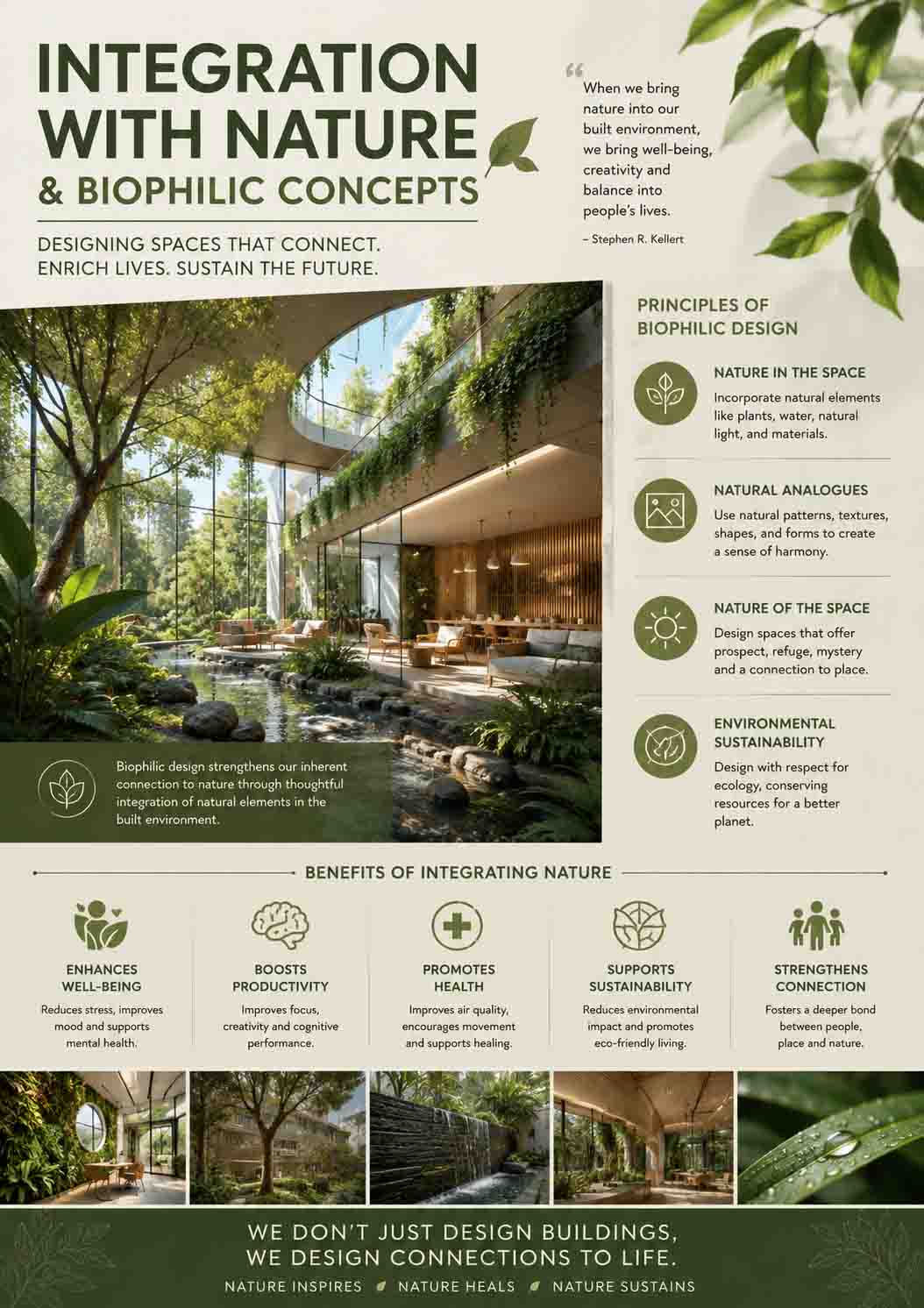
Biophilic concepts provide a structured framework for reversing this detachment. The foundational hypothesis of biophilia, first articulated by Edward O. Wilson, suggests an inherent human inclination to affiliate with natural systems and life forms. This hypothesis has since evolved into applied design strategies used in architecture, urban planning, workplace design, healthcare infrastructure, and educational environments. A comprehensive overview of biophilic theory is documented by the Biophilic Design Initiative and its research compendium
(https://biophilicdesigninitiative.org).
2. Scientific Basis of Biophilic Design Principles
Biophilic design is not aesthetic preference but an evidence-based discipline supported by neuroscience, environmental psychology, and physiology. According to research published by Terrapin Bright Green, biophilic design is structured around three core categories: Nature in the Space, Natural Analogues, and Nature of the Space
(https://www.terrapinbrightgreen.com/reports/14-patterns).
Peer-reviewed studies show that exposure to natural light, vegetation, water features, and organic spatial geometry activates parasympathetic nervous system responses, reducing cortisol levels and enhancing cognitive performance. The Journal of Environmental Psychology reports statistically significant improvements in memory retention and problem-solving abilities when biophilic elements are integrated into interior spaces
(https://www.sciencedirect.com/journal/journal-of-environmental-psychology).
3. Quantitative Impact on Human Health and Well-Being
Empirical data demonstrates that integration with nature has measurable health outcomes. A large-scale longitudinal study conducted by Harvard T.H. Chan School of Public Health found that individuals with regular exposure to green environments showed lower incidence of depression, anxiety disorders, and cardiovascular disease
(https://www.hsph.harvard.edu/news/features/green-spaces-health).
Further analysis by the World Health Organization highlights the correlation between urban green infrastructure and reduced mortality rates, particularly in high-density metropolitan areas
(https://www.who.int/publications/i/item/WHO-EURO-2017-3302-42920-60034).
These findings establish biophilic integration as a public health intervention rather than a design luxury.
4. Economic and Productivity Performance Metrics
From an economic standpoint, biophilic integration yields quantifiable returns on investment. A comprehensive workplace performance study by Human Spaces Global Report revealed that offices incorporating natural light, indoor plants, and outdoor views recorded a 6% increase in productivity and a 15% increase in employee well-being metrics
(https://humanspaces.com/reports/biophilic-design-global-impact).
Additionally, data from McKinsey & Company supports the link between employee well-being and organizational performance, reinforcing the financial rationale for biophilic investment
(https://www.mckinsey.com/capabilities/people-and-organizational-performance/our-insights).
These metrics indicate that integration with nature enhances operational efficiency while reducing absenteeism and employee turnover.
5. Environmental Sustainability and Climate Resilience
Biophilic concepts extend beyond human benefits to address ecological resilience and climate adaptation. Green roofs, living walls, and urban forests mitigate heat island effects, improve air quality, and enhance stormwater management. According to the U.S. Environmental Protection Agency, green infrastructure can reduce surface temperatures by up to 30% compared to conventional materials
(https://www.epa.gov/green-infrastructure).
Urban ecological modeling conducted by The Nature Conservancy demonstrates that cities with higher canopy coverage experience reduced energy demand and lower carbon emissions
(https://www.nature.org/en-us/what-we-do/our-insights/perspectives/urban-nature).
This data positions biophilic integration as a critical tool in climate-responsive urban design.
6. Application in Urban Planning and Architecture
Modern urban planning increasingly prioritizes nature-integrated development models. Concepts such as transit-oriented green corridors, mixed-use ecological zones, and regenerative urban landscapes are now embedded in international planning standards. The United Nations Environment Programme advocates nature-based solutions as core strategies for sustainable urbanization
(https://www.unep.org/explore-topics/resource-efficiency/what-we-do/cities).
Architectural research published by the Royal Institute of British Architects highlights that buildings incorporating biophilic frameworks demonstrate improved occupant satisfaction and extended asset lifespan
(https://www.architecture.com/knowledge-and-resources/resources-landing-page/biophilic-design).
These findings support a systemic shift from isolated green features to holistic nature-integrated design ecosystems.
7. Educational and Cognitive Development Outcomes
Integration with nature has proven implications for learning environments. Studies conducted by the University of Illinois Urbana-Champaign show that students in nature-rich educational settings exhibit higher attention restoration scores and improved academic performance
(https://ncrc.education.illinois.edu).
Similarly, the OECD Education Working Papers emphasize that natural learning environments enhance creativity, emotional regulation, and collaborative behavior
(https://www.oecd.org/education).
This evidence underscores the necessity of biophilic integration in future educational infrastructure planning.
8. Digital Disconnection and Neurocognitive Balance
The rise of digital environments has intensified cognitive fatigue and attentional fragmentation. Research from the American Psychological Association indicates that exposure to natural environments counteracts digital overload by restoring directed attention capacity
(https://www.apa.org/monitor/2019/01/nature).
Biophilic integration serves as a neurocognitive balancing mechanism, particularly in high-technology workplaces and residential developments, reinforcing its relevance in contemporary society.
9. Implementation Challenges and Constraints
Despite extensive evidence, implementation barriers persist. High upfront costs, lack of interdisciplinary expertise, and regulatory limitations often hinder large-scale adoption. A policy analysis by the Urban Land Institute identifies the need for standardized biophilic performance metrics to facilitate broader market adoption
(https://uli.org/research/centers-initiatives/building-healthy-places).
However, lifecycle cost analysis consistently demonstrates that long-term operational savings outweigh initial capital expenditure, particularly in energy efficiency and healthcare cost reduction.
10. Future Outlook and Strategic Integration Models
The future of integration with nature lies in data-driven, performance-based design frameworks. Advances in environmental sensing, building analytics, and ecological modeling enable precise measurement of biophilic outcomes. Research by MIT Senseable City Lab illustrates how real-time environmental data can optimize nature-human interactions in urban systems
(https://senseable.mit.edu).
As global urbanization accelerates, biophilic concepts will increasingly define resilient, adaptive, and human-centered environments.
Conclusion
Evidence across health sciences, economics, environmental studies, and urban planning confirms that integration with nature through biophilic concepts delivers multidimensional value. It enhances human well-being, improves economic performance, strengthens environmental resilience, and supports cognitive and social development. The convergence of empirical research and real-world implementation establishes biophilic integration not as a design trend, but as an essential strategy for sustainable human habitats.
Future development paradigms that prioritize nature-integrated systems will be better positioned to address climate challenges, public health demands, and evolving societal needs through evidence-based, performance-oriented solutions.