1) Why Liu Jiakun matters in contemporary architecture
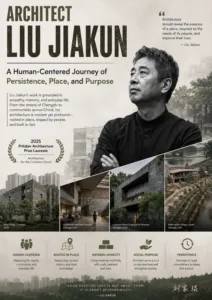
Liu Jiakun (刘家琨) is a Chengdu-based Chinese architect and the founder of Jiakun Architects. Over four decades, his work has become widely associated with human-scale urbanism, restrained material honesty, and a deep respect for local culture—especially in Western China’s fast-changing cities. In 2025, his impact was internationally recognized when he was named the Pritzker Architecture Prize Laureate, an honor often considered architecture’s highest global award.
What makes Liu Jiakun distinctive is not a signature “look,” but a repeatable method: starting from real civic life—density, memory, climate, craft, and everyday routines—and shaping architecture that feels grounded rather than performative.
2) Early life and the beginnings of a non-linear path
Born in 1956 in Chengdu, Liu’s childhood unfolded partly in the corridors of Chengdu Second People’s Hospital, where his mother worked as a physician. That early exposure to public institutions—busy, pragmatic, and emotionally charged—would later echo in his lifelong attention to ordinary citizens and shared civic space.
His route into architecture was not straightforward. He gravitated toward drawing and literature, and was only gradually guided toward architecture as a profession. At 17, he was sent to the countryside as part of China’s “educated youth” (Zhiqing) program, an experience that shaped his grounded worldview and sensitivity to common life.
In 1978, he entered the Institute of Architecture and Engineering in Chongqing (now Chongqing University), graduating in 1982 with a Bachelor of Engineering degree in Architecture.
3) The struggle years: doubts, distance, and returning to architecture
After graduation, Liu worked at the state-owned Chengdu Architectural Design and Research Institute—a practical starting point, but not necessarily a creative one. In the mid-1980s, he volunteered to relocate to Nagqu, Tibet, a move that tested him physically and mentally, while also expanding his understanding of landscape, scarcity, and resilience.
During these years, Liu lived a dual life: architect by day, writer by night, increasingly immersed in literary creation. At one point, he nearly abandoned architecture altogether. The turning point arrived in 1993, when he attended a solo architectural exhibition by Tang Hua (a former classmate) that reignited his belief that architecture could be a personal, cultural, and intellectual medium—not only a delivery system for buildings.
This period of uncertainty is central to Liu Jiakun’s story: his later clarity about community, humility, and context was forged through years of questioning the role architecture should play in society.
4) Jiakun Architects and a philosophy built on “strategy, not style”
In 1999, Liu founded Jiakun Architects in Chengdu. From the outset, the studio’s direction resisted spectacle. The Pritzker jury later emphasized that he works from a project-by-project strategy, evaluating each site’s specific conditions rather than repeating a branded aesthetic.
A widely quoted metaphor captures this approach: Liu has said he aspires to be “like water”—adapting to a place without imposing a fixed form, then slowly “solidifying” into architecture that still carries the local environment’s qualities.
This is also where Liu’s writing background becomes architectural: he has spoken about the narrative quality and pursuit of poetry in his designs, even when the building programs are practical and constrained.
5) Material ethics and post-disaster resilience
One of the most important threads in Liu Jiakun’s career is his attention to material meaning—especially after the 2008 Sichuan (Wenchuan) earthquake. In the years following the disaster, he explored reuse and reconstruction approaches, including the idea of making new building materials from debris, a concept that entered broader architectural discussion through initiatives such as “Rebirth Brick.”
This dimension of his work is not only “sustainability” in the marketing sense; it is about architecture acting as a public memory system—carrying trauma, repair, and continuity forward through tangible matter and careful craft.
6) Famous buildings and landmark projects by Liu Jiakun
Below is a curated, high-relevance list of widely cited Liu Jiakun buildings and urban works (with locations and years where publicly documented):
- West Village (Chengdu, 2015) — A block-spanning mixed-use complex that reframes density by embedding public circulation, civic activity, and layered open space into a single urban form.
- Luyeyuan Stone Sculpture Art Museum (Chengdu, 2002) — A contemplative museum environment that draws on garden logics and a restrained material palette, often discussed as an early milestone in his career.
- Department of Sculpture, Sichuan Fine Arts Institute (Chongqing, 2004) — Known for spatial efficiency and inventive massing that expands usable area within tight constraints.
- Design Department (New Campus), Sichuan Fine Arts Institute (Chongqing, 2006) — A campus cluster exploring craft, climate response, and spatial sequencing.
- Museum of Clocks, Jianchuan Museum Cluster (Chengdu, 2007) — A project frequently referenced in discussions of Liu’s time-based, narrative approach to museums.
- Hu Huishan Memorial (Chengdu, 2009) — A small memorial work tied to earthquake remembrance, often highlighted for emotional precision and restraint.
- Shuijingfang Museum (Chengdu, 2013) — A heritage-oriented museum project integrating layered history and material storytelling.
- Novartis (Shanghai) Block – C6 (Shanghai, 2014) — A corporate building framed in the Pritzker materials as part of his broader portfolio across China.
- Suzhou Museum of Imperial Kiln Brick (Suzhou, 2016) — A museum protecting historic ruins while evoking imperial-era craft traditions through architectural structure and atmosphere.
- Songyang Culture Neighborhood (Lishui, 2020) — A cultural/community-oriented project included among the Pritzker-selected works.
- Renovation of Tianbao Cave District of Erlang Town (Luzhou, 2021) — A large-scale revitalization connecting built interventions with terrain, tourism, and local identity.
7) Legacy: what Liu Jiakun leaves to cities, architects, and communities
a) A model for civic space in dense cities
Liu’s work repeatedly argues that density does not have to eliminate breathing room. Projects such as West Village show how architecture can multiply programs—culture, sport, commerce, walking, cycling—without turning the city into a closed consumption machine.
b) A credible alternative to “icon architecture”
At a time when global architecture often chases instantly recognizable forms, Liu’s reputation has grown through the opposite: patient craft, contextual intelligence, and social realism. The Pritzker jury explicitly emphasized his ability to construct “new worlds” without aesthetic or stylistic constraint.
c) Architecture as memory and repair
His post-earthquake thinking—material reuse, memorialization, and reconstruction ethics—positions architecture as a tool for collective continuity, not just new development.
d) Influence through teaching and discourse
Beyond buildings, Liu’s impact includes teaching, lectures, and international exhibitions—extending his ideas into the wider architectural conversation while keeping his practice deeply rooted in China.

wish you best and best