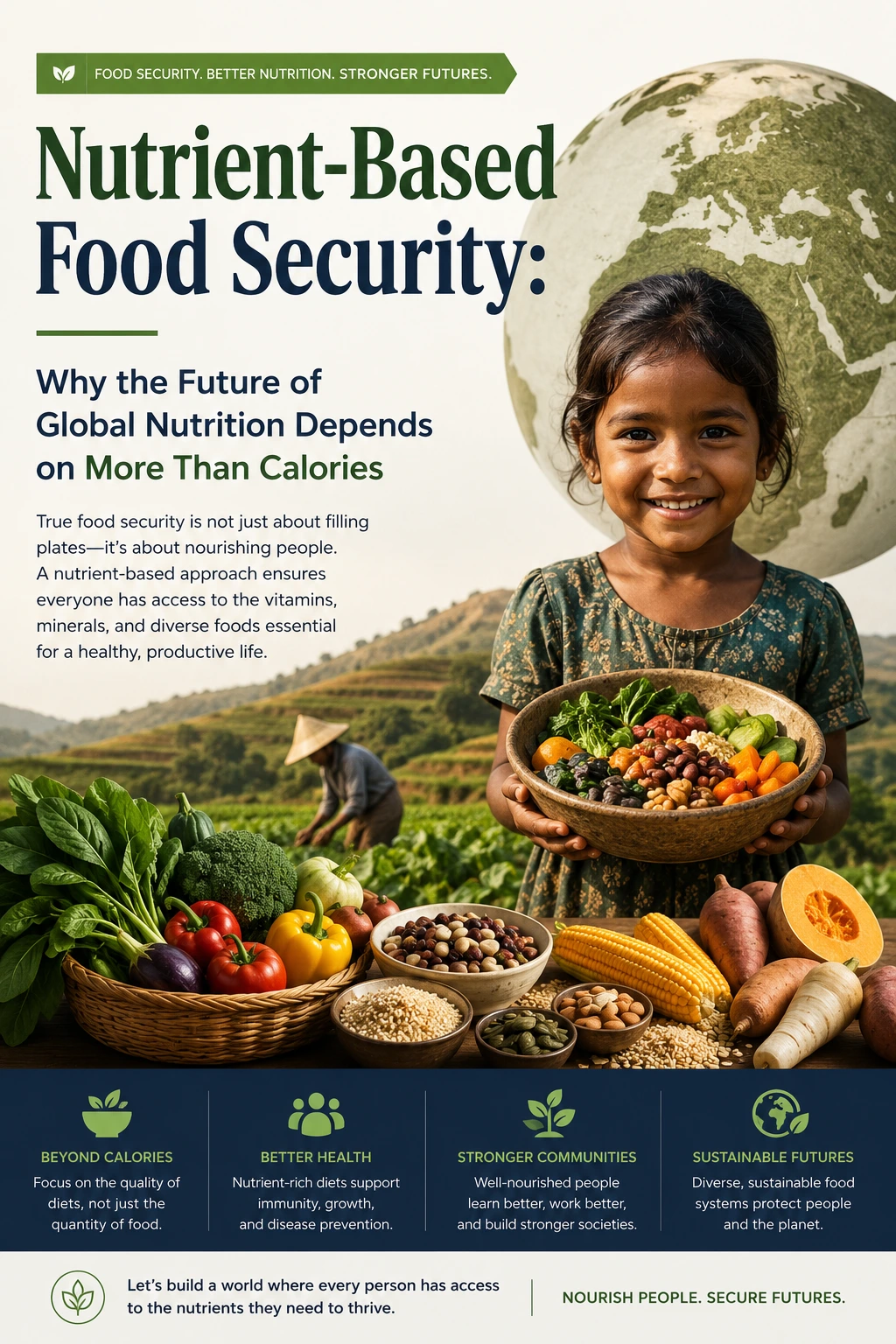
Food security is no longer just about producing enough calories. Across the world, governments, researchers, and global health agencies are shifting toward a more advanced framework known as nutrient-based food security — a system focused not merely on food quantity, but on the quality, diversity, and micronutrient value of diets.
According to the World Health Organization (WHO) Healthy Diet Guidelines, diversified nutrient-dense diets are essential for reducing micronutrient deficiencies and non-communicable diseases. This evolving model is becoming central to national nutrition policies, agricultural planning, and sustainable development strategies worldwide.
What Is Nutrient-Based Food Security?
Traditional food security models focused heavily on caloric sufficiency — ensuring populations had enough staple grains such as rice, wheat, or maize. However, modern nutrition science has revealed that populations can consume sufficient calories while still suffering from “hidden hunger,” a condition caused by deficiencies in essential vitamins and minerals.
The WHO Micronutrients Initiative identifies deficiencies in iron, zinc, vitamin A, iodine, and folate as among the world’s most critical public health challenges.
Nutrient-based food security therefore emphasizes:
- Dietary diversity
- Micronutrient-rich foods
- Food fortification
- Biofortified crops
- Nutrition-sensitive agriculture
- Public health nutrition interventions
- Sustainable food systems
This model directly aligns with the United Nations Sustainable Development Goal 2: Zero Hunger.
Why Calorie-Based Food Security Is No Longer Enough
For decades, agricultural policy prioritized maximizing yield per hectare. While this increased global food production, it also created unintended nutritional consequences.
The FAO Nutrition-Sensitive Food Systems Framework highlights how many low-income countries now face a “multiple burden of malnutrition,” where undernutrition, obesity, and micronutrient deficiencies coexist simultaneously.
Major problems associated with calorie-centric food systems include:
1. Hidden Hunger
More than 2 billion people globally suffer from micronutrient deficiencies, especially iron, zinc, iodine, and vitamin A deficiencies.
2. Rising Non-Communicable Diseases
High-calorie but nutrient-poor diets contribute to:
- Obesity
- Diabetes
- Cardiovascular disease
- Hypertension
- Metabolic disorders
The WHO identifies unhealthy diets as one of the leading risk factors for global mortality.
3. Economic Productivity Loss
Micronutrient deficiencies reduce cognitive performance, labor productivity, educational attainment, and workforce efficiency.
Core Pillars of Nutrient-Based Food Security
1. Nutrition-Sensitive Agriculture
Nutrition-sensitive agriculture integrates nutritional outcomes into farming systems rather than focusing solely on crop yield.
The FAO Nutrition-Sensitive Agriculture Program defines this approach as placing nutrient-rich foods and dietary diversity at the center of agricultural development.
Key strategies include:
- Crop diversification
- Legume integration
- Fruit and vegetable production
- Livestock diversity
- Soil micronutrient management
- Women-centered agricultural programs
Research published through ScienceDirect on Nutrition-Sensitive Agriculture found that these programs significantly improve maternal and child nutrition outcomes when integrated with sanitation, healthcare, and education interventions.
2. Food Fortification
Food fortification involves adding vitamins and minerals to staple foods such as flour, rice, salt, and cooking oil.
The WHO Food Fortification Program identifies salt iodization as one of the most successful public health interventions globally.
Common fortification examples include:
| Food | Nutrient Added | Public Health Goal |
|---|---|---|
| Salt | Iodine | Prevent iodine deficiency |
| Wheat Flour | Iron & Folic Acid | Reduce anemia |
| Rice | Zinc & Iron | Improve micronutrient intake |
| Cooking Oil | Vitamin A | Improve child nutrition |
WHO recommendations also support wheat flour, rice, and maize fortification programs globally.
3. Biofortification
Biofortification improves nutrient levels in crops through plant breeding, agronomy, or biotechnology.
This strategy is becoming increasingly important in regions where populations rely heavily on staple crops.
The HarvestPlus Biofortification Initiative documents how governments are integrating zinc rice, iron beans, and vitamin A sweet potatoes into national food systems.
Scientific evidence published in Nature Communications on Biofortification Impact demonstrates measurable improvements in zinc, iron, and vitamin A status among vulnerable populations consuming biofortified foods.
Countries Successfully Using Nutrient-Based Food Security Models
Bangladesh
Bangladesh has become one of Asia’s strongest adopters of zinc-rich rice programs.
Government-supported procurement systems now include zinc rice within public safety-net schemes.
Key achievements include:
- Large-scale zinc rice distribution
- Vitamin A supplementation programs
- National food fortification initiatives
- School nutrition interventions
Bangladesh’s strategy is widely viewed as a scalable model for South Asia.
India
India has increasingly integrated nutrient-based approaches through:
- Fortified rice distribution under public welfare systems
- POSHAN Abhiyaan nutrition mission
- Biofortified zinc wheat and iron pearl millet
- National anemia reduction campaigns
The country also supports biofortified crop adoption through agricultural research institutions and public procurement systems.
India’s transition is especially important because rice and wheat dominate national calorie intake.
Zambia
Zambia has become globally recognized for vitamin A maize adoption.
According to HarvestPlus, Zambia successfully scaled biofortified crops through coordinated public-private partnerships and farmer outreach.
The country now integrates:
- Vitamin A maize
- Nutrition-sensitive agriculture
- Child nutrition interventions
- Rural dietary diversification programs
Pakistan
Pakistan has accelerated zinc wheat adoption across national seed systems.
The HarvestPlus Asia Regulatory Review reports that zinc wheat reached approximately 20% of Pakistan’s certified wheat seed market.
Pakistan’s policy strategy includes:
- Biofortified seed regulations
- Food labeling standards
- Public awareness campaigns
- Agricultural extension support
Kenya
Kenya has integrated nutrition-sensitive agriculture into broader food security planning through FAO-supported programs.
Key interventions include:
- Micronutrient-sensitive crop production
- School feeding programs
- Climate-resilient nutrition systems
- Community health nutrition networks
Peru
Peru has combined food fortification, indigenous nutrition programs, and anemia reduction strategies with strong public health coordination.
WHO case studies highlight Peru’s progress in addressing childhood anemia and micronutrient deficiencies.
The Economic Importance of Nutrient-Based Food Systems
Nutrient-based food security is increasingly viewed not just as a health issue, but as an economic growth strategy.
Micronutrient deficiencies contribute to:
- Reduced workforce productivity
- Higher healthcare costs
- Poor educational outcomes
- Lower national GDP growth potential
The FAO State of Food Security and Nutrition Report emphasizes that healthy diets are now becoming central to long-term economic resilience and sustainable development.
Countries investing in nutrient-focused systems are increasingly achieving:
- Better maternal health
- Improved child development
- Higher labor productivity
- Reduced malnutrition burden
- Stronger food system resilience
Key Technologies Driving Nutrient-Based Food Security
Precision Agriculture
Data-driven farming improves nutrient density through:
- Soil micronutrient mapping
- Smart fertilizer application
- Crop nutrient optimization
- Climate-responsive farming systems
Biofortified Seed Innovation
Modern breeding technologies are accelerating development of:
- Zinc rice
- Iron beans
- Vitamin A cassava
- Iron pearl millet
- Zinc wheat
Digital Nutrition Monitoring
The WHO Vitamin and Mineral Nutrition Information System (VMNIS) now supports national micronutrient surveillance and nutrition data systems globally.
Challenges Limiting Global Adoption
Despite strong evidence, several barriers continue slowing implementation:
1. Policy Fragmentation
Agriculture, health, and food systems often operate independently.
2. Consumer Awareness Gaps
Many populations remain unaware of hidden hunger and micronutrient deficiencies.
3. Cost and Infrastructure Constraints
Fortification systems require regulatory oversight, processing infrastructure, and quality monitoring.
4. Climate Change
Climate stress threatens nutrient density in crops while disrupting agricultural production systems globally.
The Future of Food Security Is Nutritional Security
The next phase of global food policy is moving beyond the simplistic goal of “feeding populations” toward ensuring populations are genuinely nourished.
Organizations such as WHO, FAO, and international nutrition research institutions increasingly recognize that the future of food security depends on:
- Nutrient diversity
- Sustainable agriculture
- Biofortification
- Fortification systems
- Nutrition-sensitive public policy
- Affordable healthy diets
Countries that integrate these approaches are likely to achieve stronger health outcomes, greater economic resilience, and more sustainable food systems over the coming decades.
Conclusion
Nutrient-based food security represents one of the most significant shifts in modern agricultural and public health policy. While traditional food security models prioritized calorie sufficiency, the global nutrition crisis has revealed that true food security must also guarantee adequate vitamins, minerals, and dietary diversity.
Countries such as Bangladesh, India, Zambia, Pakistan, Kenya, and Peru are already demonstrating that nutrition-sensitive agriculture, biofortification, and food fortification can significantly improve public health outcomes.
As climate change, inflation, and population growth place increasing pressure on food systems, nutrient-focused food policies may become one of the defining pillars of sustainable development in the 21st century.