
The Countries Facing the Biggest Climate Shockwaves This Decade
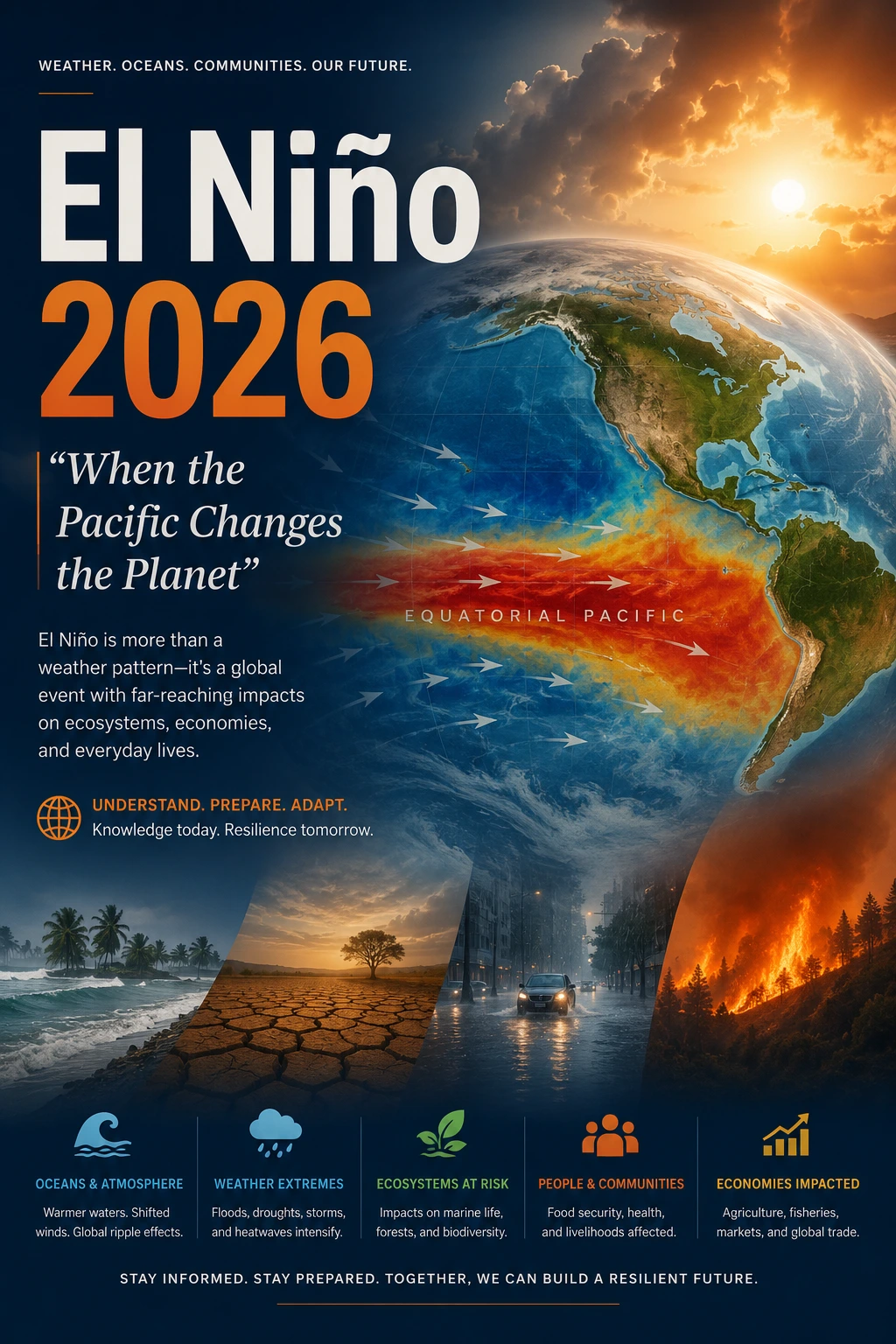
The return of El Niño in 2026 is rapidly becoming one of the most closely monitored climate developments in the world. Forecast models from the World Meteorological Organization (WMO), NOAA, ECMWF, and multiple climate research institutes now indicate a high probability that El Niño conditions will emerge by mid-2026 and strengthen into late 2026 and early 2027.
For governments, investors, agricultural markets, insurers, commodity traders, and energy planners, the 2026 El Niño is no longer a theoretical event. It is increasingly being treated as a major macro-climate risk capable of disrupting global food supply chains, water availability, logistics corridors, hydropower systems, and economic growth.
What Is El Niño and Why 2026 Matters
El Niño is the warm phase of the El Niño–Southern Oscillation (ENSO), a periodic warming of sea surface temperatures in the central and eastern Pacific Ocean. This warming alters atmospheric circulation globally, shifting rainfall patterns, intensifying heatwaves, and redistributing drought and flooding risks across continents.
Climate agencies now report:
- A rapidly warming Niño 3.4 region
- Strong subsurface Pacific heat accumulation
- Increasing alignment among long-range forecast models
- Elevated probability of a strong or potentially “super” El Niño scenario
The WMO confirmed in April 2026 that El Niño is expected to develop from mid-2026 onward.
The International Research Institute for Climate and Society (IRI Columbia) estimates probabilities above 88% for El Niño persistence through late 2026.
Some forecasts even suggest the strongest Pacific warming since the historic 1997-98 and 2015-16 events.
Countries Expected To Be Hit Hardest By El Niño 2026
1. India: Monsoon Volatility and Agricultural Stress
India faces one of the highest economic exposures to El Niño due to its dependence on monsoon rainfall.
Historically, El Niño weakens the Indian summer monsoon, often reducing rainfall and increasing the probability of:
- Agricultural losses
- Heatwaves
- Water shortages
- Food inflation
- Power demand surges
A weaker monsoon directly threatens rice, wheat, sugarcane, and pulse production. India’s agricultural economy still supports hundreds of millions of livelihoods, making ENSO shifts economically significant.
Several past El Niño years coincided with below-average monsoons in India, including 2002, 2009, and 2015. Analysts are closely monitoring whether 2026 could replicate similar rainfall deficits.
According to WMO assessments, parts of southern Asia are among the regions likely to experience drought stress under El Niño conditions.
Key Risks for India in 2026
- Monsoon rainfall deficits
- Food inflation spikes
- Groundwater depletion
- Extreme pre-monsoon heatwaves
- Electricity demand surges due to cooling needs
2. Australia: Severe Drought and Bushfire Risk
Australia is historically one of the clearest El Niño impact zones.
El Niño frequently brings:
- Reduced rainfall
- Hotter temperatures
- Drought intensification
- Elevated bushfire danger
The Australian Bureau of Meteorology and ASEAN climate monitoring systems have already warned that 2026 may transition toward El Niño conditions by June–July.
The agricultural sector is particularly vulnerable. Wheat production, livestock systems, and water reservoirs often face severe stress during strong ENSO years.
A prolonged El Niño into 2027 could significantly raise wildfire exposure across southeastern Australia.
Industries Most Exposed
- Wheat exports
- Livestock production
- Water infrastructure
- Insurance markets
- Energy utilities
3. Indonesia: Drought, Wildfires, and Food Security Risks
Indonesia typically experiences below-normal rainfall during El Niño periods.
This creates elevated risks for:
- Forest fires
- Peatland burning
- Haze pollution
- Palm oil production
- Hydropower output
- Rice cultivation
Indonesia’s peatland ecosystems become highly flammable during dry ENSO years, often generating transboundary haze across Southeast Asia.
WMO and ASEAN climate agencies identify Indonesia among the most drought-vulnerable regions during El Niño intensification.
Strategic Global Impact
Indonesia is a major supplier of:
- Palm oil
- Nickel
- LNG
- Rubber
- Coal
Any prolonged drought could influence global commodity pricing.
4. Brazil: Agricultural Disruptions and Hydropower Pressure
Brazil may experience highly uneven El Niño impacts depending on the region.
Research and economic assessments suggest:
- Southern Brazil may receive excessive rainfall
- Central agricultural zones could face irregular precipitation
- Coffee and soybean production may become volatile
Hydropower is another major concern. Brazil remains heavily dependent on hydroelectric generation, leaving electricity systems sensitive to rainfall disruptions.
Coffee markets are especially vulnerable. Previous drought episodes in Minas Gerais significantly reduced output and tightened global supply.
Potential Economic Effects
- Soybean export volatility
- Coffee price spikes
- Energy market instability
- Flood damage in southern states
5. Argentina: Agricultural Boom or Extreme Flooding
Argentina often experiences increased rainfall during El Niño years.
Unlike drought-prone Asia-Pacific regions, Argentina can sometimes benefit agriculturally from El Niño through improved soil moisture for soybeans and corn.
However, excessively strong events can also produce:
- River flooding
- Crop damage
- Infrastructure losses
- Transportation disruption
Agricultural markets globally monitor Argentina closely because of its central role in soybean and grain exports.
6. United States: Coastal Storms and Regional Weather Extremes
United States is likely to experience mixed regional impacts.
NOAA-linked projections suggest El Niño may contribute to:
- Wetter southern states
- Increased West Coast storms
- Milder northern winters
- Altered hurricane activity
Texas and the southern U.S. could see wetter winter conditions, although forecasters emphasize uncertainty remains high.
California historically experiences elevated flood risk during strong El Niño winters.
Areas Most Exposed
- California flood corridors
- Gulf Coast storm systems
- Southwest rainfall variability
- Agricultural production zones
7. Horn of Africa: Flooding and Humanitarian Risks
Horn of Africa nations often experience above-average rainfall during El Niño.
Countries such as:
- Ethiopia
- Somalia
- Kenya
could face:
- Flooding
- Disease outbreaks
- Infrastructure damage
- Displacement risks
WMO forecasts specifically identify the Horn of Africa as a region likely to receive increased precipitation during El Niño phases.
This creates dual risks:
- Flash flooding in urban areas
- Agricultural disruption from rainfall extremes
8. Panama: Global Trade Disruption Risk
Panama may again face pressure on the Panama Canal if drought conditions intensify.
The 2023-24 El Niño sharply reduced water levels in Gatun Lake, forcing shipping restrictions and creating global supply chain bottlenecks.
Economic analysis now warns that another strong El Niño could once again constrain canal operations.
Why This Matters Globally
The Panama Canal is one of the world’s most important maritime trade corridors.
Reduced vessel transit capacity affects:
- LNG shipments
- Grain exports
- Container logistics
- Global freight rates
Why 2026 Could Be More Dangerous Than Previous El Niño Cycles
Climate scientists increasingly warn that El Niño impacts are now interacting with long-term global warming.
This combination amplifies:
- Heat extremes
- Ocean warming
- Atmospheric instability
- Wildfire intensity
- Hydrological volatility
Researchers now believe strong El Niño events may trigger long-lasting “climate regime shifts” rather than short temporary disruptions.
The Washington Post reports that several climate models now indicate the possibility of one of the strongest El Niño events in modern observational history.
Meanwhile, Carbon Brief estimates 2026 could become one of the warmest years ever recorded globally.
Economic Sectors Facing the Highest Global Exposure
Agriculture
The biggest global exposure remains food production.
Major crops at risk include:
- Rice
- Soybeans
- Wheat
- Palm oil
- Coffee
- Corn
Commodity volatility typically rises sharply during strong El Niño years.
Energy Markets
Hydropower-dependent economies are highly vulnerable.
Countries exposed include:
- Brazil
- Colombia
- Paraguay
- Indonesia
Reduced rainfall can sharply reduce electricity generation capacity.
Insurance and Reinsurance
Extreme weather events tied to El Niño often generate:
- Flood losses
- Crop insurance claims
- Wildfire liabilities
- Infrastructure damage
Global insurers are already integrating ENSO risk modeling into 2026 pricing strategies.
Shipping and Logistics
Drought conditions affecting major waterways may disrupt:
- Panama Canal operations
- Inland river shipping
- Port logistics
- Global freight pricing
Scientific Uncertainty Still Exists
Despite growing consensus, scientists continue emphasizing caution.
Forecast accuracy during the Northern Hemisphere spring remains challenged by the “spring predictability barrier,” which historically reduces ENSO forecasting confidence.
Some academic models still project a weaker El Niño or even continued neutral conditions.
However, most operational forecasting agencies now lean strongly toward El Niño development by mid-2026.
Final Outlook: A Defining Climate Event for 2026–27
The emerging El Niño cycle is shaping into one of the defining global climate risks of 2026 and potentially 2027.
The countries expected to experience the largest disruptions include:
- India
- Australia
- Indonesia
- Brazil
- Argentina
- United States
- Horn of Africa nations
- Panama
Whether the event ultimately becomes a “super El Niño” remains uncertain, but the probability of major global climate disruption is rising rapidly.
Governments, industries, investors, and infrastructure planners now face a narrowing preparation window as the Pacific warming trend accelerates into the second half of 2026.