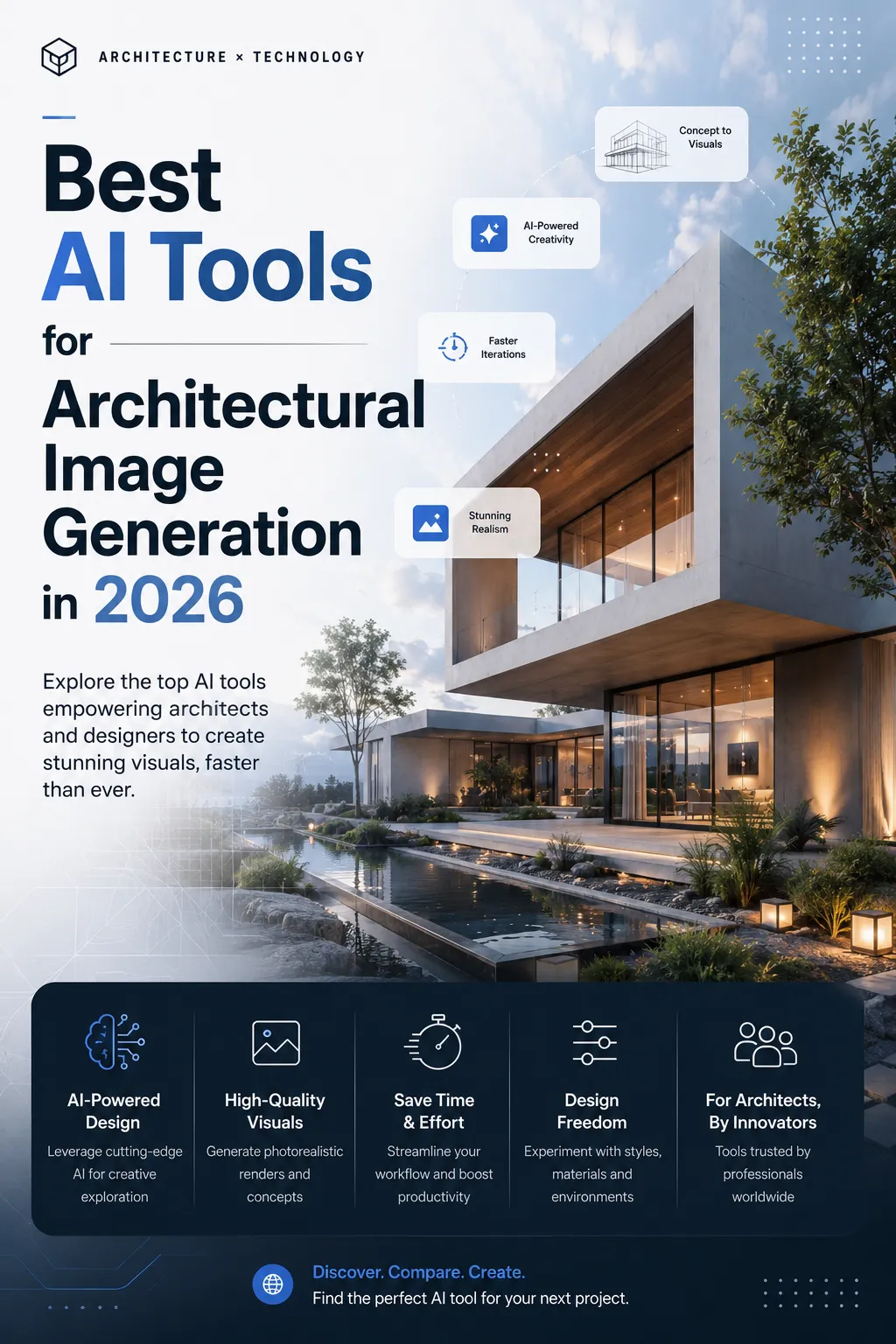
A Deep Dive for Architects, Designers & Visualization Studios
This guide analyzes the best AI image generation tools for architecture based on:
- Rendering realism
- Architectural accuracy
- Workflow integration
- Prompt responsiveness
- Iteration speed
- Commercial usability
- Concept development capability
- BIM/CAD compatibility
- Scalability for studios
1. Midjourney — The Industry Benchmark for Architectural Concept Visualization
Official Website
Among all AI image generators currently used by architects, Midjourney remains the dominant platform for conceptual architectural imagery.
Multiple industry comparisons consistently rank Midjourney as the strongest tool for:
- Mood creation
- Atmospheric rendering
- Material richness
- Cinematic architecture
- Conceptual ideation
- Luxury residential visualization
- High-end presentation imagery
Architectural publications and rendering specialists repeatedly identify Midjourney as the most widely adopted AI visualization engine among architects.
2. Stable Diffusion — Best Open-Source AI Rendering Ecosystem
Official Website
Stable Diffusion by Stability AI
Stable Diffusion remains the most flexible AI image generation framework for architecture professionals who require customization, control, and scalability.
Unlike proprietary tools, Stable Diffusion enables:
- Local deployment
- Custom architectural models
- Style training
- ControlNet workflows
- Depth map conditioning
- Sketch-to-render pipelines
- Image-to-image precision editing
Architectural AI specialists increasingly rely on Stable Diffusion for studio-grade rendering pipelines.
Key Advantages for Architecture Studios
Full Workflow Customization
Studios can fine-tune models using proprietary datasets including:
- Architectural styles
- Material libraries
- Local building typologies
- Office-specific rendering styles
3. Leonardo AI — Best Hybrid Platform for Professional Design Teams
Official Website
Leonardo AI has evolved rapidly into one of the most commercially practical AI visualization ecosystems for architecture and design professionals.
Originally known as a Stable Diffusion-powered interface, Leonardo now includes:
- Real-time canvas workflows
- Advanced editing
- Style consistency systems
- Image refinement tools
- Motion generation capabilities
- Team-based workflows
Recent platform upgrades significantly improved photorealism and architectural detail quality.
4. Blue Moon AI and Specialized Architectural AI Platforms
Architecture-specific AI generators are emerging rapidly as firms demand more control over architectural realism and workflow compatibility.
Specialized Architecture AI Platforms
ArchiVinci
ArchiVinci is gaining popularity for:
- Sketch-to-render conversion
- Architectural enhancement
- Exterior rendering
- Fast concept visualization
AI Architectures
AI Architectures focuses heavily on:
- Architectural workflows
- Floorplan assistance
- Style generation
- CAD-oriented processes
Chaos AI Rendering Tools Comparison
Chaos’ 2026 architectural AI analysis highlights increasing demand for BIM-integrated AI rendering ecosystems.
Why Specialized Tools Matter
General-purpose image generators are excellent at visual storytelling.
However, architecture-focused systems are improving in areas such as:
- Scale consistency
- Structural realism
- Material logic
- Architectural detailing
- BIM compatibility
- Design iteration continuity
This specialization is likely to define the next generation of AI architectural visualization.
5. DALL·E and ChatGPT Image Generation — Best for Prompt Accuracy
Official Website
OpenAI ChatGPT Image Generation
DALL·E-powered image generation has become increasingly important for architectural workflows due to its strong semantic interpretation.
Compared to Midjourney, DALL·E often produces outputs that more closely follow detailed prompt instructions.
Strengths for Architects
Better Prompt Fidelity
DALL·E performs especially well when prompts include:
- Detailed design requirements
- Spatial descriptions
- Material instructions
- Human interaction scenes
- Urban environments
Conversational Iteration
The conversational workflow dramatically simplifies revision cycles.
Architects can iteratively refine:
- Facade design
- Material mood
- Lighting
- Urban density
- Interior layouts
…without restarting prompts from scratch.
Limitations
Compared to Midjourney, DALL·E can sometimes produce:
- Less dramatic cinematic quality
- Softer atmospheric rendering
- Less stylized architectural emotion
However, its prompt comprehension remains one of the strongest in the industry.
Comparative Analysis: Architectural Image Generation tools
| Tool | Best Use Case | Key Strength | Limitation |
|---|---|---|---|
| Midjourney | Concept architecture | Cinematic realism | Lower technical precision |
| Stable Diffusion | Studio workflows | Full customization | Technical complexity |
| Leonardo AI | Design iteration | Workflow efficiency | Less artistic depth than Midjourney |
| Blue Moon AI / Specialized Platforms | Architectural rendering | Architecture-focused outputs | Smaller ecosystems |
| DALL·E | Prompt accuracy | Semantic interpretation | Less atmospheric richness |
Industry-wide evaluations indicate that no single platform dominates every architectural workflow. Instead, firms increasingly combine multiple AI systems depending on project phase.
Key Trends Defining AI Architectural Image Generation tools in 2026
1. AI + BIM Integration
The strongest market demand is shifting toward:
- Revit-connected AI rendering
- SketchUp AI visualization
- Rhino AI enhancement
- CAD-aware rendering systems
This is expected to become the dominant enterprise segment.
2. Real-Time Iterative Rendering
Architectural teams increasingly require:
- Instant design variations
- Live rendering feedback
- Real-time concept exploration
This is pushing vendors toward ultra-fast generation pipelines.
3. Hyper-Localized Architectural Training
Studios are beginning to train AI systems on:
- Regional architecture
- Local material palettes
- Climate-specific building typologies
- City-specific design aesthetics
This trend is expected to redefine architectural visualization realism.
4. Multi-Modal Design Pipelines
Future workflows will increasingly merge:
- Text prompts
- Sketches
- BIM geometry
- Site photographs
- GIS data
- Parametric systems
…into unified AI rendering ecosystems.
Final Verdict: Which Architectural Image Generation tools Is Best for Architecture?
The answer depends entirely on workflow requirements.
Best Overall for Architectural Concept Rendering
Midjourney
Best for:
- Visual storytelling
- Concept competitions
- Luxury presentation imagery
- Atmosphere-rich visualization
Best for Professional Studio Control
Stable Diffusion
Best for:
- Custom pipelines
- Architectural consistency
- Private deployment
- Technical workflows
Best for Fast Commercial Production
Leonardo AI
Best for:
- Interior visualization
- Team workflows
- Rapid iteration
- Client presentation generation
Best Emerging Specialized Category
Architecture-Specific AI Platforms
Best for:
- BIM-oriented workflows
- Sketch-to-render processes
- Architectural precision
- Industry-specific optimization