
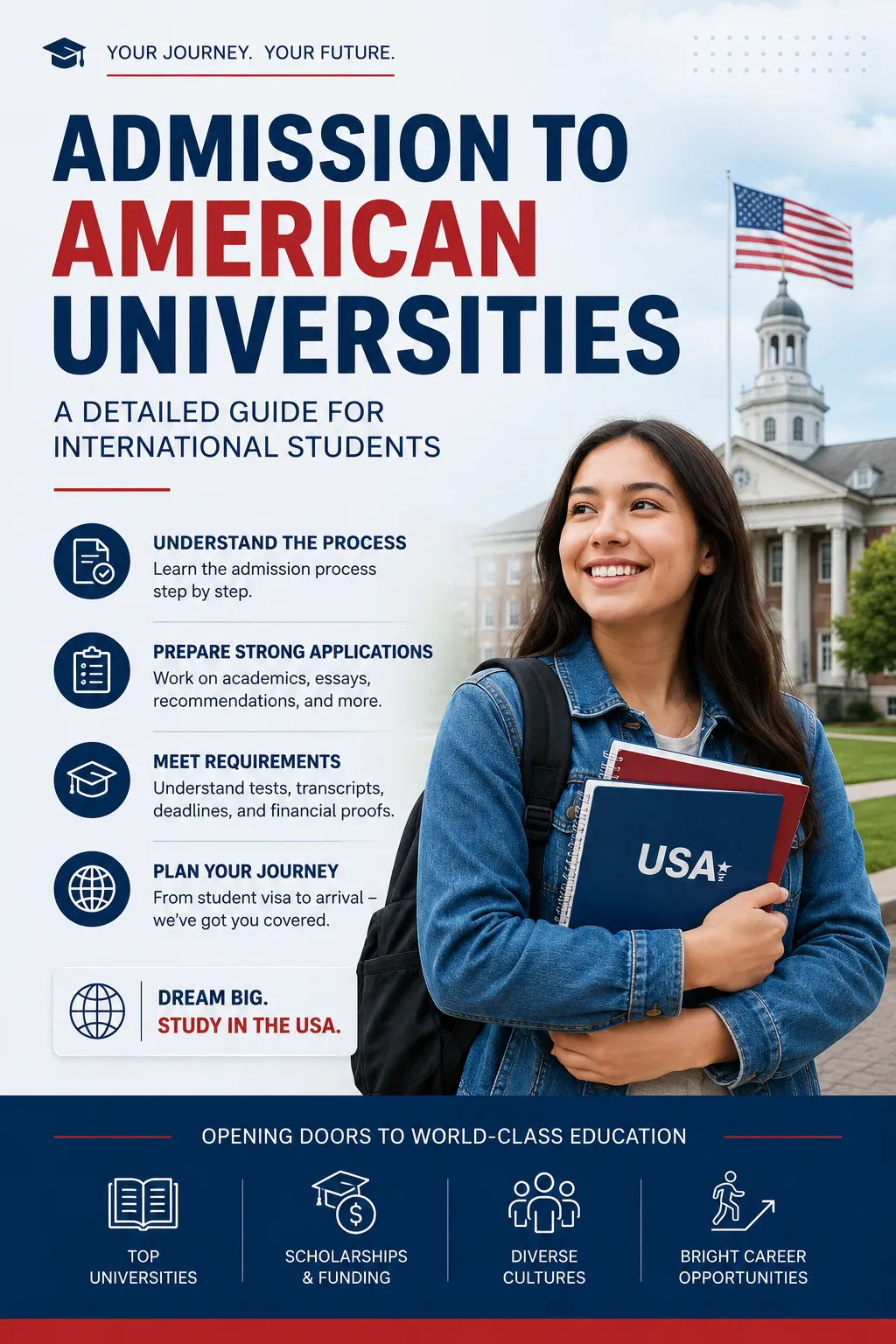
A Detailed Guide for International Students on ” How to apply for admission to American Universities”
1. Research and Shortlist Universities (12–18 months before applying for admission to American Universities)
Identify academic goals: Choose your field of study (e.g., Engineering, Business, Arts).
Decide on the level of education:
Undergraduate (Bachelor’s Degree)
Graduate (Master’s/Ph.D.)
Search for universities that fit:
Academic strengths and curriculum
Rankings, location, tuition cost, and student life
Use trusted sources:
Official university websites
U.S. News & World Report, QS Rankings, College Board
Create a shortlist:
Apply to a mix of “dream,” “match,” and “safe” schools (usually 5–10 total)
📝 2. Understand Admission Requirements
General requirements before applying for admissions:
Completed application form (online via Common App, Coalition App, or university portal)
Academic transcripts (high school or prior university records)
Letters of recommendation (typically 2–3)
Standardized test scores (if required)
Statement of Purpose / Personal essay
Resume or CV (especially for graduate applications)
English language proficiency test scores (TOEFL, IELTS, or Duolingo)
Additional for certain programs:
Portfolio (Art, Architecture, Design)
GRE/GMAT for graduate programs
Research proposal (Ph.D.)
🧾 3. Prepare for and Take Standardized Tests
Undergraduate level:
SAT or ACT (optional at many schools since COVID-19, but still accepted)
Graduate level:
GRE (general test; required by many STEM and social science programs)
GMAT (business schools)
English Proficiency:
TOEFL: Widely accepted
IELTS: Also accepted by most U.S. universities
Duolingo English Test: Accepted by an increasing number of schools
Tips:
Start preparing at least 6–9 months in advance
Register for tests early to secure seats and receive scores on time
Aim to take tests 6–12 months before the application deadline
🗓️ 4. Track Application Deadlines
Fall intake (August–September) is the most common
Application types:
Early Decision (ED): Binding, usually due in Nov
Early Action (EA): Non-binding, also in Nov
Regular Decision (RD): Due around Jan 1–Feb 1
Rolling Admission: Open until all seats are filled
Graduate deadlines vary:
Often between December and March depending on program
Set reminders to avoid missing:
Application deadlines
Test registration dates
Scholarship or financial aid forms (e.g., CSS Profile)
✍️ 5. Write Personal Statements and Essays
Undergraduate:
Common App essay (650 words): Choose from prompts
Supplementary essays: “Why this college?” or “What will you contribute?”
Graduate:
Statement of Purpose (SOP): Focus on academic/professional background, goals, why the program fits
Tailor essays to each program
Tips:
Start drafts early and revise
Avoid clichés, focus on personal experiences
Ask teachers, counselors, or mentors for feedback
📚 6. Secure Transcripts and Recommendations
Request official transcripts:
From high school or previous colleges/universities
May need to be translated and/or evaluated (e.g., via WES)
Letters of Recommendation:
Ask teachers/professors who know you well
Provide them with your resume and a summary of your achievements
Give at least 3–4 weeks’ notice
💸 7. Financial Planning & Aid
Tuition & Costs:
Vary widely ($15,000–$60,000/year)
Include housing, meals, books, insurance
Apply for Scholarships:
University-based merit scholarships
Need-based aid (e.g., CSS Profile)
External scholarships (e.g., Fulbright, Inlaks, Tata Trusts)
Assistantships (for graduates):
Teaching Assistant (TA) or Research Assistant (RA) positions
Apply early and express interest in SOP or emails to faculty
🌐 8. Submit Applications
Choose platform:
Common App (for undergrad, used by 900+ schools)
University portals (especially for graduate programs)
Pay application fee:
Typically $50–$100 per university
Fee waivers may be available for financial need
Check for confirmation emails and log-in portals:
Universities usually provide a checklist and updates
📩 9. Attend Interviews (if required)
Undergraduate interviews:
Not always required; may be evaluative or informational
Graduate interviews:
Often conducted by faculty or admissions committees
Tips:
Be prepared to discuss your goals, background, and interest in the program
Practice common questions
Dress professionally (even for virtual interviews)
📬 10. Await Results & Respond
Admission decisions typically released:
Early Action/Decision: December–January
Regular Decision: March–April
Decision types:
Admitted
Waitlisted
Rejected
Respond by May 1 (national decision deadline for undergrad)
Graduate offers: Follow deadlines in offer letters (usually April 15)
🛂 11. Apply for Student Visa (F-1 or J-1)
Receive Form I-20 from your university (needed to apply for F-1 Visa)
Pay SEVIS fee ($350) and schedule visa interview at U.S. Embassy or Consulate
Prepare visa documents:
I-20 form
Passport
Visa application form (DS-160)
Proof of financial support
Admission letter
Academic transcripts and test scores
Visa Interview Tips:
Be honest and concise
Clearly explain study plans and ties to home country
✈️ 12. Pre-Departure Preparation
Book travel: Once visa is approved
Arrange housing: On-campus or off-campus
Health insurance: Often mandatory; check with university
Attend university orientation: Many offer online or pre-arrival sessions
Pack essentials: Documents, medication, adapters, etc.
🎯 Summary of Timeline (to apply for admission to American Universities)
| Month | Activity |
|---|---|
| April–June | Research universities, start test prep |
| July–Sept | Take TOEFL/IELTS, SAT/GRE, draft SOP/essays |
| Oct–Dec | Submit applications (Early & Regular) |
| Jan–March | Complete remaining applications |
| March–April | Receive offers, apply for scholarships |
| May–June | Accept offers, get I-20, apply for visa |
| July–August | Fly to U.S., attend orientation, start classes |