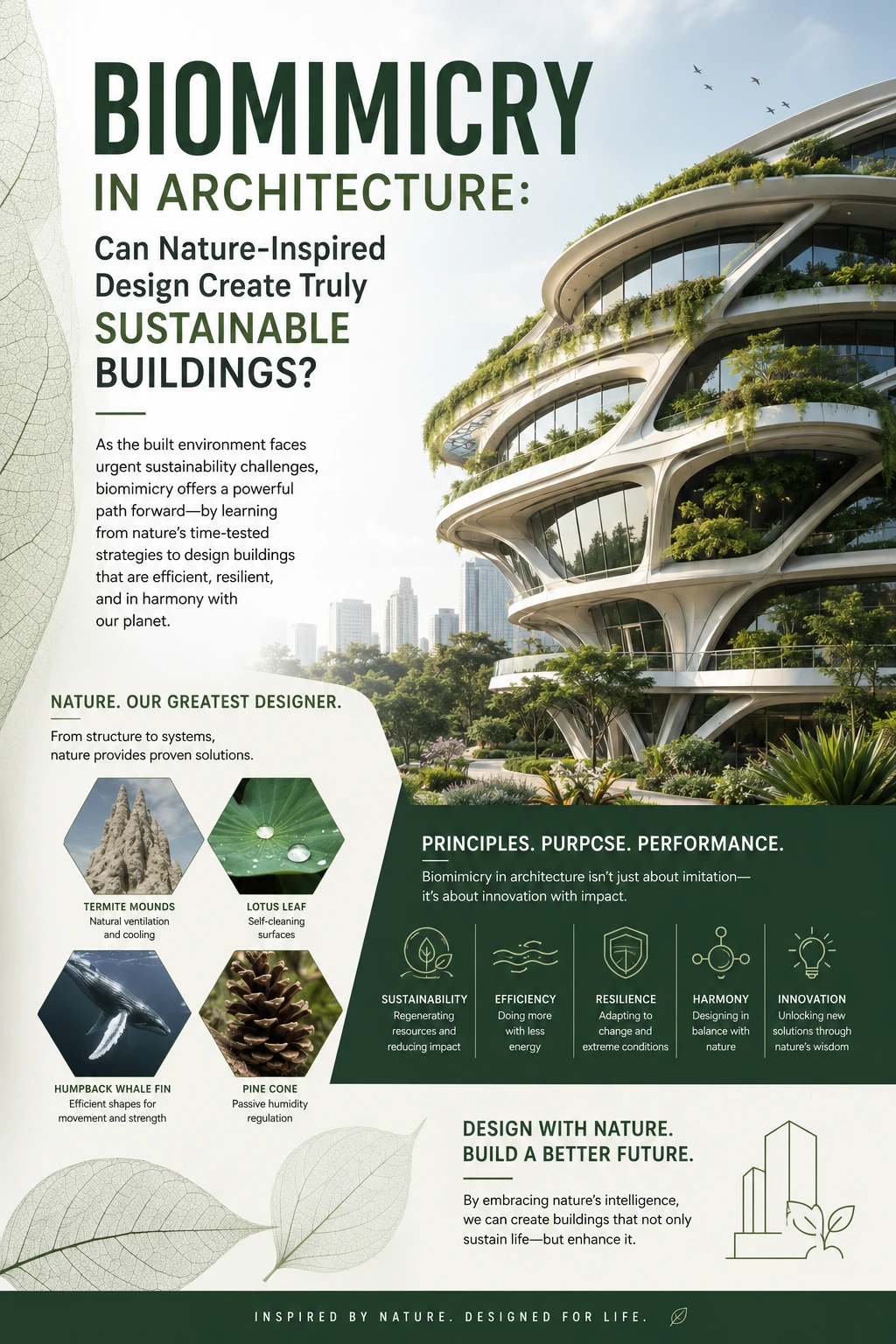
As the global construction industry faces mounting pressure to reduce carbon emissions, energy consumption, and environmental degradation, architects are increasingly turning to an unlikely mentor: nature itself. Biomimicry in architecture—the practice of emulating nature’s forms, systems, and processes to solve human design challenges—has emerged as one of the most promising approaches to sustainable building design.
From termite-inspired cooling systems to geodesic structures modeled after soap bubbles, biomimicry is transforming how buildings are designed, constructed, and operated. But beyond its aesthetic appeal, can biomimicry genuinely deliver measurable sustainability benefits? The evidence suggests that it can.
What is Biomimicry in Architecture?
Biomimicry is the science and design philosophy of learning from nature’s 3.8 billion years of evolutionary research and development. Rather than extracting resources from ecosystems, biomimicry studies how natural systems achieve efficiency, resilience, adaptability, and sustainability.
In architecture, biomimicry operates at three levels:
1. Organism-Level Biomimicry
Buildings imitate specific plants, animals, or biological structures.
2. Behavioral Biomimicry
Architectural systems replicate how organisms function within their environments.
3. Ecosystem Biomimicry
Entire developments are designed to mimic the resource cycles and interdependencies found in natural ecosystems.
This approach aligns closely with modern sustainable architecture goals by reducing resource consumption while improving building performance.
Why Biomimicry Matters in Sustainable Architecture
The built environment is one of the largest consumers of global energy. Research cited by the Biomimicry Institute indicates that building operations account for approximately 40% of humanity’s energy consumption, making efficiency improvements a critical climate objective.
Nature offers proven solutions because ecosystems operate through:
- Minimal waste generation
- Passive energy regulation
- Closed-loop resource cycles
- Climate adaptability
- Material efficiency
Architects applying these principles can often reduce reliance on mechanical systems while enhancing occupant comfort.
Example 1: Eastgate Centre, Zimbabwe – Learning from Termites


4
The most frequently cited example of biomimicry in architecture is the Eastgate Centre, designed by architect Mick Pearce.
The Biological Inspiration
African termite mounds maintain remarkably stable internal temperatures despite dramatic fluctuations in external weather conditions. They achieve this through a sophisticated network of vents, tunnels, and airflow pathways.
Architectural Application
Pearce adapted these principles into a passive ventilation system that continuously regulates indoor temperatures using:
- Thermal mass
- Natural airflow channels
- Ventilation chimneys
- Controlled air exchange
Instead of relying heavily on conventional air-conditioning systems, the building uses natural temperature regulation mechanisms.
Sustainability Results
The outcomes are significant:
- Approximately 90% less energy used for ventilation compared with similar conventional buildings.
- More than $3.5 million saved in cooling costs over time.
- Dramatically lower operational carbon emissions.
This project demonstrated that biomimicry can deliver measurable environmental and economic benefits rather than merely serving as a design concept.
Example 2: The Eden Project, United Kingdom


4
Another benchmark project is the Eden Project.
Nature-Inspired Design Principles
The Eden Project’s biomes were inspired by naturally efficient structural geometries found in soap bubbles, pollen grains, and plant growth patterns. Their hexagonal and pentagonal cellular structures maximize strength while minimizing material consumption.
The project’s Core building also incorporates Fibonacci-based growth patterns commonly found in plants.
Sustainable Features
Key sustainability advantages include:
Lightweight Structural Systems
The ETFE-clad geodesic domes require substantially less material than traditional glass enclosures while maintaining high structural integrity.
Natural Light Optimization
The cellular geometry maximizes daylight penetration, reducing artificial lighting requirements.
Resource Efficiency
The project incorporates rainwater harvesting, renewable energy integration, and ecosystem restoration principles.
The Eden Project demonstrates how biomimicry can simultaneously improve structural performance, environmental efficiency, and visitor experience.
Key Sustainability Benefits of Biomimetic Architecture
1. Reduced Energy Consumption
Nature rarely wastes energy. Buildings inspired by biological systems frequently incorporate:
- Passive cooling
- Passive heating
- Natural ventilation
- Daylighting optimization
These strategies reduce dependence on mechanical HVAC systems, which remain among the largest contributors to building energy consumption.
The Eastgate Centre provides one of the strongest real-world demonstrations of this principle.
2. Material Efficiency
Natural structures achieve exceptional strength with minimal material usage.
Examples include:
- Honeycomb geometries
- Bone structures
- Spider silk arrangements
- Shell formations
Architectural adaptations of these principles can reduce embodied carbon by decreasing the quantity of construction materials required.
3. Climate Resilience
Natural organisms continuously adapt to environmental pressures.
Buildings designed through biomimetic principles often perform better under:
- Heat stress
- Water scarcity
- Extreme weather conditions
- Temperature fluctuations
Adaptive facades, responsive shading systems, and dynamic ventilation mechanisms are increasingly borrowing concepts from cacti, flowers, and marine organisms.
4. Improved Indoor Environmental Quality
Natural ventilation systems often provide:
- Better air circulation
- Reduced indoor pollutants
- Enhanced thermal comfort
- Lower sick-building syndrome risks
This creates healthier environments for occupants while simultaneously reducing energy requirements.
5. Circular Resource Management
Ecosystems function through closed-loop systems where waste becomes a resource.
Biomimetic buildings increasingly integrate:
- Water recycling
- Rainwater harvesting
- Waste-to-energy systems
- Regenerative landscaping
These approaches support long-term environmental sustainability.
Challenges Limiting Wider Adoption
Despite its promise, biomimicry is not yet mainstream.
Several barriers remain:
Higher Design Complexity
Nature-inspired systems often require interdisciplinary collaboration among architects, engineers, biologists, and environmental scientists.
Knowledge Gaps
Many architectural firms lack specialized expertise in biological modeling and biomimetic research.
Initial Capital Costs
Some biomimetic technologies require higher upfront investment, even though lifecycle costs are typically lower.
Regulatory Constraints
Building codes are often written around traditional construction methods, slowing innovation.
However, growing sustainability regulations and net-zero building mandates are steadily increasing interest in biomimetic solutions.
Future Trends in Biomimetic Architecture
The next generation of biomimetic buildings is likely to incorporate:
- AI-assisted biological design optimization
- Responsive building skins
- Self-healing construction materials
- Carbon-sequestering facades
- Adaptive climate-control systems
As computational design advances, architects will increasingly be able to simulate and replicate nature’s highly efficient systems with greater precision.
Can Biomimicry Create More Sustainable Buildings?
The evidence strongly supports the conclusion that biomimicry can significantly enhance building sustainability.
Projects such as the Eastgate Centre and the Eden Project demonstrate that nature-inspired architecture is not merely a design trend—it is a practical methodology capable of reducing energy consumption, improving resource efficiency, lowering operational costs, and enhancing environmental resilience.
As cities pursue net-zero carbon targets and sustainable development goals, biomimicry offers a compelling pathway forward. Nature has spent billions of years refining efficient systems; architecture’s future may depend on how effectively we learn from them.
Suggested Links
- https://biomimicry.org
- https://asknature.org
- https://www.edenproject.com
- https://www.archdaily.com/tag/biomimicry
- https://www.worldgbc.org
- https://www.usgbc.org
- https://www.ribaj.com
- https://www.dezeen.com/tag/biomimicry
- https://www.wbcsd.org
- https://www.unep.org
- https://www.arup.com
- https://www.architecture.com
- https://www.biomimicry.net
- https://www.c40.org
- https://www.worldgreenbuildingweek.org