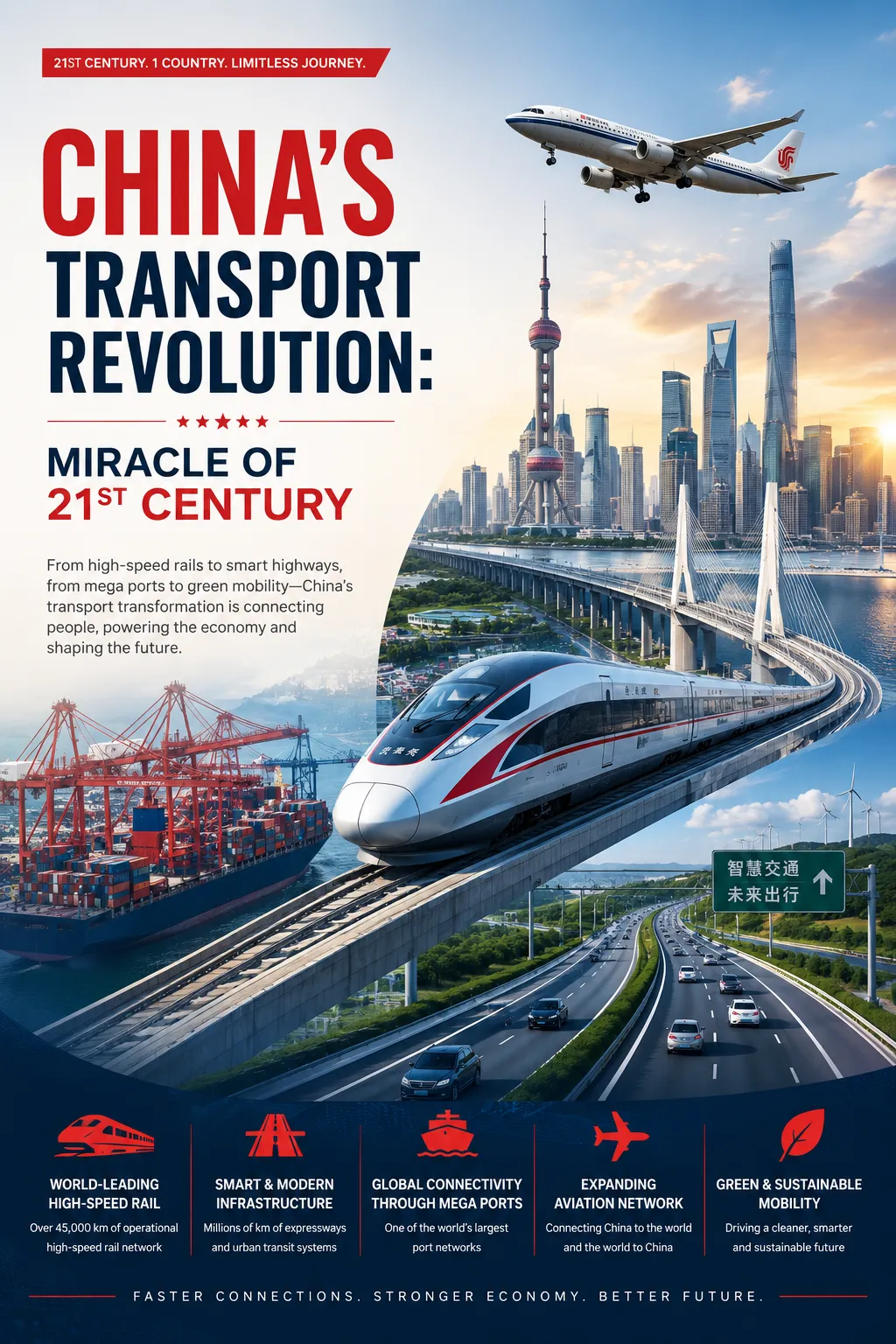
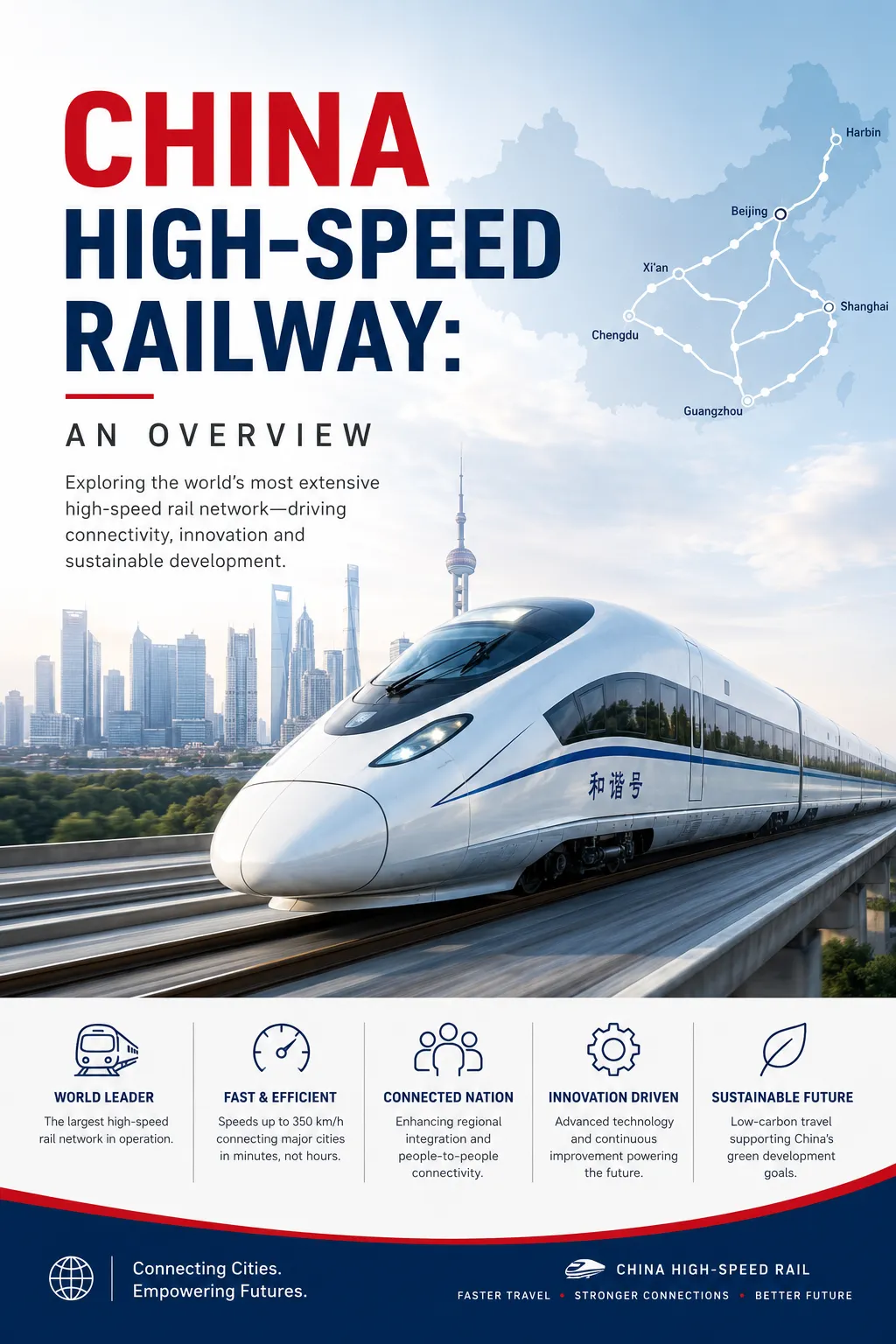
China’s high-speed railway (HSR) system is the world’s largest transport infrastructure project of its kind, fundamentally changing domestic mobility, regional integration, industrial development, and global railway technology exports. It currently accounts for roughly two-thirds of the world’s total and has expanded to more than 50,000 km in operational length.
1. Network Scale: The Largest High-Speed Railway Globally
China operates approximately 50,000 km of dedicated high-speed railway, accounting for well over two-thirds of the global HSR network. Since the first modern HSR line opened in 2008, expansion has averaged several thousand kilometers annually, with long-term planning targeting approximately 60,000 km by 2030.
Reference:
- https://www.worldbank.org/en/news/press-release/2019/07/08/chinas-experience-with-high-speed-rail-offers-lessons-for-other-countries
- https://en.wikipedia.org/wiki/High-speed_rail_in_China
Key Statistics
- World’s largest HSR network
- Maximum commercial operating speed: 350 km/h
- Thousands of daily train services
- Coverage across nearly every major metropolitan region
- Continuous expansion under national infrastructure planning
2. Travel Time Reduction and Economic Integration
China’s HSR network has significantly reduced intercity travel times, allowing economic regions to function as integrated labor and commercial markets. Major corridors including Beijing–Shanghai, Beijing–Guangzhou, and Shanghai–Hangzhou have experienced increased business mobility, tourism, investment, and labor participation.
Research from the World Bank concludes that reduced travel time improves market accessibility, regional productivity, and long-term economic efficiency rather than simply increasing passenger capacity.
Reference:
3. Technology Development and Domestic Manufacturing
Unlike many countries that initially relied on imported railway technology, China rapidly localized manufacturing capabilities. Today, companies such as CRRC manufacture complete rolling stock, signaling systems, traction equipment, and railway components domestically.
The Fuxing series represents China’s indigenous high-speed train platform, capable of sustained commercial operations at 350 km/h, making it one of the fastest regularly operated railway services globally.
The domestic manufacturing ecosystem has also strengthened China’s export competitiveness in railway engineering and infrastructure development.
4. Passenger Demand Supports Core Corridors
The strongest financial performance is concentrated along densely populated economic corridors.
High-demand routes consistently achieve:
- High seat occupancy
- Frequent departures
- Competitive pricing compared with aviation
- Lower per-passenger operating costs
- Strong operational efficiency
The Beijing–Shanghai corridor remains one of the busiest high-speed railway routes worldwide, demonstrating that dense population and strong economic activity are essential drivers of HSR profitability.
5. Economic Benefits Extend Beyond Ticket Revenue
Infrastructure economists generally evaluate HSR using broader economic indicators instead of railway profits alone.
Major measurable impacts include:
- Higher labor mobility
- Increased tourism
- Improved regional supply chain efficiency
- Greater business connectivity
- Expansion of metropolitan economic clusters
- Higher accessibility for secondary cities
The World Bank estimates that China’s HSR investments generated positive economic returns through productivity gains, urban integration, and reduced transportation costs.
Reference:
6. Financial Sustainability Remains a Major Challenge
Despite operational success, financial sustainability varies considerably across the network.
High-density routes generate strong passenger volumes, while many lower-demand regional lines depend on continued public investment. Infrastructure construction, maintenance, financing costs, and debt servicing remain significant long-term considerations.
Economic research consistently shows that passenger density is the single most important determinant of HSR profitability.
Consequently, China’s railway strategy increasingly evaluates projects based on national development objectives rather than direct commercial returns alone.
7. Environmental Performance
China’s HSR network contributes to lower transport emissions by shifting passenger traffic from automobiles and short-haul aviation toward electrified rail transport.
Environmental advantages include:
- Lower per-passenger carbon emissions
- Reduced highway congestion
- Lower fossil fuel consumption
- Improved energy efficiency through electric traction
These benefits align with China’s long-term carbon reduction and transportation electrification strategies.
8. Global Railway Industry Leadership
China has evolved from a technology importer into one of the world’s largest railway exporters.
Chinese firms now participate in railway construction, engineering consulting, rolling stock manufacturing, and infrastructure financing across Asia, Africa, the Middle East, and parts of Europe through international infrastructure initiatives.
| Network Size | China operates the world’s largest high-speed railway (HSR) network, spanning approximately 50,000 km, with expansion planned to around 60,000 km by 2030. |
| Operating Speed | Commercial trains operate at speeds of up to 350 km/h, making China’s HSR among the fastest regular rail services globally. |
| Infrastructure Scale | The network connects nearly all major metropolitan regions, significantly improving national connectivity and reducing travel times. |
| Economic Impact | HSR has enhanced regional integration, labor mobility, tourism, investment, and productivity by connecting major economic hubs efficiently. |
| Technology Development | China has developed a largely indigenous HSR ecosystem, manufacturing trains, signaling systems, and railway infrastructure through domestic companies such as CRRC. |
| Passenger Demand | Core routes, especially Beijing–Shanghai and Beijing–Guangzhou, maintain high passenger occupancy and operational efficiency due to strong population density and business demand. |
| Financial Performance | While major corridors generate substantial revenue, several regional lines rely on government investment due to lower passenger demand and high infrastructure costs. |
| Environmental Benefits | Electrified HSR reduces carbon emissions, lowers highway congestion, decreases dependence on short-haul aviation, and supports China’s climate objectives. |
| Global Influence | China has become a leading exporter of railway technology, engineering expertise, and infrastructure projects across Asia, Africa, the Middle East, and parts of Europe. |
| Strategic Assessment | China’s HSR functions as a national economic development tool, delivering long-term benefits through connectivity, industrial growth, and regional development despite varying commercial profitability. |
| Key Strengths | Massive network coverage, high-speed operations, technological self-reliance, economic integration, and global competitiveness. |
| Primary Challenges | High capital expenditure, debt servicing, uneven profitability across regional routes, and long-term financial sustainability. |
See also: