
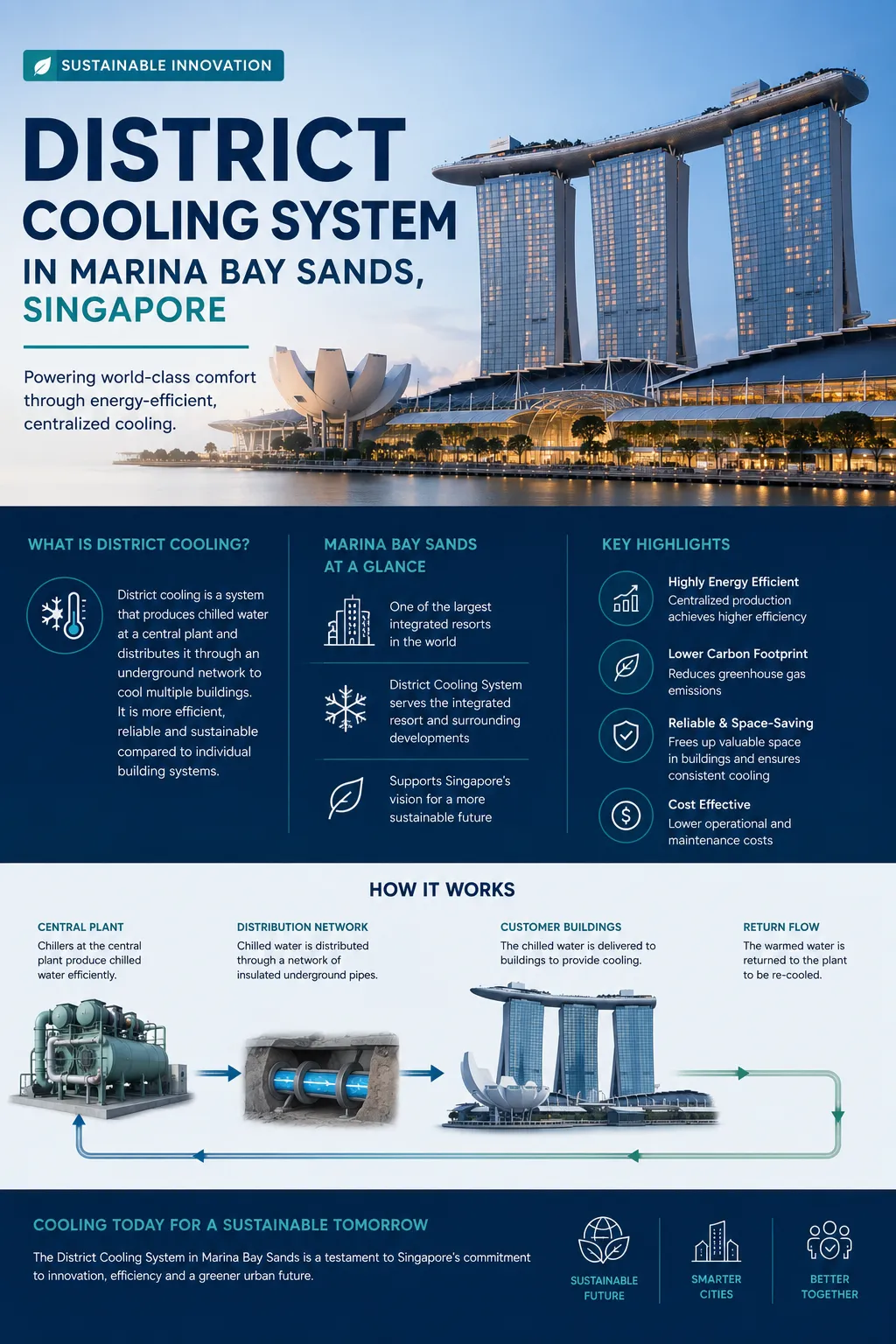
1. Centralised Cooling Architecture & System Scale
The Marina Bay District Cooling System (DCS) operates as one of the world’s largest underground district cooling networks, replacing conventional building-level chillers with a centralised chilled water production model. The system supplies cooling through underground pipes connected across the Marina Bay Sands precinct and surrounding commercial developments.
2. Energy Efficiency Performance Metrics
District cooling improves operational efficiency by aggregating cooling demand across multiple buildings instead of running separate HVAC plants. Analysis indicates that the Marina Bay cooling network reduces carbon emissions by thousands of tonnes annually while lowering cooling-related energy consumption compared with traditional air-conditioning infrastructure.
3. Underground Utility Integration Strategy
A major engineering advantage of the Marina Bay DCS is integration with Singapore’s Common Services Tunnel infrastructure, enabling chilled water distribution without individual cooling towers occupying premium urban space. Centralised assets improve land optimisation, equipment utilisation rate and long-term maintenance efficiency.
4. Cooling Capacity & Network Expansion Analysis
The system has expanded progressively with increasing commercial demand. The Marina Bay network is planned to reach up to 80,000 refrigeration tons (RT) of cooling capacity through additional plants and network extensions. Future connections include more developments across Singapore’s central business district.
5. Marina Bay Sands Sustainability Integration
Marina Bay Sands energy optimisation integrates with the district cooling network by using chilled water supply and heat recovery strategies to improve building-level energy performance. This supports Singapore’s movement toward low-carbon urban infrastructure.
6. Economic & Environmental Impact Assessment
District cooling reduces dependency on individual chillers, cooling towers, plant rooms and duplicated maintenance systems. The shared infrastructure model improves lifecycle cost efficiency while supporting Singapore’s Green Plan sustainability targets through lower electricity consumption and reduced operational emissions.
Key Performance Indicators
| Category | Key Details |
|---|---|
| Project | Expansion of SP Group’s Marina Bay District Cooling Network |
| Location | Marina Bay, Singapore |
| Operator | SP Group (SP) |
| System Type | Underground District Cooling System (DCS) with centralised chiller plants |
| Started Operation | 2006 |
| Network Status | World’s largest underground district cooling network |
| New Developments Connected (5) | • 8 Shenton Way (former AXA Tower) • 80 Anson Road commercial component (former Fuji Xerox Towers) • IOI Central Boulevard Towers • Marina Bay Sands Integrated Resort Expansion • NS Square |
| Total Buildings Served After Expansion | 28 buildings |
| Cooling Capacity (Marina Bay Network) | Increased to 70,000 RT (Refrigerant Tons), Total Future Cooling Capacity Operated by SP 118,500 RT |
| Additional Chilled Water Pipe Network | More than 2 km of underground insulated pipes added |
| Reliability Record | Zero supply interruptions since operations began in 2006 |
| Carbon Reduction Impact | 19,439 tonnes CO₂ avoided annually |
| Equivalent Environmental Impact | Similar to removing 17,672 cars from roads |
| Cost Benefit for Buildings | Up to 15% reduction in total cost of ownership vs conventional air-conditioning |
| Energy Infrastructure | Two underground district cooling plants integrated into Marina Bay developments |
| Future Enhancement | Thermal storage tanks planned in CBD area to increase energy storage capacity and reduce peak load |
| Renewable Energy Support | Thermal storage helps manage renewable energy intermittency and grid stability |
| Certification Advantage | Supports smoother compliance with BCA Green Mark 2021 energy efficiency requirements |
Refer : https://www.spgroup.com.sg/
See also: District Cooling System: Energy Efficiency and Urban Cooling

One thought on “District Cooling System in Marina Bay Sands, Singapore”