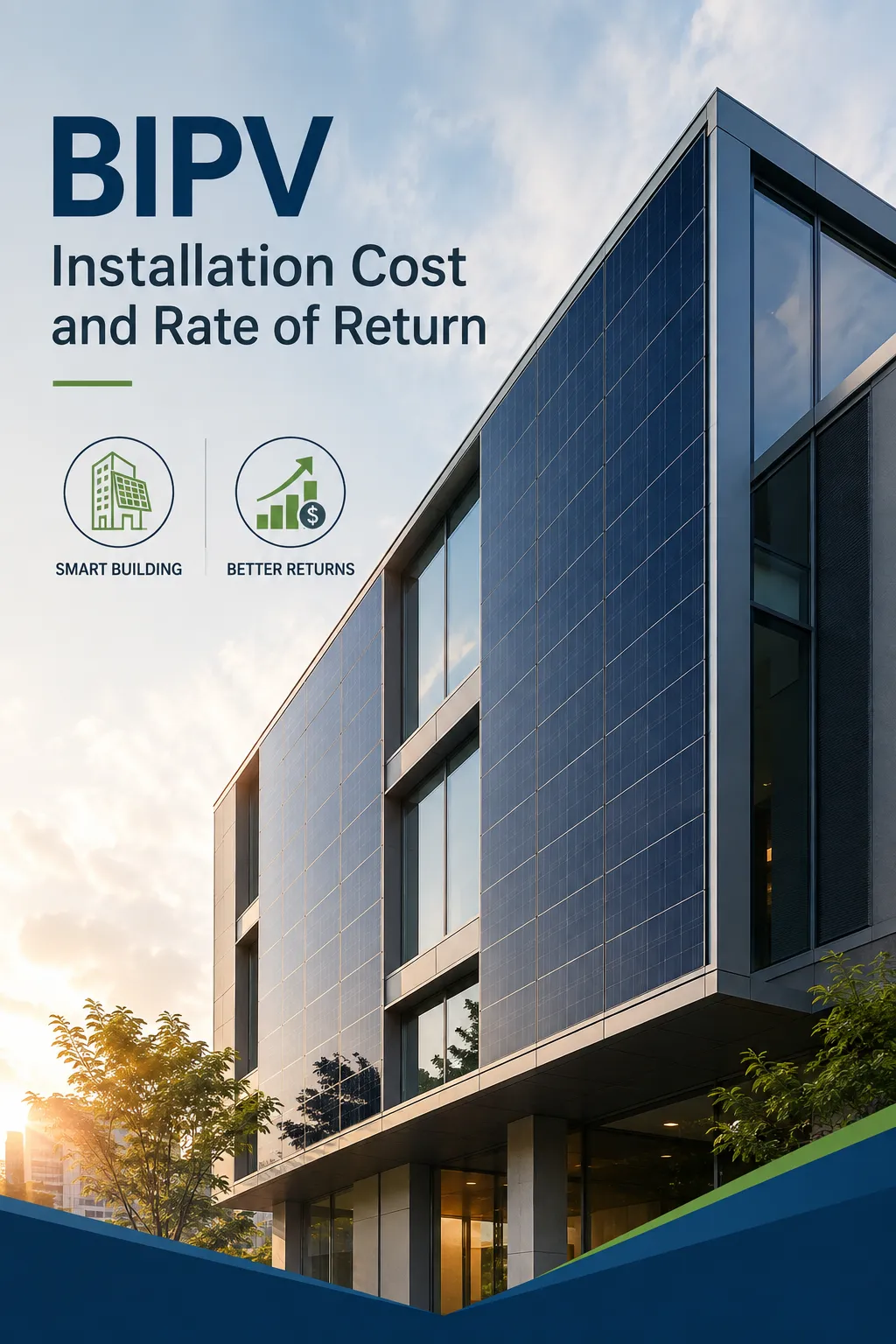
Building-Integrated Photovoltaics (BIPV) have evolved from premium architectural products into long-term energy-producing building materials. Unlike conventional rooftop solar systems, BIPV replaces traditional roofing, façade, skylight, or glazing materials while simultaneously generating electricity. Therefore, evaluating BIPV solely on installation cost is misleading. The correct financial approach is to assess incremental construction cost, lifecycle savings, and investment return (ROI) using Net Present Value (NPV), Internal Rate of Return (IRR), Levelized Cost of Energy (LCOE), and Payback Period, as recommended by the International Energy Agency (IEA PVPS) and National Renewable Energy Laboratory (NREL).
| Parameter | BIPV (Building-Integrated Photovoltaics) | Analytical Insight |
|---|---|---|
| Initial Installation Cost | Higher than conventional rooftop PV | Includes both photovoltaic system and replacement of building materials (roof, façade, glazing, cladding). |
| Incremental Construction Cost | Moderate | The true investment should be measured after deducting the cost of conventional building materials that BIPV replaces. |
| Annual Energy Generation | Depends on system size and solar irradiation | A 150 kWp BIPV system can generate approximately 150,000 –210,000 kWh/year under favorable conditions. |
| Annual Electricity Savings | High | Savings are directly proportional to electricity tariffs and on-site energy consumption. |
| Annual Maintenance Cost | Low | Typically around 0.5–1% of the initial installation cost per year. |
| Simple Payback Period | 5–8 years | Payback shortens with higher electricity prices, incentives, and high self-consumption. |
| Estimated Lifetime (Project) | 25–30 years | Most BIPV modules are warranted for 25 years with gradual performance degradation. |
| Estimated ROI (25-Year Lifecycle) | 200–300%+ | Lifetime electricity savings generally exceed the initial investment by more than two times in favorable conditions. |
| Net Present Value (NPV) | Positive | Positive NPV indicates the project generates value over its operational life when discounted cash flows are considered. |
| Internal Rate of Return (IRR) | Attractive | IRR generally exceeds financing costs for commercial projects with high daytime electricity demand. |
| Property Value Impact | Positive | BIPV enhances building sustainability, aesthetics, and long-term asset value. |
| Best Use Case | New commercial, institutional, and high-end residential buildings | Most financially viable when integrated during the design and construction phase. |
| Major ROI Drivers | Electricity tariff, solar irradiation, incentives, self-consumption, avoided building material costs | These variables have the greatest influence on financial performance. |
| Overall Investment Verdict | Financially attractive over the long term | Although upfront costs are higher, lifecycle savings, energy generation, and material replacement benefits result in strong long-term returns. |
BIPV Installation Cost Analysis
The installation cost of BIPV varies significantly because the photovoltaic modules replace conventional building envelope materials rather than being mounted on top of them.
| Component | Conventional Building | BIPV Equivalent |
|---|---|---|
| Roofing | Asphalt/Metal Roof | Solar Roof |
| Curtain Wall | Glass Façade | PV Glass |
| Skylight | Tempered Glass | Solar Glass |
| Cladding | ACP/Stone | PV Cladding |
Typical project economics indicate:
- Conventional rooftop PV generally has a lower upfront capital cost.
- BIPV requires higher initial investment but offsets part of the building material cost.
- Lifecycle economics improve substantially when replacement material costs are deducted from total project expenditure.
Economic studies therefore recommend evaluating incremental cost instead of gross installation cost, particularly for new construction projects.
2. Factors Influencing ROI
The financial return of BIPV depends on multiple measurable variables rather than installation price alone.
Primary ROI Drivers
- Electricity tariff
- Solar irradiation
- Building orientation
- Self-consumption ratio
- Export tariff
- Government incentives
- Module degradation
- Maintenance cost
- Building material replacement savings
Research consistently shows that electricity savings represent the largest contributor to lifecycle returns, while avoided façade or roofing costs significantly improve project economics in new buildings.
3. ROI Formula
A simplified investment model is:
ROI (%)
= ((Total Lifetime Savings − Total Investment) ÷ Total Investment) × 100
Professional feasibility studies additionally evaluate:
- Net Present Value (NPV)
- Internal Rate of Return (IRR)
- Levelized Cost of Energy (LCOE)
- Simple Payback Period
These metrics provide a more accurate representation of long-term investment performance than installation cost alone.