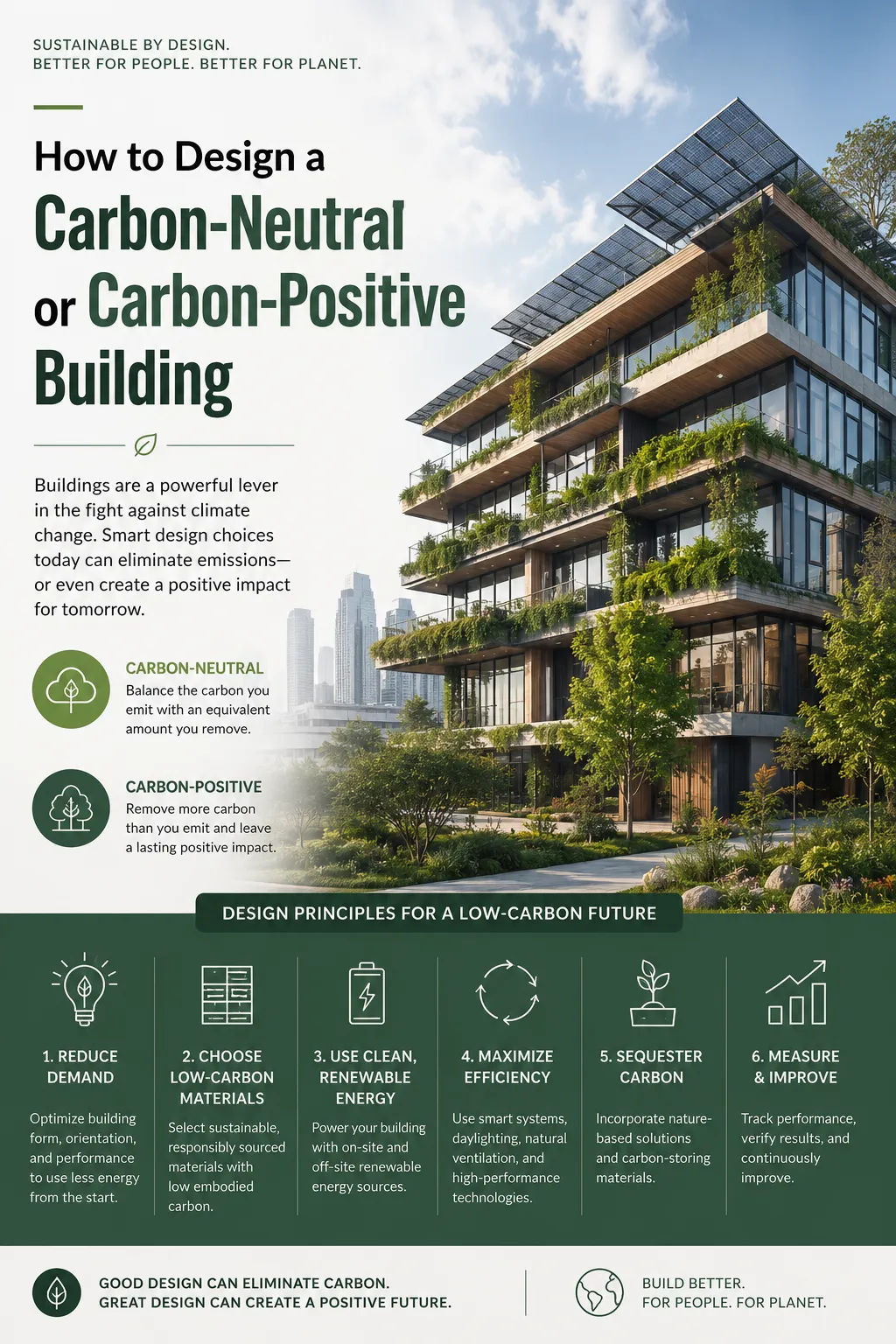
The global building sector contributes nearly 40% of energy-related CO₂ emissions, making architecture one of the largest opportunities for climate mitigation. Modern sustainable design is no longer limited to reducing operational energy; today’s high-performance buildings must minimize whole-life carbon, including embodied emissions from construction materials and operational emissions throughout the building’s lifecycle. Research from MIT, OECD, and the World Business Council for Sustainable Development (WBCSD) consistently shows that reducing both forms of carbon is essential for achieving genuine carbon neutrality.
| Design Stage | Primary Objective | Key Strategies | Impact | Example Technologies / Materials |
|---|---|---|---|---|
| 1. Whole-Life Carbon Assessment (WLCA) | Quantify total lifecycle emissions | Assess embodied, operational, maintenance, and end-of-life carbon | Enables data-driven decision-making and identifies major emission sources before construction | One Click LCA, EC3, Life Cycle Assessment (LCA) tools |
| 2. Low-Carbon Material Selection | Reduce embodied carbon | Use recycled steel, low-carbon concrete, mass timber, bamboo, reclaimed materials, local sourcing | Can reduce embodied carbon by 20–50%, depending on material substitution | Cross-Laminated Timber (CLT), Glulam, SCM concrete, recycled steel |
| 3. Passive Building Design | Minimize energy demand | Optimize orientation, insulation, airtightness, daylighting, natural ventilation, shading | Reduces heating and cooling loads by 40–90% compared to conventional buildings | Triple-glazed windows, insulated envelope, thermal mass, MVHR systems |
| 4. Building Electrification | Eliminate fossil fuel dependence | Replace gas systems with electric heat pumps, induction cooking, electric water heating | Enables near-zero operational emissions as electricity grids become cleaner | Air-source heat pumps, geothermal heat pumps, smart HVAC systems |
| 5. Renewable Energy Integration | Offset operational energy consumption | Install rooftop solar PV, BIPV, battery storage, solar thermal systems | Achieves Net-Zero or Net-Positive energy performance | Solar PV, lithium-ion batteries, Building Integrated Photovoltaics (BIPV) |
| 6. Circular Construction | Reduce future embodied emissions | Modular construction, design for disassembly, reusable and recyclable components | Extends material lifespan and minimizes demolition waste | Prefabricated modules, recyclable steel, reusable façade systems |
| 7. Residual Carbon Offset | Neutralize unavoidable emissions | Purchase verified carbon credits only after maximum emission reductions | Addresses emissions that cannot currently be eliminated | Gold Standard, Verra (VCS), nature-based carbon offset projects |
| 8. Continuous Performance Monitoring | Maintain long-term efficiency | Smart meters, IoT sensors, Building Management Systems (BMS), predictive maintenance | Ensures buildings operate as designed and prevents energy performance gaps | Smart BMS, AI-based energy analytics, occupancy sensors |
Comparative Overview
| Parameter | Conventional Building | Carbon-Neutral Building | Carbon-Positive Building |
|---|---|---|---|
| Embodied Carbon | High | Minimized | Minimized + Offset |
| Operational Energy | Fossil Fuel Dependent | Net-Zero | Net-Positive |
| Renewable Energy Production | Minimal | Matches Annual Demand | Exceeds Annual Demand |
| Carbon Emissions | Positive | Approximately Zero | Net Negative |
| Grid Interaction | High Energy Consumer | Balanced Import/Export | Exports Surplus Clean Energy |
| Long-Term Environmental Impact | High | Neutral | Regenerative |
Real-World Example: Kāpiti House (New Zealand)
| Feature | Implementation | Outcome |
|---|---|---|
| Passive Design | Solar orientation, natural ventilation, insulated envelope | Significant reduction in heating and cooling demand |
| Renewable Energy | Rooftop solar photovoltaic system | Generates more electricity than annual consumption |
| Building Systems | Fully electrified services | Zero fossil fuel dependency |
| Materials | Locally sourced, low-carbon construction materials | Reduced embodied carbon footprint |
| Water Management | Rainwater harvesting and efficient water systems | Reduced environmental resource consumption |
| Overall Performance | Carbon-positive residential building | Produces surplus renewable energy while minimizing lifecycle emissions |
1. Begin with Whole-Life Carbon Assessment (WLCA)
A carbon-neutral building starts with measuring every source of emissions before construction begins.
Whole-Life Carbon Assessment evaluates:
- Embodied carbon from material extraction, manufacturing, transportation, and construction.
- Operational carbon from heating, cooling, lighting, appliances, and maintenance.
- End-of-life emissions from demolition, recycling, or reuse.
According to the OECD, whole-life carbon accounting is rapidly becoming the global benchmark for zero-carbon buildings because operational emissions alone no longer represent the complete environmental footprint.
Reference:
- https://www.oecd.org/en/publications/zero-carbon-buildings-in-cities_daae8779-en.html
- https://www.wbcsd.org/resources/net-zero-buildings-where-do-we-stand/
2. Reduce Embodied Carbon Before Reducing Operational Carbon
Embodied carbon is released immediately during construction and cannot be recovered later.
Priority strategies include:
- Recycled structural steel
- Low-carbon concrete mixes
- Engineered timber (CLT and Glulam)
- Bamboo
- Reclaimed brick
- Locally sourced materials
- Modular prefabrication
WBCSD reports that approximately 50% of a modern building’s total lifetime emissions may originate from embodied carbon, while only six material categories often contribute nearly 70% of construction-related emissions.
Reference:
3. Design the Building Envelope Before Installing Renewable Energy
Energy efficiency should always precede solar panels.
Key passive design strategies include:
- High-performance insulation
- Airtight construction
- Triple-glazed windows
- Passive solar orientation
- Natural daylight optimization
- External shading
- Heat recovery ventilation (MVHR)
The Passivhaus methodology demonstrates that reducing energy demand first significantly lowers lifetime carbon emissions while improving occupant comfort.
Reference:
- https://www.passivhaustrust.org.uk/competitions_and_campaigns/passivhaus-embodied-carbon/
- https://doi.org/10.1177/01436244251317000
4. Electrify Every Building System
Carbon-neutral buildings eliminate fossil fuel dependence.
Recommended systems include:
- Heat pumps
- Induction cooking
- Electric water heating
- Smart HVAC controls
- Battery storage
- Demand-response energy management
As electricity grids continue decarbonizing, operational emissions decline substantially, making electrification one of the most effective long-term carbon reduction strategies.
5. Generate More Renewable Energy Than the Building Consumes
A carbon-positive building exports more clean energy than it imports.
Typical renewable systems include:
- Rooftop solar PV
- Building-integrated photovoltaics (BIPV)
- Small wind systems (where appropriate)
- Solar thermal systems
- Battery storage
Recent monitored case studies show properly designed net-zero homes exporting 3–37 times more electricity than they import, effectively offsetting operational emissions within a few years.
6. Design for Circular Construction
Future-ready buildings minimize waste throughout their lifecycle.
Best practices include:
- Modular construction
- Design for disassembly
- Material reuse
- Recyclable components
- Adaptable interior layouts
- Long-life structural systems
Circular construction significantly reduces future embodied emissions by extending material lifespans.
7. Offset Only Residual Carbon
Carbon offsets should never replace emission reduction.
Offset only emissions that cannot currently be eliminated, such as:
- Specialized construction activities
- Certain industrial materials
- Transportation limitations
Leading sustainability frameworks recommend prioritizing direct emission reductions before purchasing verified carbon credits.