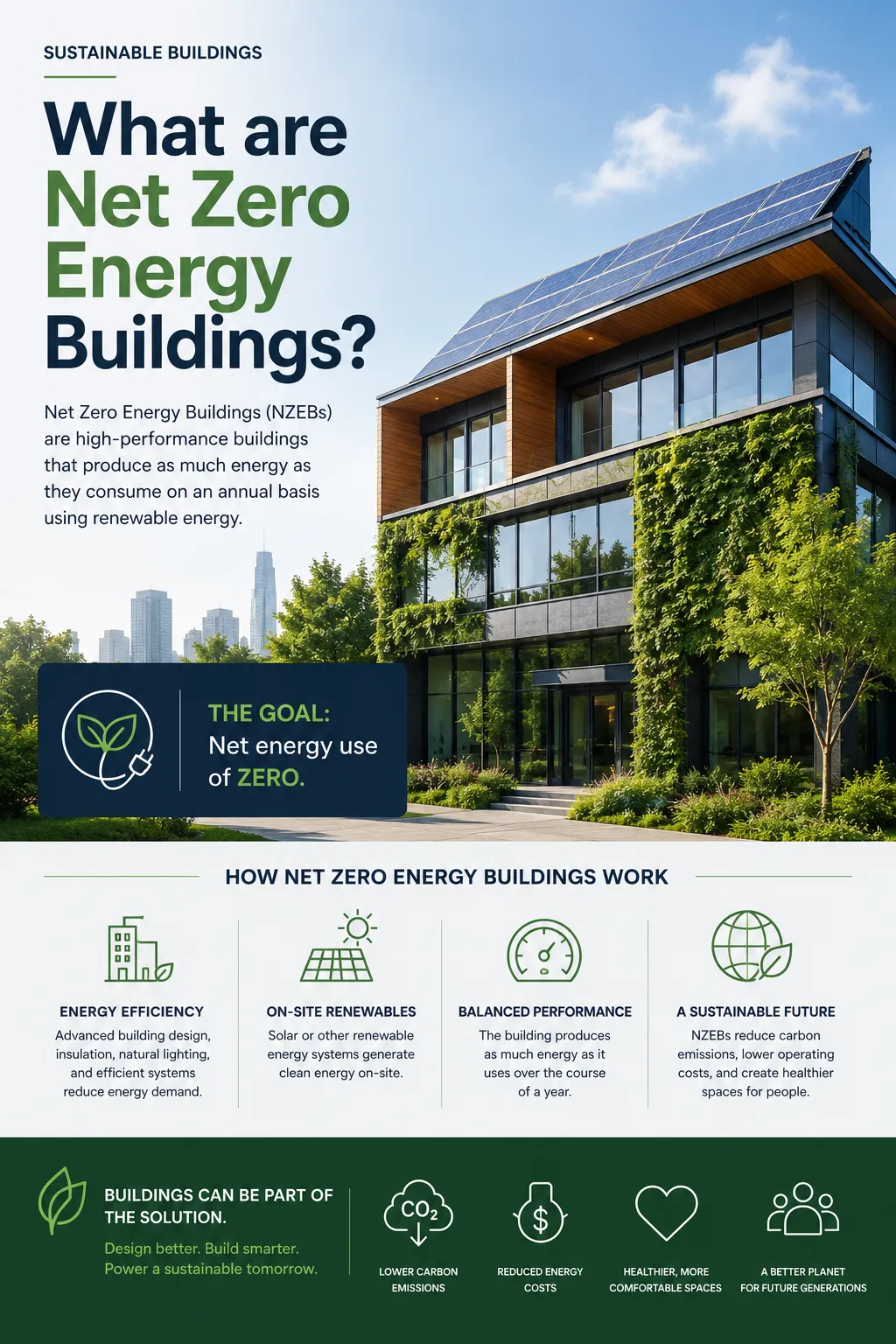
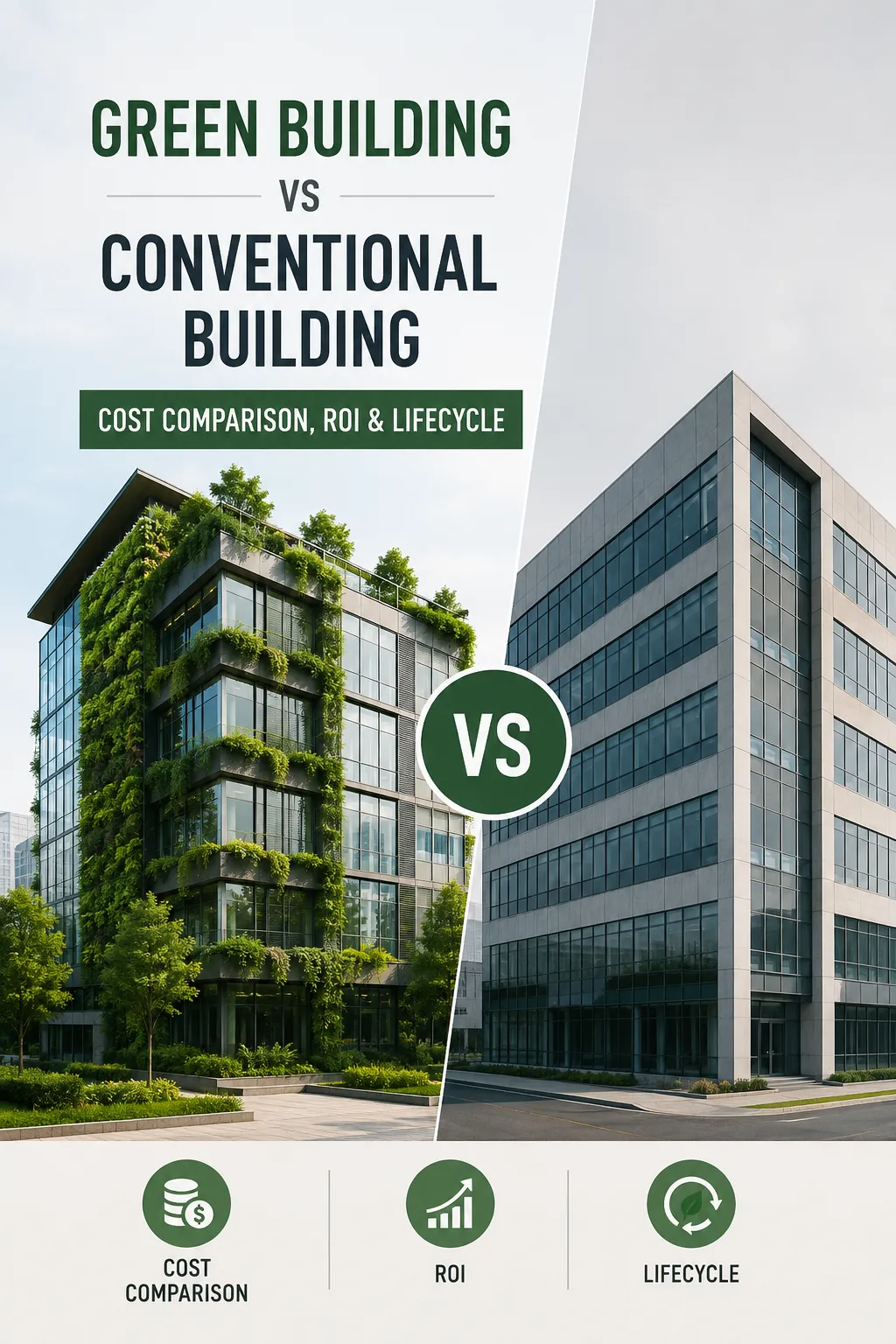
The idea that green buildings are more expensive than conventional buildings has become outdated. Modern research suggest that a sustainable buildings require a modest upfront investment, the total lifecycle cost (LCC) is often substantially lower due to reduced energy, water, maintenance, and operational expenses.
This article studies the construction cost differences, lifecycle economics, and real-world examples using internationally recognized research.
Summary: Green Building vs Conventional Building Cost Comparison
| Comparison Parameter | Conventional Building | Green Building | Key Insight |
|---|---|---|---|
| Initial Construction Cost | Baseline | Typically 0–10% higher | Small upfront premium depending on project scope and certification level |
| Construction Cost (Example) | $7.50 Million | $7.95 Million | Additional investment of $450,000 (6%) |
| Annual Energy Cost | $300,000 | $195,000 | Approximately 35% lower energy expenses |
| Annual Maintenance Cost | $90,000 | $67,500 | Around 25% lower maintenance costs |
| Annual Operating Savings | — | $127,500 | Combined savings from energy and maintenance |
| Payback Period | N/A | ~3.5-6 Years | Initial cost premium recovered through operational savings |
| Water Consumption | Standard usage | 20–50% lower | Lower utility costs and improved resource efficiency |
| Energy Consumption | Higher | 20–40% lower | Reduced operational expenditure and carbon emissions |
| Lifecycle Cost (30+ Years) | Higher | Lower | Green buildings generally provide better long-term financial returns |
| Equipment Replacement | More frequent | Less frequent | Durable systems reduce replacement costs |
| Indoor Environmental Quality | Standard | Enhanced | Better ventilation, lighting, and occupant comfort can improve productivity |
| Property Value | Standard appreciation | Higher market value | Sustainable buildings often command premium rental and resale values |
| Environmental Impact | Higher carbon footprint | Lower carbon footprint | Supports sustainability goals and regulatory compliance |
| Return on Investment (ROI) | Limited operational savings | Higher long-term ROI | Operational savings typically outweigh the initial premium |
| Best Financial Metric | Initial construction cost | Lifecycle Cost (LCC) | Total cost of ownership provides the most accurate investment comparison |
1. Initial Construction Cost: Green vs Conventional Building
The studies indicate that the construction cost premium for green buildings generally falls between 0% and 10%, although certain high-performance projects can exceed this depending on certification level and technology selection. A comprehensive literature review found that over 90% of documented green building cost premiums ranged from -0.4% to 21%, highlighting that many projects achieve sustainability with little or no additional construction cost.
Typical Cost Comparison
| Parameter | Conventional Building | Green Building |
|---|---|---|
| Initial Construction Cost | Baseline | 0–10% Higher (typical) |
| Energy Consumption | High | 20–40% Lower |
| Water Consumption | Standard | 20–50% Lower |
| Maintenance Cost | Higher | Lower over lifecycle |
| Lifecycle Cost | Higher | Lower |
2. Why Green Buildings May Cost More Initially
The incremental cost primarily originates from performance-oriented components, not from the entire building.
These include:
- High-performance building envelope
- Efficient HVAC systems
- Low-E glazing
- Solar photovoltaic integration
- Rainwater harvesting
- Water-efficient fixtures
- Building automation systems
- Sustainable materials
- Commissioning and certification processes
However, integrated design practices increasingly offset many of these additional costs by optimizing building systems. The World Green Building Council reports that sustainable buildings can often be delivered at costs comparable to conventional buildings while generating measurable operational savings.
3. Lifecycle Cost Is the Real Financial Metric
Construction cost represents only a fraction of a building’s total expenditure.
According to the U.S. National Institute of Standards and Technology (NIST), Life Cycle Cost Analysis (LCCA) provides a more accurate investment evaluation because it includes:
- Initial capital cost
- Energy consumption
- Water consumption
- Maintenance
- Repairs
- Equipment replacement
- Operating expenses
- Residual asset value
Buildings designed using lifecycle costing frequently outperform lower-cost conventional buildings in long-term financial returns.
4. Example (USD)
Commercial Office Building Example
Project Size: 100,000 sq. ft.
Conventional Building
- Construction Cost: $7.50 Million
- Annual Energy Cost: $300,000
- Annual Maintenance Cost: $90,000
Green Building
- Construction Cost: $7.95 Million
- Additional Initial Investment: $450,000 (6% Premium)
- Annual Energy Cost: $195,000
- Annual Maintenance Cost: $67,500
Annual Cost Savings
| Cost Component | Conventional | Green Building | Annual Savings |
|---|---|---|---|
| Energy | $300,000 | $195,000 | $105,000 |
| Maintenance | $90,000 | $67,500 | $22,500 |
| Total Annual Savings | — | — | $127,500 |
5. Cost Comparison Over a 30-Year Lifecycle
| Cost Component | Conventional | Green Building |
|---|---|---|
| Construction | $7.50 Million | $7.95 Million |
| Energy | High | Significantly Lower |
| Water | Higher | Lower |
| Maintenance | Higher | Lower |
| Replacement Cost | Higher | Lower |
| Total Lifecycle Cost | Highest | Lowest |
Research consistently shows that operational savings generally recover any reasonable upfront premium within a practical payback period.
6. Market Evidence
Global empirical evidence shows several consistent trends:
- Initial green cost premiums continue to decline.
- Integrated project delivery reduces additional costs.
- Higher certification levels increase upfront investment but also improve operational performance.
- Buildings emphasizing passive design often achieve significant efficiency without substantial cost increases.
- Lifecycle savings typically outweigh construction premiums.
7. Factors That Influence Green Building Cost
Construction cost varies according to:
- Building type
- Geographic location
- Local material availability
- Certification target (LEED, IGBC, GRIHA, BREEAM)
- Energy efficiency goals
- Renewable energy integration
- Project scale
- Design optimization.
Conclusion
| Aspect | Conclusion |
|---|---|
| Upfront Investment | Green buildings require a modest additional investment, typically between 0% and 10%. |
| Operational Performance | Green buildings significantly reduce energy, water, and maintenance costs throughout their lifespan. |
| Financial Outcome | Lower operating expenses offset the initial premium within a relatively short payback period, resulting in superior long-term economic performance. |
| Investment Decision | For projects intended to operate over several decades, green buildings generally provide greater lifecycle value, stronger return on investment, and improved asset resilience compared with conventional buildings. |