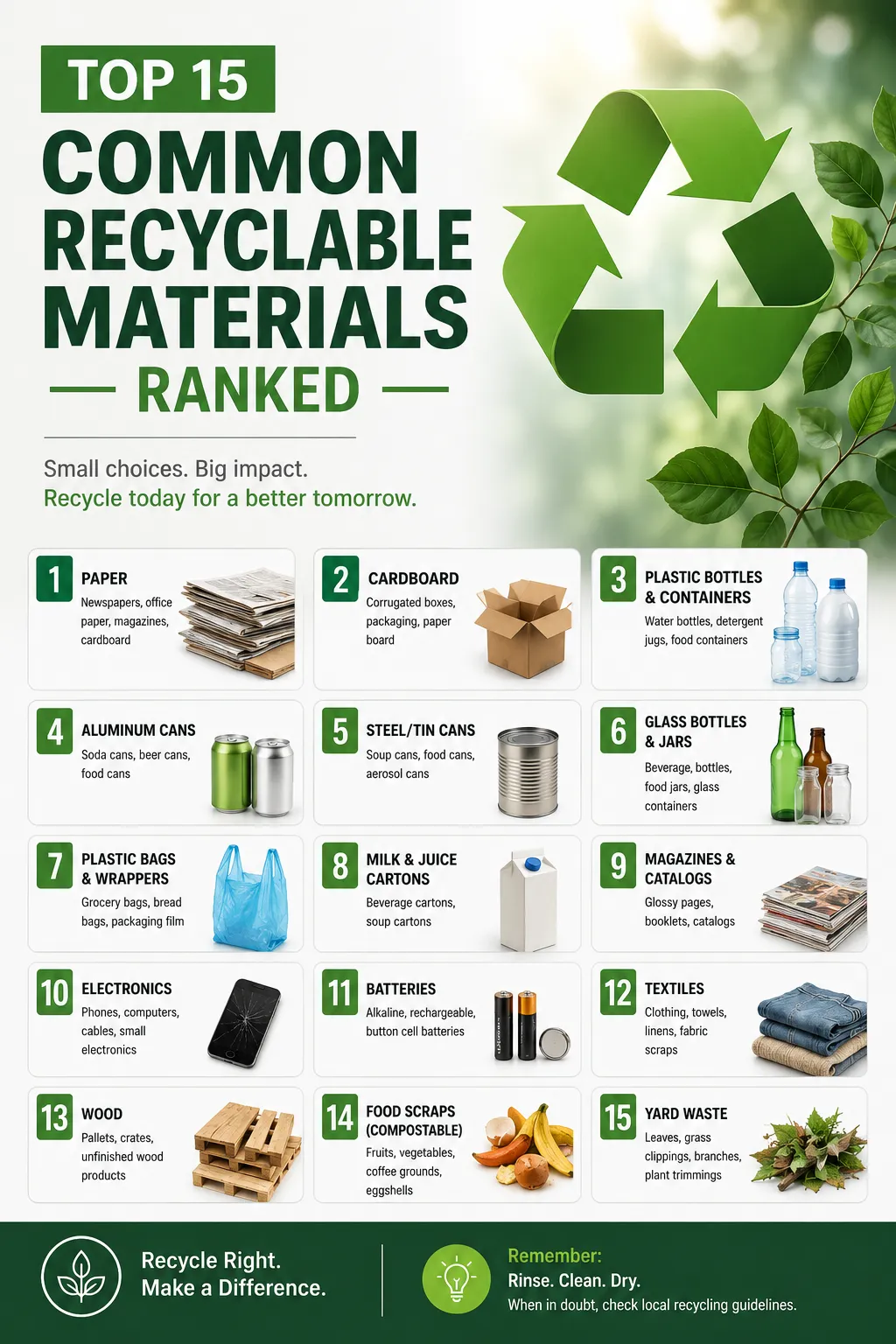
| Rank | Material | Recycling Cost | Skill Required | Space Required | Processing Time | Practicality | Overall Difficulty |
|---|
| 1 | Aluminum | Very Low | Very Low | Very Low | Very Fast | Excellent | ⭐ Very Easy |
| 2 | Steel | Very Low | Very Low | Low | Fast | Excellent | ⭐ Very Easy |
| 3 | Copper | Low | Low | Low | Fast | Excellent | Very Easy |
| 4 | Cardboard | Low | Low | Low | Moderate | Excellent | Easy |
| 5 | Office Paper | Low | Low | Low | Moderate | Excellent | Easy |
| 6 | Glass Bottles & Jars | Moderate | Low | High | Moderate | High | Moderate |
| 7 | HDPE Plastic (#2) | Moderate | Moderate | Moderate | Moderate | High | Moderate |
| 8 | PET Plastic (#1) | Moderate | Moderate | Moderate | Moderate | High | Moderate |
| 9 | Textiles (Cotton) | Moderate | Moderate | High | Slow | Moderate | Moderate |
| 10 | Natural Wood | Moderate | Moderate | High | Slow | Moderate | Moderately Difficult |
| 11 | Electronic Waste (E-waste) | High | High | Moderate | Slow | Moderate | Difficult |
| 12 | Rubber Tires | High | High | High | Slow | Moderate | Difficult |
| 13 | Mixed Plastics (#3–#7) | High | High | Moderate | Slow | Low | Very Difficult |
| 14 | Composite Packaging (Tetra Pak, Laminates) | Very High | Very High | Moderate | Slow | Low | Extremely Difficult |
| 15 | Thermoset Plastics & Fiberglass | Extremely High | Specialized | High | Very Slow | Very Low | Hardest to Recycle |
1. Aluminum
Difficulty Score: 1/10
Aluminum is the global benchmark for recyclable materials. It can be recycled indefinitely without losing strength or purity while requiring approximately 95% less energy than producing primary aluminum. High scrap value also makes collection economically attractive.
2. Steel
Difficulty Score: 1.5/10
Steel benefits from inexpensive magnetic separation and can be recycled repeatedly without degrading material quality. It dominates automotive, appliance, and construction recycling streams.
3. Copper
Difficulty Score: 2/10
Copper is among the most valuable scrap recyclable Materials and can be recycled almost indefinitely with minimal quality loss. The primary challenge is separating insulated wiring from other materials.
Analysis
- Cost: ★★★★☆
- Skill: ★★★★☆
- Space: ★★★★★
- Time: ★★★★☆
- Practicality: ★★★★★
4. Cardboard
Difficulty Score: 2.5/10
Flattened cardboard is inexpensive to transport and widely accepted by recycling facilities. Clean corrugated boxes are among the highest-volume recyclable materials.
5. Office Paper
Difficulty Score: 3/10
Paper recycling is mature and efficient but fibers shorten after repeated recycling, limiting reuse cycles.
6. Glass
Difficulty Score: 4/10
Glass is infinitely recyclable but heavy, fragile, and expensive to transport. Color sorting is often required to maintain product quality.
7. HDPE Plastic
Difficulty Score: 5/10
Commonly used for detergent bottles, milk jugs, and containers, HDPE has one of the highest recycling rates among plastics due to its chemical stability.
8. PET Plastic
Difficulty Score: 5.5/10
PET beverage bottles are widely recycled but require intensive washing and contamination removal. Repeated recycling gradually reduces polymer quality.
9. Cotton Textiles
Difficulty Score: 6.5/10
Pure cotton fabrics can be mechanically recycled into insulation, industrial wipes, or regenerated fibers. Blended fabrics are significantly more difficult to process.
10. Natural Wood
Difficulty Score: 7/10
Untreated wood can be chipped into mulch, particleboard, or biomass fuel. Painted, treated, or chemically preserved wood is much harder to recycle safely.
11. Electronic Waste (E-waste)
Difficulty Score: 8/10
Electronic devices contain valuable metals such as gold, silver, palladium, and copper but require specialized dismantling, hazardous material handling, and advanced separation technologies.
12. Rubber Tires
Difficulty Score: 8.5/10
Tires are reinforced with steel, textiles, and synthetic rubber, making separation labor-intensive. Most recycled tires become crumb rubber, playground surfaces, or fuel.
13. Mixed Plastics
Difficulty Score: 9/10
Materials such as PVC, LDPE films, polypropylene, polystyrene, and miscellaneous plastics often require separate recycling streams. Mixed polymer contamination significantly reduces recycling efficiency.
14. Composite Packaging (Tetra Pak, Foil Laminates, Flexible Pouches)
Difficulty Score: 9.5/10
Composite packaging combines paper, plastic, and aluminum layers. These materials must be separated using specialized hydrapulping or chemical processes, which are available at relatively few facilities.
15. Thermoset Plastics & Fiberglass
Difficulty Score: 10/10
Thermoset plastics cannot be remelted after curing because their molecular structure forms permanent cross-linked bonds. Fiberglass composites used in boats, wind turbine blades, aircraft, and industrial equipment present similar challenges. Most end-of-life material is currently landfilled, downcycled, or processed using costly mechanical or chemical methods.
See also:
Embodied Carbon Ranking of Construction Materials (Highest to Lowest)