
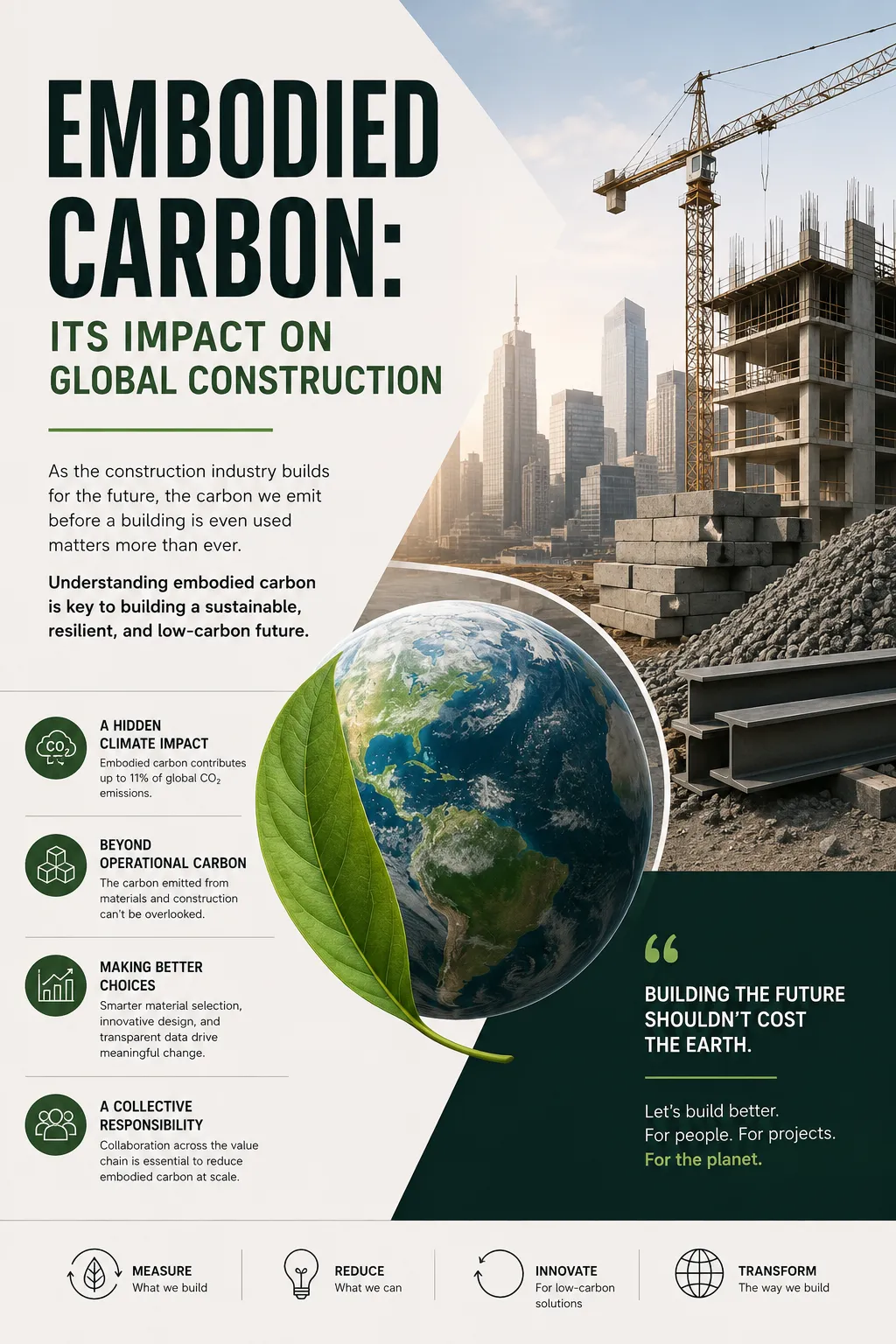
What is Embodied Carbon?
Embodied carbon refers to the total greenhouse gas (GHG) emissions generated throughout the lifecycle of building materials before and after a building becomes operational. It includes emissions from raw material extraction, manufacturing, transportation, construction, maintenance, replacement, demolition, and disposal.
1. Why Embodied Carbon Has Become a Critical Climate Metric
Operational carbon has historically dominated sustainability discussions. However, advances in building efficiency have shifted attention toward embodied emissions, which are released immediately during construction and cannot be recovered through future operational savings.
Key findings include:
- Buildings contribute approximately 39% of global energy-related carbon emissions.
- Around 11% originates directly from construction materials and building processes, representing embodied carbon.
- Operational emissions account for the remaining 28%.
Source:
https://worldgbc.org/climate-action/embodied-carbon/
2. Global Construction Demand is Increasing Carbon Pressure
The world’s building stock is projected to nearly double by 2060 due to rapid urbanization.
Implications:
- Higher demand for cement, steel, aluminum, and glass.
- Larger extraction of virgin raw materials.
- Significant increase in upfront carbon emissions.
- Greater pressure on achieving Paris Agreement targets.
According to the World Green Building Council, upfront embodied carbon could account for nearly 50% of all emissions from new construction between now and 2050.
3. Major Sources of Embodied Carbon
Life Cycle Assessment (LCA) consistently identifies the following contributors:
Cement
- Responsible for approximately 7–8% of global CO₂ emissions
- High emissions due to limestone calcination and kiln operations
Steel
- Large emissions from blast furnace production
- Represents one of the highest embodied carbon materials used in commercial buildings
Aluminum
- Extremely energy intensive during smelting
- Carbon intensity varies depending on electricity source
Glass
- High-temperature manufacturing significantly increases lifecycle emissions
Further reading:
- https://www.unep.org/resources/report/building-materials-and-climate-constructing-new-future
- https://www.ipcc.ch/report/ar6/wg3/chapter/chapter-9/
4. How to calculate embodied carbon emissions
Embodied carbon is in essence the carbon footprint of a material, or cumulatively, a building. To calculate these emissions, multiply the quantity of the material (e.g. steel or concrete) by its carbon factor – the amount of carbon released in the creation/production of the material up to this point.
5. The difference between embodied and operational emissions
While embodied carbon is the emissions produced by the construction of a building pre-operation, operational carbon is the emissions that then arise from its use and from things like heat, energy and lighting.
Operational carbon emissions account for 28% of greenhouse gases. However, thanks to new innovations and technological advancements, the amount of operational carbon emissions produced by buildings has decreased, meaning much of the focus has moved to dealing with embodied emissions.
Reference: What is embodied carbon (and what can we do about it)?
Summary
| Aspect | Summary | Industry Significance |
|---|
| Definition | Embodied carbon refers to greenhouse gas emissions generated throughout the lifecycle of construction materials, from extraction to end-of-life. | Measures the true environmental impact of buildings beyond operational energy use. |
| Global Contribution | Buildings account for approximately 39% of global energy-related CO₂ emissions, with 11% attributed to embodied carbon and 28% to operational emissions. | Demonstrates the growing importance of reducing construction-related emissions. |
| Primary Emission Sources | Cement, steel, aluminum, glass, transportation, and on-site construction activities contribute the highest embodied carbon. | Material selection significantly influences a building’s total carbon footprint. |
| Major Carbon Contributor | Cement production alone contributes 7–8% of global CO₂ emissions due to clinker manufacturing and high-temperature kiln operations. | Low-carbon cement alternatives offer one of the largest emission reduction opportunities. |
See also:


One thought on “Embodied Carbon: Its Impact on Global Construction”