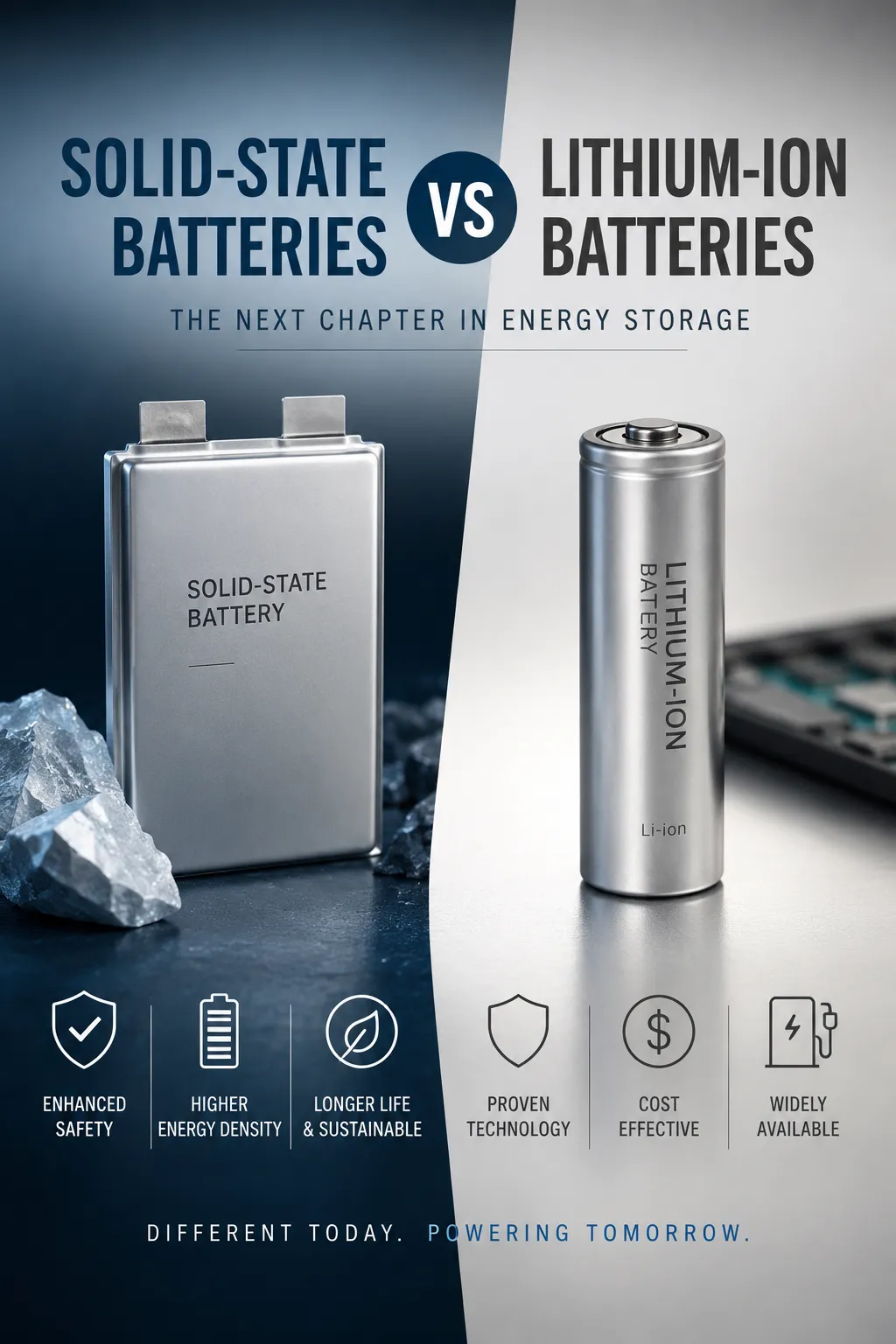
The rapid expansion of solar energy, wind power, and grid-scale battery storage has intensified the debate between solid-state batteries vs lithium-ion batteries. While lithium-ion technology currently dominates renewable energy storage due to its maturity and declining costs, solid-state batteries promise higher energy density, improved safety, and longer operational life.
The critical question is not which battery is technologically superior, but which delivers the best economic and operational value for renewable energy systems today and over the next decade.
According to the International Energy Agency (IEA), lithium-ion batteries account for virtually all new battery storage deployments, driven by dramatic cost reductions and manufacturing scale. Solid-state batteries remain an emerging technology with commercial potential but have not yet achieved mass-market deployment.
| Comparison Factor | Lithium-Ion Batteries | Solid-State Batteries | Conclusion |
|---|---|---|---|
| Technology | Uses liquid electrolyte for ion transport. | Uses solid electrolyte instead of liquid. | Solid-state is an advanced evolution but not yet widely commercialized. |
| Commercial Readiness | Fully commercial and globally deployed. | Mostly in pilot and early commercial stages. | Lithium-ion dominates current renewable energy storage. |
| Energy Density | 150–300 Wh/kg. | 250–500+ Wh/kg (prototype estimates). | Solid-state offers significantly higher storage capacity per unit weight. |
| Safety | Moderate; risk of thermal runaway due to flammable electrolyte. | Excellent; non-flammable electrolyte reduces fire risk. | Solid-state has a clear safety advantage. |
| Charging Speed | Fast charging with mature charging infrastructure. | Potentially faster due to improved ion conductivity (technology dependent). | Solid-state shows future potential but lacks large-scale validation. |
| Cycle Life | Typically 3,000–8,000 charge cycles depending on chemistry. | Expected to exceed lithium-ion with lower degradation. | Solid-state is projected to last longer but requires commercial proof. |
| Efficiency | High round-trip efficiency (90–95%). | Similar or potentially higher efficiency under development. | Both technologies are highly efficient for renewable energy storage. |
| Manufacturing Cost | Low due to established mass production and economies of scale. | High because of complex materials and manufacturing processes. | Lithium-ion is currently far more cost-effective. |
| Maintenance Requirements | Requires Battery Management Systems (BMS) and thermal management. | Lower thermal management needs due to improved stability. | Solid-state could reduce operational maintenance costs. |
| Renewable Energy Suitability | Proven for solar farms, wind farms, residential, and utility-scale storage. | Promising for future renewable energy applications but not yet mainstream. | Lithium-ion is the preferred technology today. |
| Grid Storage Performance | Excellent performance with mature deployment in Battery Energy Storage Systems (BESS). | Potentially better due to higher energy density and safety. | Lithium-ion remains the industry standard for grid-scale storage. |
| Environmental Impact | Recycling infrastructure is expanding, though mining remains a challenge. | Potentially reduced environmental impact through longer lifespan and safer materials. | Both technologies require sustainable supply chains and improved recycling. |
| Scalability | Highly scalable with global manufacturing capacity. | Limited scalability because production remains in early stages. | Lithium-ion is better suited for immediate large-scale deployment. |
| Market Adoption | Dominates over 95% of current battery energy storage installations. | Limited adoption, primarily in research, automotive, and pilot projects. | Lithium-ion has overwhelming market leadership. |
| Future Outlook | Expected to remain dominant through the late 2020s. | Strong long-term growth potential as manufacturing costs decline. | Solid-state is a future technology rather than a present replacement. |
| Best Use Cases | Grid storage, solar energy storage, wind farms, electric vehicles, residential backup systems. | Next-generation electric vehicles, aerospace, high-performance electronics, and future grid storage. | Technology selection depends on application maturity and cost. |
| Real-World Example | A 100 MW solar farm uses lithium-ion BESS for peak shaving and energy storage because of lower cost and proven reliability. | The same solar farm could eventually adopt solid-state batteries for higher energy density and enhanced safety once commercially viable. | Lithium-ion provides the best return on investment today, while solid-state represents a future upgrade path. |
| Overall Verdict | Best current choice for renewable energy storage due to affordability, scalability, and proven performance. | Most promising next-generation battery technology with superior safety and energy density, but commercialization is still evolving. | Lithium-ion wins in the present; solid-state is positioned as the long-term successor. |
1. Technology Overview
Lithium-Ion Batteries
Lithium-ion batteries use a liquid electrolyte that transports lithium ions between the anode and cathode during charging and discharging.
Common renewable energy chemistries include:
- Lithium Iron Phosphate (LFP)
- Nickel Manganese Cobalt (NMC)
Their major strengths include:
- Mature manufacturing
- High efficiency
- Competitive pricing
- Proven reliability
Solid-State Batteries
Solid-state batteries replace the liquid electrolyte with a solid electrolyte.
Potential advantages include:
- Higher energy density
- Improved thermal stability
- Reduced fire risk
- Potentially longer cycle life
However, commercial-scale manufacturing remains under development due to production complexity and cost challenges.
2. Analytical Comparison
| Parameter | Lithium-Ion Battery | Solid-State Battery |
|---|---|---|
| Commercial Availability | Excellent | Limited Pilot Scale |
| Energy Density | High | Very High |
| Safety | Moderate | Excellent |
| Fire Risk | Medium | Very Low |
| Manufacturing Cost | Low | High |
| Charging Speed | Fast | Potentially Faster |
| Cycle Life | High | Potentially Higher |
| Renewable Energy Deployment | Proven | Emerging |
3. Energy Density
Energy density determines how much electricity can be stored within a given weight or volume.
Typical values:
- Lithium-Ion: 150–300 Wh/kg
- Solid-State: 250–500+ Wh/kg (prototype range)
Higher energy density enables:
- Smaller battery banks
- Lower installation footprint
- Reduced transportation costs
- Greater storage capacity
This becomes particularly valuable for:
- Utility-scale solar farms
- Offshore wind storage
- Residential energy storage systems
However, current commercial lithium-ion batteries already provide sufficient density for most stationary renewable applications, reducing the immediate economic advantage of solid-state technology.
4. Safety Analysis
Battery safety remains one of the most important considerations for renewable energy installations.
Lithium-ion batteries:
- Use flammable liquid electrolytes
- Can experience thermal runaway
- Require sophisticated Battery Management Systems (BMS)
Solid-state batteries:
- Use non-flammable solid electrolytes
- Greatly reduce thermal runaway risk
- Improve system reliability in high-temperature environments
For utility-scale renewable projects, improved safety can significantly reduce long-term operational risk.
5. Cost Analysis
Cost remains the largest factor influencing renewable energy deployment.
The IEA reports lithium-ion battery prices have declined by nearly 90% since 2010, making them the dominant technology for energy storage worldwide.
Solid-state batteries currently face:
- Expensive raw materials
- Complex manufacturing
- Low production yields
- Limited economies of scale
Consequently, their installed cost remains significantly higher than conventional lithium-ion systems.
For today’s renewable energy projects, lithium-ion remains the economically superior choice.
6. Lifespan and Durability
Renewable energy systems require batteries capable of daily charge-discharge cycling over many years.
Lithium-ion batteries typically provide:
- 3,000–8,000 cycles (chemistry dependent)
Solid-state batteries are projected to achieve:
- Higher cycle life
- Reduced degradation
- Better long-term capacity retention
Although laboratory data are promising, long-term commercial validation is still ongoing.
7. Renewable Energy Integration
Renewable electricity generation is inherently intermittent.
Battery storage must efficiently manage:
- Solar generation peaks
- Wind variability
- Grid stabilization
- Peak demand shifting
Lithium-ion technology already satisfies these requirements at commercial scale.
According to the IEA, battery storage installations continue expanding rapidly, with lithium iron phosphate (LFP) batteries accounting for the overwhelming majority of new stationary deployments because of their lower cost and long cycle life.
Solid-state batteries may eventually enhance renewable systems by:
- Increasing storage capacity
- Improving operational safety
- Reducing maintenance requirements
8. Real-World Example
Example: Utility Solar Farm
A 100 MW solar farm generates excess electricity during daylight hours.
Lithium-Ion Storage
Advantages:
- Lower capital expenditure
- Proven commercial technology
- High operational efficiency
- Established maintenance practices
Result:
Widely deployed across utility-scale renewable projects.
Solid-State Storage
Potential future advantages:
- Smaller installation footprint
- Higher storage density
- Enhanced fire safety
- Longer operational lifespan
Current limitation:
High costs and limited manufacturing prevent widespread commercial adoption.
9. Market Outlook
Industry investment in solid-state batteries continues accelerating.
Major automotive and battery manufacturers are investing heavily in commercialization, but the IEA notes that solid-state batteries must still demonstrate large-scale manufacturing performance, durability, and cost competitiveness before replacing conventional lithium-ion batteries.
For the foreseeable future:
- Lithium-ion batteries will continue dominating renewable energy storage.
- Solid-state batteries are expected to enter premium and specialized applications first before broader grid adoption.
Final Verdict
From an analytical and economic perspective, lithium-ion batteries remain the best technology for renewable energy storage today. Their mature supply chains, declining costs, high efficiency, and proven reliability make them the preferred choice for solar farms, wind projects, residential storage, and utility-scale battery systems.
Solid-state batteries represent the future rather than the present. Their higher energy density, improved safety, and potential longevity could redefine renewable energy storage once manufacturing challenges and costs are substantially reduced.
For investors, developers, and energy planners, the evidence indicates a clear trajectory:
- Short to Medium Term (2026–2030): Lithium-Ion dominates.
- Long Term (2030+): Solid-State batteries could become a transformative technology if commercialization targets are achieved.
Reference:
- International Energy Agency (Battery Report): https://www.iea.org/reports/batteries-and-secure-energy-transitions
- IEA Global EV Outlook (Battery Technology): https://www.iea.org/reports/global-ev-outlook-2025/electric-vehicle-batteries
- U.S. Department of Energy – Office of Electricity: https://www.energy.gov/oe
- National Renewable Energy Laboratory (NREL): https://www.nrel.gov
- Nature Energy: https://www.nature.com/nenergy
- Applied Energy Journal: https://www.sciencedirect.com/journal/applied-energy
- Journal of Industrial Ecology: https://onlinelibrary.wiley.com/journal/15309290
- BIPV vs PV: Which Solar Technology Delivers Better Real-World Performance?