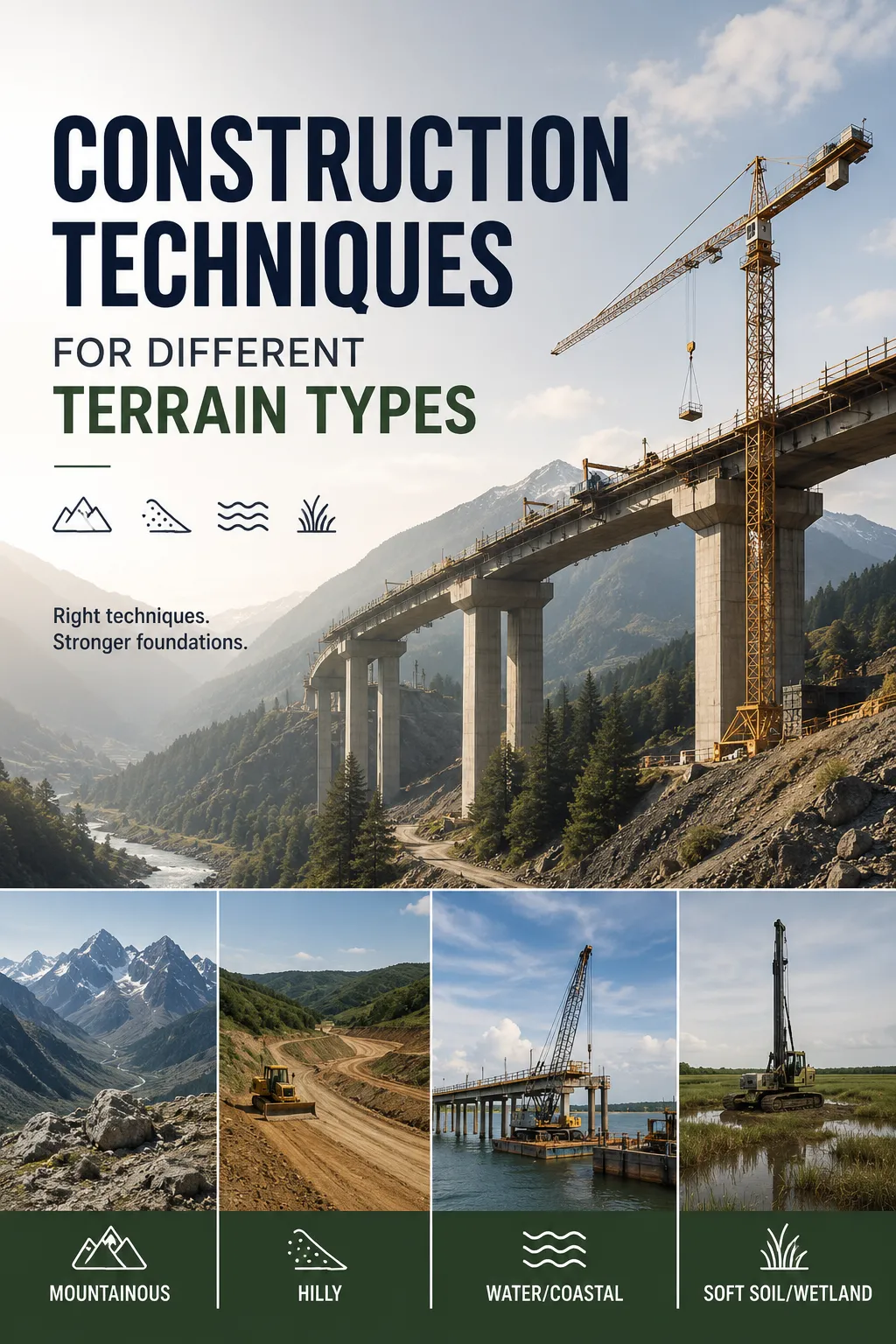
The construction technique is primarily governed by terrain characteristics, soil mechanics, groundwater conditions, seismicity, climate, and long-term structural performance. The terrain-specific design significantly reduces foundation failures, maintenance costs, and lifecycle risks. Modern civil engineering therefore classifies construction methodologies according to the site’s geographical and geological conditions
| Terrain Type | Typical Soil/Geological Condition | Major Engineering Challenges | Recommended Construction Techniques | Preferred Foundation Type | Real-World Example |
|---|---|---|---|---|---|
| Coastal (Sea Shore) | Marine clay, loose sand, high groundwater, saline environment | Corrosion, erosion, tidal forces, storm surge, liquefaction | Marine-grade RCC, deep piling, ground improvement (stone columns, vibro-compaction), seawalls, geotextiles | Deep Pile Foundation | Palm Jumeirah (Dubai), Mumbai Coastal Road |
| Mountain / Hilly Region | Rock strata, steep slopes, fractured soil | Landslides, rockfalls, seismic activity, difficult access | Terrace construction, retaining walls, soil nailing, rock anchoring, slope stabilization, drainage systems | Stepped Footing, Rock Anchored Foundation | Atal Tunnel (India), Himalayan Highway Projects |
| Plain / Flat Land | Alluvial soil, firm soil, mixed strata | Settlement, utility congestion, differential settlement | Conventional RCC framing, mechanized earthwork, strip footing, raft foundation | Isolated Footing, Strip Footing, Raft Foundation | Chandigarh, Delhi NCR Developments |
| Riverbank / Floodplain | Saturated alluvial soil, fluctuating groundwater | Flooding, bank erosion, scour, high water table | Elevated plinths, bored piles, riprap protection, gabions, flood-resilient drainage | Deep Bored Pile Foundation | Bogibeel Bridge (Assam), Ganga Bridge Projects |
| Desert Region | Loose sand, low moisture, wind-blown deposits | Wind erosion, sand movement, thermal expansion, water scarcity | Soil stabilization, compaction, wind-resistant structures, thermal insulation | Stabilized Shallow or Deep Foundation | NEOM (Saudi Arabia), Jaisalmer Infrastructure |
| Marshland / Wetland | Organic soil, peat, very soft clay | Low bearing capacity, excessive settlement, waterlogging | Pile foundations, floating raft, prefabricated vertical drains (PVD), surcharge preloading, geosynthetics | Deep Pile Foundation | Singapore Changi Airport Expansion, Netherlands Reclaimed Land |
| Black Cotton Soil Region | Expansive clay with high shrink-swell behavior | Seasonal swelling and shrinkage, foundation cracking | Under-reamed piles, moisture control, soil replacement, lime stabilization | Under-Reamed Pile Foundation | Central India (Madhya Pradesh, Maharashtra) |
| Seismic Zone | Varies by location | Earthquake-induced lateral forces, liquefaction | Base isolation, ductile RCC design, shear walls, seismic detailing | Raft or Pile Foundation (Site Dependent) | Bhuj Reconstruction (Gujarat), Japan Earthquake-Resistant Buildings |
| Snow-Bound / Cold Region | Frozen soil, frost-susceptible ground | Frost heave, freeze-thaw cycles, snow loads | Frost-protected shallow foundations, insulated slabs, deep foundations below frost line | Frost-Protected Foundation | Leh-Ladakh Infrastructure, Scandinavian Buildings |
| Reclaimed Land | Artificially filled soil, loose deposits | Long-term settlement, liquefaction, consolidation | Ground improvement, dynamic compaction, wick drains, deep soil mixing | Deep Pile Foundation | Kansai International Airport (Japan), Changi Airport (Singapore) |
1. Coastal (Sea Shore) Construction
Engineering Challenges
- High groundwater table
- Saline environment causing reinforcement corrosion
- Soft marine clay and loose sand
- Storm surge, tidal action, erosion, and liquefaction risks
Preferred Construction Techniques
- Deep pile foundations
- Marine-grade reinforced concrete
- Corrosion-resistant steel reinforcement
- Ground improvement through vibro-compaction and stone columns
- Coastal protection using seawalls, revetments, and geotextiles
Real-World Example
- Palm Jumeirah, Dubai (marine reclamation with extensive ground improvement)
- Mumbai Coastal Road Project, India
(Reference: https://technav.ieee.org/topic/geotechnical-engineering/, https://eurocodes.jrc.ec.europa.eu/publications/implementation-design-during-execution-service-life)
2. Mountain and Hill Construction
Engineering Challenges
- Steep slopes
- Landslides
- Rockfall hazards
- Seismic activity
- Limited equipment accessibility
Preferred Construction Techniques
- Step or terrace foundation systems
- Retaining walls
- Rock anchoring and soil nailing
- Gabion wall stabilization
- Controlled excavation and slope drainage
Real-World Example
- Atal Tunnel, Himachal Pradesh
- Himalayan highway developments under BRO
(Reference: https://standardsbis.bsbedge.com/BIS_Preview.aspx?id=14243_2_1995_Reff2020, https://infralens.in/code/IRC-SP-48-1998)
3. Plain (Flat Land) Construction
Engineering Challenges
- Variable bearing capacity
- Settlement of alluvial deposits
- Urban utility congestion
Preferred Construction Techniques
- Strip footing
- Isolated footing
- Raft foundation
- Conventional RCC framed construction
- Mechanized earthwork and mass concreting
Real-World Example
- Delhi NCR residential developments
- Chandigarh urban infrastructure
(Reference: https://technav.ieee.org/topic/geotechnical-engineering/, https://www.studiomatrx.org/guides/soil-bearing-capacity-india)
4. Riverbank and Floodplain Construction
Engineering Challenges
- Seasonal flooding
- Riverbank erosion
- Scour around foundations
- High groundwater fluctuations
Preferred Construction Techniques
- Deep bored piles
- Elevated plinth construction
- Riprap and gabion bank protection
- Flood-resilient drainage systems
- Scour-resistant bridge foundations
Real-World Example
- Bogibeel Bridge, Assam
- Ganga river bridge infrastructure
(Reference: https://trb.org/Publications/Blurbs/153713.aspx, https://technav.ieee.org/topic/geotechnical-structures/)
5. Desert Construction
Engineering Challenges
- Loose sand deposits
- Wind erosion
- High thermal variation
- Water scarcity
Preferred Construction Techniques
- Soil stabilization
- Deep compacted foundations
- Wind-resistant structural systems
- Ground densification
- Thermal insulation systems
Real-World Example
- NEOM infrastructure, Saudi Arabia
- Jaisalmer urban development
6. Marshland and Wetland Construction
Engineering Challenges
- Extremely soft soil
- Low bearing capacity
- Excessive settlement
- Organic soil decomposition
Preferred Construction Techniques
- Pile foundation
- Floating raft foundation
- Prefabricated Vertical Drains (PVD)
- Preloading and surcharge techniques
- Geosynthetic reinforcement
Real-World Example
- Singapore Changi Airport expansion
- Netherlands reclaimed land infrastructure
Quick Comparison
| Terrain | Construction Complexity | Relative Construction Cost | Primary Risk | Best Foundation Type |
|---|---|---|---|---|
| Coastal | Very High | Very High | Corrosion & Liquefaction | Deep Pile |
| Mountain | Very High | High | Landslides | Stepped / Rock Anchor |
| Plain | Low | Low | Settlement | Isolated / Raft |
| Riverbank | High | High | Flooding & Scour | Deep Bored Pile |
| Desert | Medium | Medium | Sand Erosion | Stabilized Foundation |
| Marshland | Very High | Very High | Differential Settlement | Deep Pile |
| Black Cotton Soil | High | Medium | Soil Expansion | Under-Reamed Pile |
| Seismic Zone | High | High | Earthquake Forces | Site-Specific Seismic Foundation |
| Snow Region | High | High | Frost Heave | Frost-Protected Foundation |
| Reclaimed Land | Very High | Very High | Consolidation & Liquefaction | Deep Pile |