
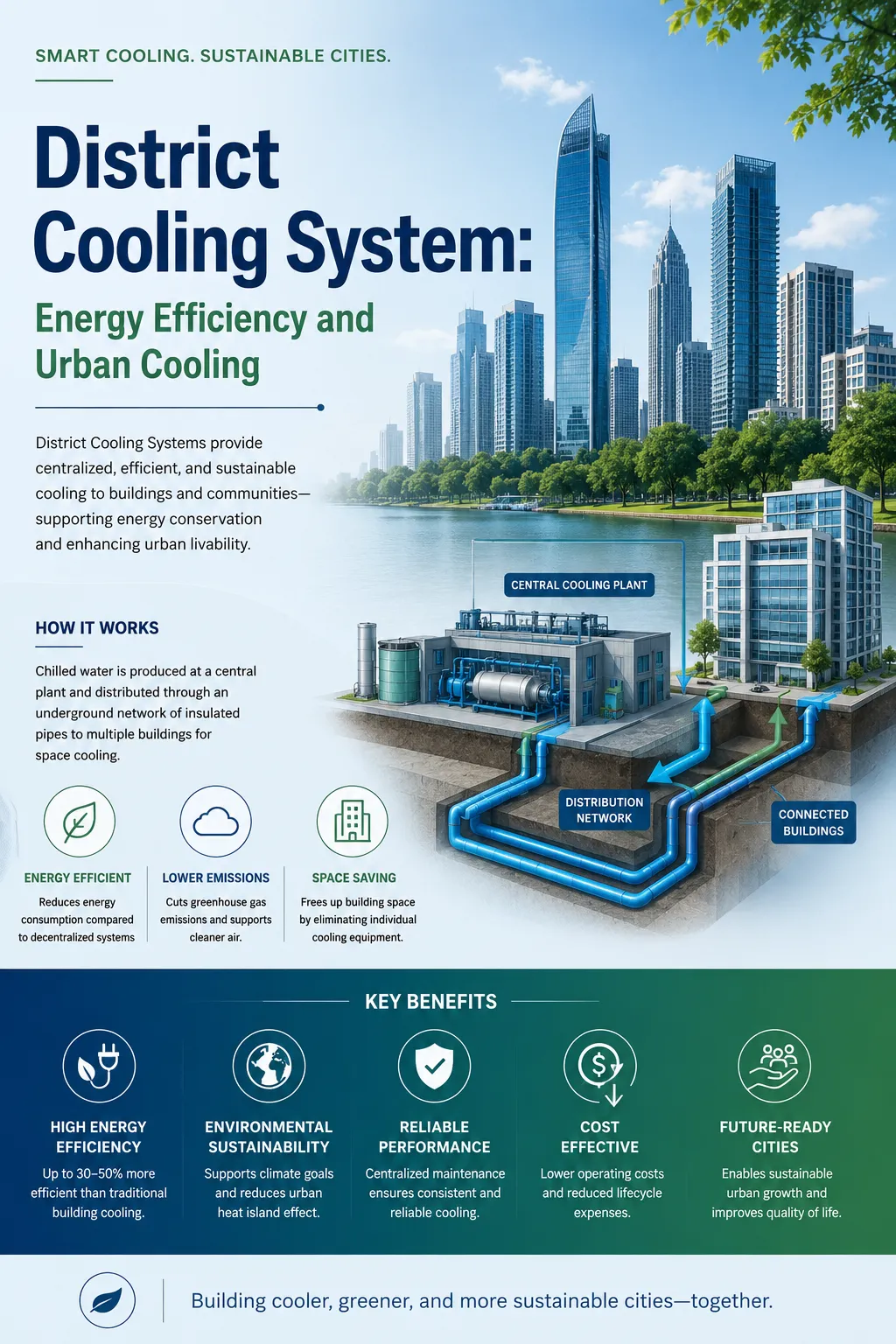
District Cooling System Overview: Centralized Cooling Infrastructure for Modern Cities
A district cooling system (DCS) is a centralized cooling network that produces chilled water at a central plant and distributes it through insulated underground pipelines to multiple buildings for air conditioning. Compared with conventional building-level cooling systems, district cooling reduces equipment duplication, improves operational efficiency, and supports large-scale urban decarbonization.
According to the International Energy Agency (IEA), cooling demand is one of the fastest-growing sources of electricity consumption globally, with air conditioning and cooling systems creating increasing pressure on power grids.
Source: https://www.iea.org/reports/the-future-of-cooling
Why District Cooling is Needed
- Room ACs contribute roughly:
- 40–60% of peak electricity load during hottest hours
Problem with traditional AC
- Higher peak electricity demand
- Increased greenhouse gas emissions
- More HFC refrigerant use
- Urban Heat Island (UHI) effect
District Cooling System (DCS) Key Specs
| Parameter | Specification / Target |
|---|---|
| Cooling approach | Centralised cooling plant + insulated chilled-water pipe network |
| Energy savings potential | Up to 50% lower electricity consumption vs conventional cooling |
| Cooling treated as | Utility/service model (“Cooling as a Service”) |
| Main infrastructure | Central chillers, pumps, chilled water network, thermal storage |
| Integration options | Waste heat recovery, treated wastewater cooling, thermal energy storage |
| Target applications | Airports, IT parks, SEZs, industrial zones, townships, campuses |
High-Potential Deployment Sites
Best locations have:
- Dense cooling demand
- Multiple buildings close together
- Mixed cooling schedules
- Large aggregated loads
Recommended threshold:
- >10,000 TR aggregated cooling load
Priority sectors:
- Airports & Transit-Oriented Developments
- Terminals
- Hotels
- Retail
- Offices
- IT Parks / FinTech Hubs / SEZs
- Example: GIFT City, Gandhinagar, Marina Bay Sand (Current Capacity 75,000 TR, planned, upto 130,000 TR)
- Planned DCS capacity: 180,000 TR
- Industrial Parks
- Process cooling
- Waste heat integration
- Large Mixed-Use Developments
- Townships
- Redevelopment zones
- Hospitals & Universities
- Stable year-round cooling loads
Financial barriers
- High upfront capital cost
- Long payback periods (10–15+ years)
Technical barriers
- Need integration into early urban planning
Refer: beeindia.gov.in
See Also: District Cooling System in Marina Bay Sands, Singapore


One thought on “District Cooling System: Energy Efficiency and Urban Cooling”