
Net Zero Energy Buildings: 10 Global Examples
Introduction The construction industry is rapidly evolving toward sustainability. Among the most groundbreaking achievements in this field are Net Zero Energy Buildings (NZEBs), which generate as much energy as they

Introduction
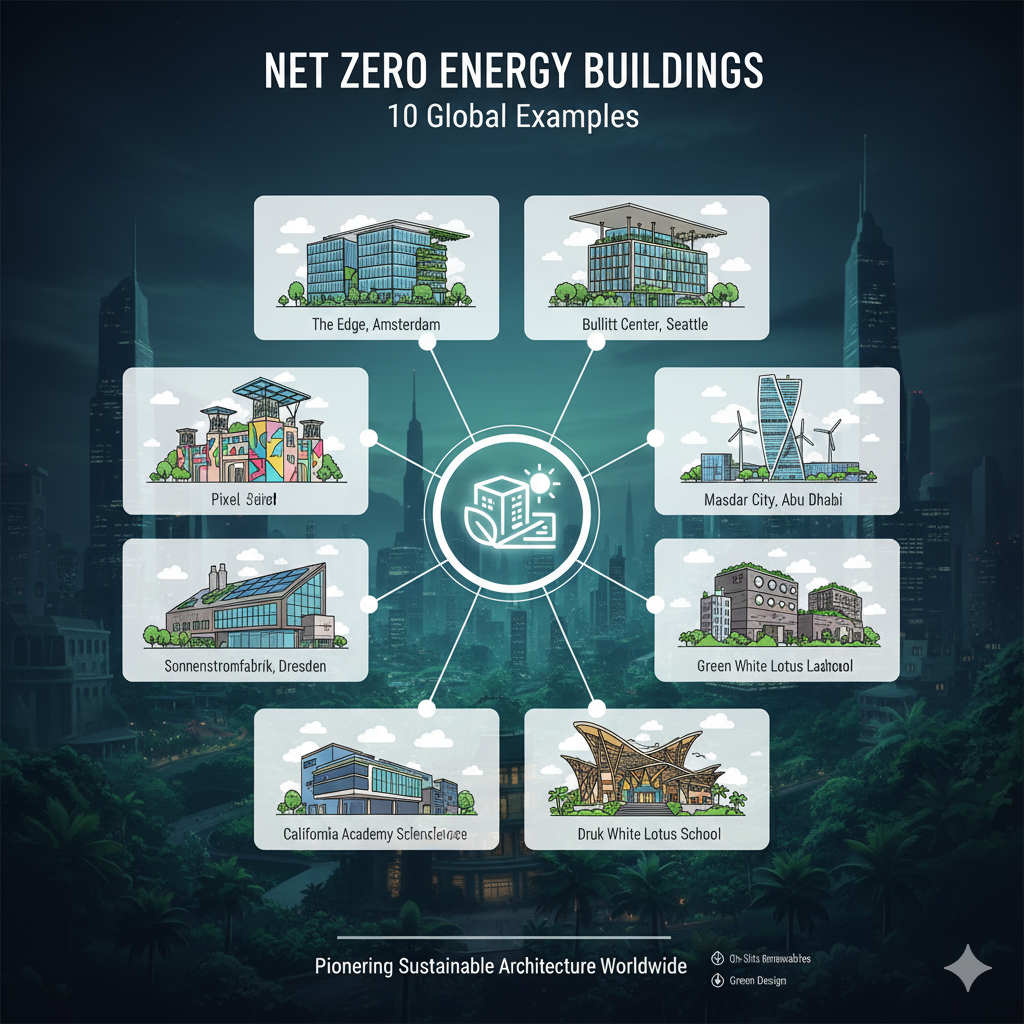
The construction industry is rapidly evolving toward sustainability. Among the most groundbreaking achievements in this field are Net Zero Energy Buildings (NZEBs), which generate as much energy as they consume annually, often through a combination of energy-efficient design and renewable energy sources. This essay examines ten notable NZEBs from around the world, highlighting their areas, costs, features, and significance.
1. Bullitt Center, Seattle, USA
Area: 52,000 sq ft (4,830 m²)
Cost: $32.5 million
Completed: 2013
Key Features:
Rooftop solar array producing 230,000 kWh/year
Rainwater harvesting and composting toilets
Designed for a 250-year lifespan
Significance: Known as the greenest commercial building globally, it meets the Living Building Challenge standards.
2. The Edge, Amsterdam, Netherlands
Area: 430,000 sq ft (40,000 m²)
Cost: Estimated $280 million
Completed: 2015
Key Features:
Solar panels covering the entire roof
Smart LED lighting connected via mobile apps
Rainwater reuse systems
Significance: Labeled the “smartest building in the world” with a BREEAM Outstanding rating of 98.36%.
3. SDE4 Building, National University of Singapore
Area: 86,000 sq ft (8,000 m²)
Cost: Estimated $50 million
Completed: 2019
Key Features:
Naturally ventilated spaces
1,200 solar panels generating about 500 MWh/year
High-performance façade for thermal control
Significance: Singapore’s first new-build net-zero energy building.
4. CIRS (Centre for Interactive Research on Sustainability), Vancouver, Canada
Area: 60,000 sq ft (5,574 m²)
Cost: $37 million
Completed: 2011
Key Features:
Energy-positive design
Solar panels and waste heat recovery
Wood structure from sustainably harvested forests
Significance: Supplies energy back to the university grid, beyond its own needs.
5. IKEA Greenwich Store, London, United Kingdom
Area: 344,445 sq ft (32,000 m²)
Cost: Estimated $125 million
Completed: 2019
Key Features:
1,000 solar panels
Rainwater harvesting
Geothermal heating system
Significance: IKEA’s most sustainable store globally, aiming for net-zero energy balance.
6. Discovery Elementary School, Arlington, USA
Area: 97,588 sq ft (9,068 m²)
Cost: $32.3 million
Completed: 2015
Key Features:
1,706 solar panels providing 500 kW
Geothermal HVAC system
Super-insulated building envelope
Significance: One of the largest net-zero energy schools in the U.S.
7. National Renewable Energy Laboratory (NREL) Research Support Facility, Colorado, USA
Area: 360,000 sq ft (33,445 m²)
Cost: $64 million
Completed: 2010
Key Features:
Massive daylight harvesting
Photovoltaic solar panels covering roofs and parking lots
Natural ventilation design
Significance: A benchmark for office building sustainability and performance.
8. Brock Environmental Center, Virginia Beach, USA
Area: 10,500 sq ft (975 m²)
Cost: $8.3 million
Completed: 2014
Key Features:
168 solar panels and 2 small wind turbines
Rainwater collection and treatment for potable use
Composting toilets
Significance: Certified under the Living Building Challenge for net-zero water and energy.
9. DPR Construction’s San Diego Office, USA
Area: 24,000 sq ft (2,230 m²)
Cost: $19 million (renovation)
Completed: 2010
Key Features:
Net-zero energy retrofit
Solar panels produce 100% of energy needs
Energy-efficient LED lighting and HVAC
Significance: First commercial building retrofit in San Diego to achieve net-zero energy.
10. Phipps Center for Sustainable Landscapes, Pittsburgh, USA
Area: 24,350 sq ft (2,263 m²)
Cost: $23.5 million
Completed: 2012
Key Features:
Solar, wind, and geothermal systems
Vertical gardens and green roofs
Natural treatment wetlands
Significance: First project worldwide to meet Living Building Challenge, LEED Platinum, and WELL Platinum certifications.