
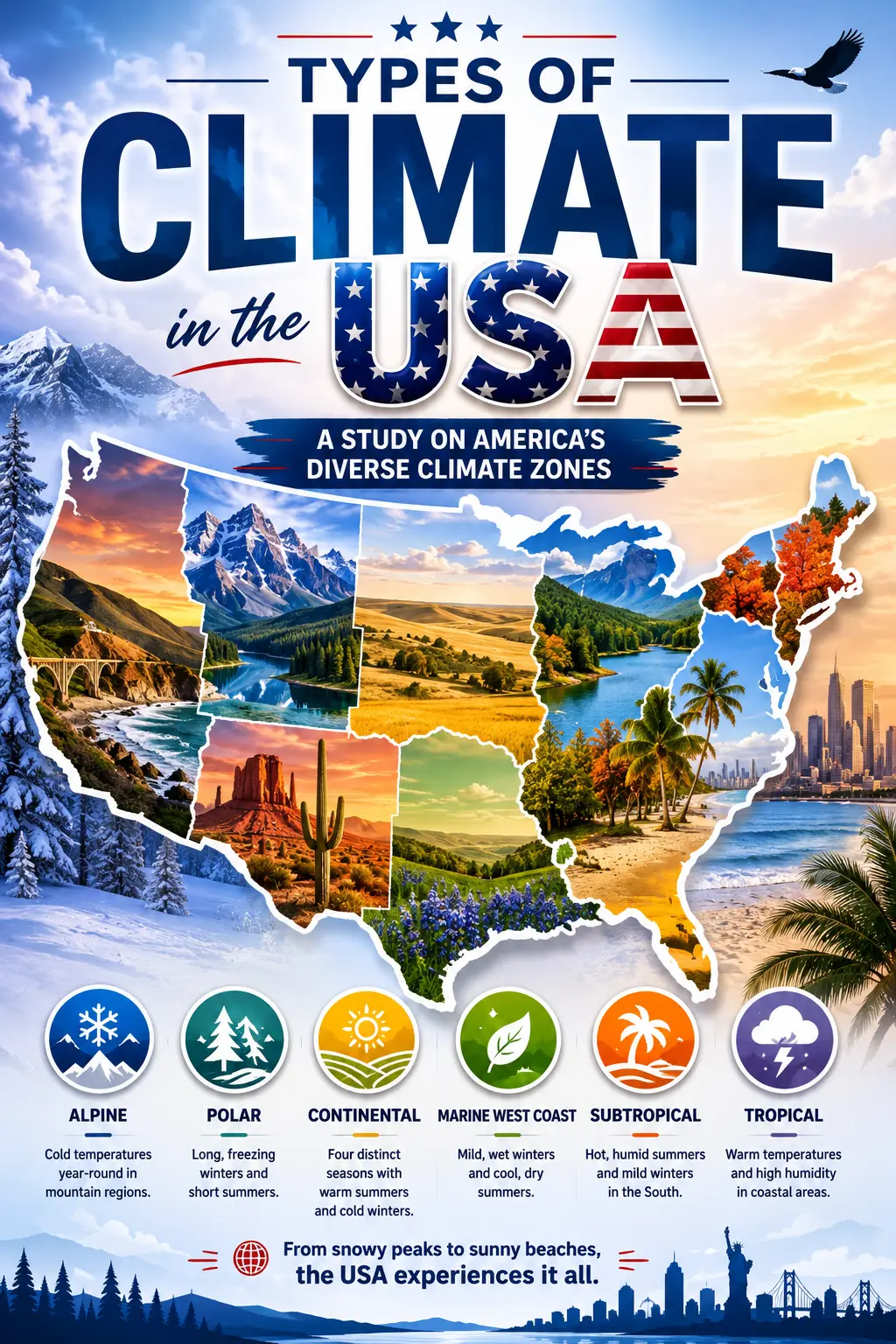
The United States has one of the most diverse climate systems in the world, ranging from frozen Arctic landscapes to humid tropical islands and dry desert regions. According to climate classification research from the National Oceanic and Atmospheric Administration (NOAA) — https://www.noaa.gov/climate, the wide variation in American climate patterns is mainly influenced by latitude, elevation, ocean currents, mountain barriers, and atmospheric circulation.
Based on the globally accepted Köppen Climate Classification System — https://www.britannica.com/science/Koppen-climate-classification, the USA contains nearly every major climate category found on Earth. This geographical diversity affects agriculture, biodiversity, population distribution, water resources, and economic activities.
1. Humid Continental Climate – Northeastern and Midwestern USA
• The humid continental climate is mainly found across the Northeast and Upper Midwest, including states such as New York, Michigan, Wisconsin, Minnesota, and North Dakota.
• Data from the U.S. Climate Normals by NOAA — https://www.ncei.noaa.gov/products/land-based-station/us-climate-normals shows that these regions experience large seasonal temperature differences, with hot summers and extremely cold winters.
• Cities such as Chicago and Minneapolis represent this climate type, where winter temperatures often drop below freezing due to cold continental air masses.
Key characteristics:
- Warm to hot summers
- Heavy snowfall during winter
- Strong seasonal temperature variation
- Mixed forests and agricultural landscapes
2. Humid Subtropical Climate – Southeastern United States
• The humid subtropical climate dominates the southeastern USA, covering areas like Florida, Georgia, Alabama, Mississippi, Louisiana, Texas, and the Carolinas.
• Research from the U.S. Environmental Protection Agency (EPA) climate indicators — https://www.epa.gov/climate-indicators highlights that this region experiences high humidity, long summers, and frequent rainfall.
• Cities including Atlanta, Houston, and New Orleans are major examples of this climate zone.
Key characteristics:
- Hot and humid summers
- Mild winters
- Frequent thunderstorms
- Long agricultural growing seasons
3. Desert Climate – Southwestern USA
• The desert climate occurs mainly in the American Southwest, including parts of Arizona, Nevada, California, New Mexico, and Utah.
• According to the U.S. Geological Survey (USGS) desert ecosystem research — https://www.usgs.gov, low annual rainfall and high evaporation rates define these landscapes.
• The Mojave Desert and Sonoran Desert are prime examples, with cities like Phoenix and Las Vegas experiencing extreme summer temperatures.
Key characteristics:
- Very low precipitation
- Extremely hot summers
- Large day-night temperature differences
- Drought-resistant vegetation
4. Mediterranean Climate – Coastal California
• A rare but economically important climate type in the USA is the Mediterranean climate, mainly located along coastal California.
• Climate analysis from the California Climate Change Assessment — https://www.climateassessment.ca.gov identifies this zone by dry summers and wet winters.
• Major locations such as Los Angeles, San Diego, and San Francisco Bay Area fall under Mediterranean climate influence.
Key characteristics:
- Dry, warm summers
- Mild rainy winters
- Ideal conditions for vineyards and specialty crops
- High wildfire sensitivity during dry seasons
5. Marine West Coast Climate – Pacific Northwest
• The marine west coast climate is found mainly in Washington and Oregon, especially along coastal regions.
• Data from the University Corporation for Atmospheric Research climate resources — https://scied.ucar.edu/learning-zone/climate explains that nearby oceans moderate temperatures and increase precipitation.
• Cities such as Seattle and Portland experience this climate pattern.
Key characteristics:
- Cool summers
- Mild winters
- Frequent rainfall
- Dense temperate forests
6. Tropical Climate – Hawaii and Southern Florida
• The USA also contains tropical climates, primarily found in Hawaii and parts of southern Florida.
• According to climate observations from NOAA Climate.gov — https://www.climate.gov, these areas maintain warm temperatures throughout the year due to their low latitude.
• Tropical climate supports unique ecosystems, including coral reefs, tropical forests, and diverse wildlife habitats.
Key characteristics:
- Year-round warmth
- High humidity
- Distinct wet and dry seasons
- Rich biodiversity
7. Arctic and Subarctic Climate – Alaska
• The coldest climate zones in the United States occur in Alaska, where Arctic and subarctic conditions dominate.
• Research from the National Snow and Ice Data Center — https://nsidc.org shows that these regions are strongly affected by snow cover, sea ice, and polar temperature patterns.
• Interior Alaska experiences extremely cold winters, while northern Alaska has tundra landscapes.
Key characteristics:
- Long freezing winters
- Short cool summers
- Permafrost regions
- Arctic vegetation systems
Overview of USA Climate Diversity
The climate diversity of the United States results from its massive geographic range, extending from Arctic latitudes in Alaska to tropical zones in Hawaii. Climate data from organizations such as NASA Earth Observatory — https://earthobservatory.nasa.gov demonstrates that elevation, ocean influence, and atmospheric circulation create strong regional differences.
Understanding the major climate types of the USA is essential for studying agriculture, urban development, environmental planning, renewable energy potential, and future climate adaptation strategies.
From the deserts of Arizona to the forests of Washington and frozen regions of Alaska, the United States represents one of the most complete natural climate laboratories on the planet.