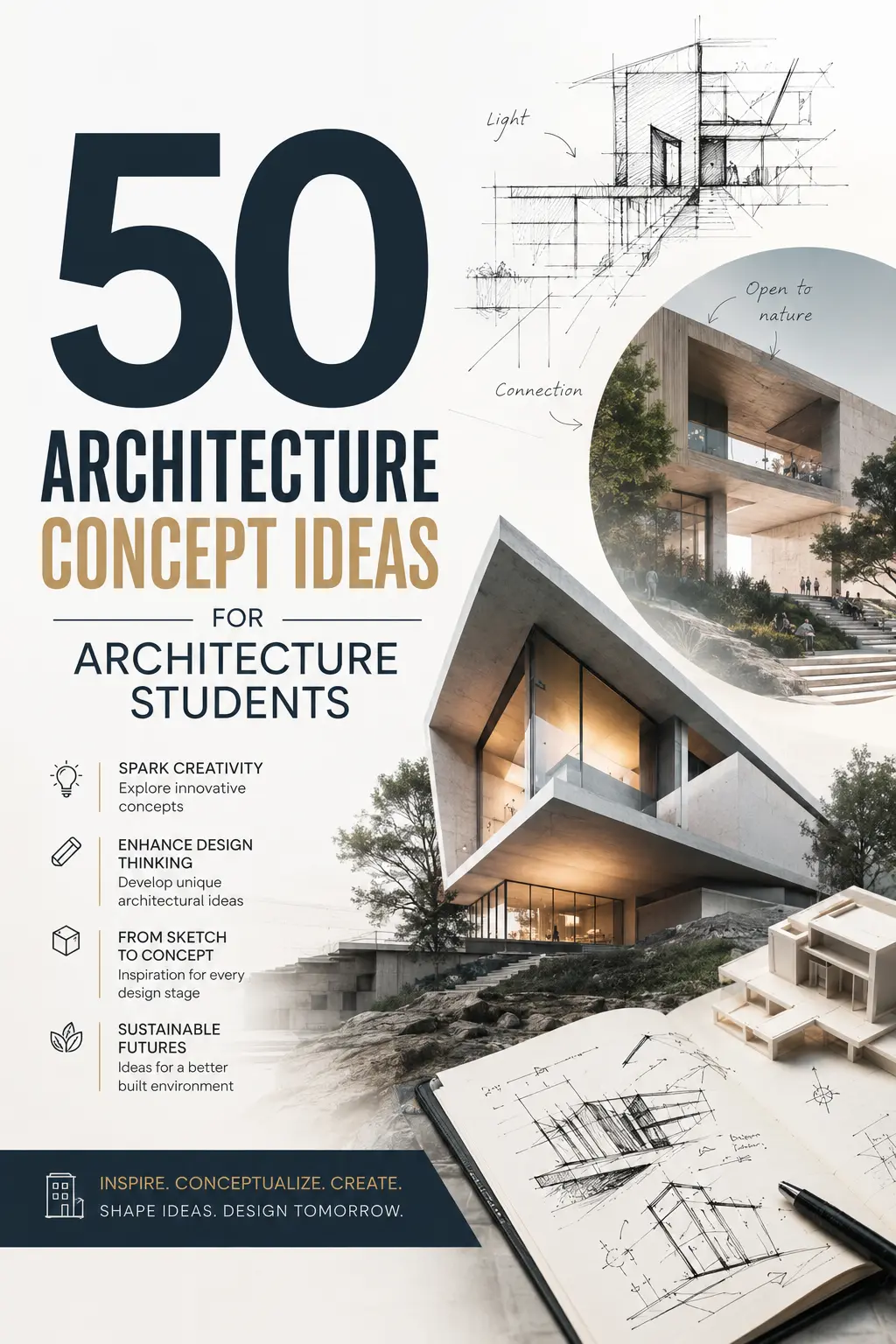
Developing a strong architecture concept idea is one of the most critical stages of architectural design. A well-researched concept defines the relationship between space, people, environment, technology, and cultural context. According to architectural design studies, successful student projects usually emerge from concepts backed by site analysis, user behavior studies, climate response, and material research.
This research-driven guide explores 50 architecture concept ideas for students that can help in developing meaningful academic projects, thesis proposals, and competition entries.
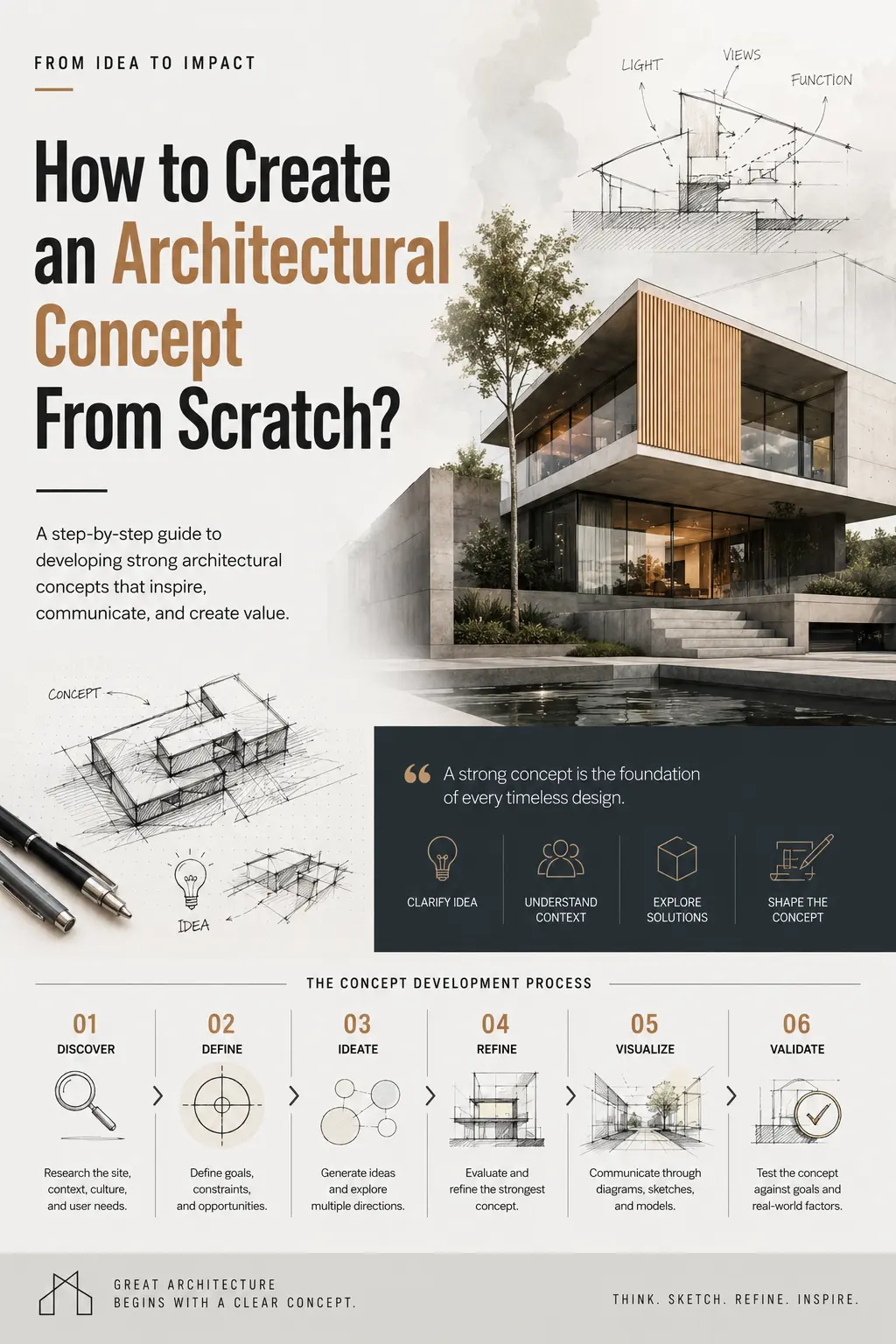
Read more: Architectural Design Process Guide
Why Architecture Concepts Matter in Student Projects
Architecture concepts work as the foundation of a design decision-making system. Research indicates that projects with a clearly defined conceptual framework achieve stronger spatial organization, environmental performance, and user experience.
A strong concept usually responds to:
- Site characteristics and climate conditions
- Social and cultural requirements
- Human psychology and behavior patterns
- Sustainability objectives
- Future adaptability
Related study: Sustainable Architecture Principles
50 Architecture Concept Ideas
1. Biomimicry Architecture Concept
Inspired by natural systems, biomimicry studies biological processes and applies them to architectural solutions.
Design research areas:
- Natural ventilation inspired by organisms
- Structural efficiency from natural forms
- Climate-responsive building skins
Explore: Biomimicry in Architecture
2. Sustainable Architecture Concept
Sustainability-driven concepts focus on reducing environmental impact through efficient resource management.
Key parameters:
- Renewable materials
- Energy efficiency
- Passive design strategies
- Waste reduction
3. Contextual Architecture Concept
Context-based architecture analyzes surroundings before developing design solutions.
Research factors:
- Local history
- Urban pattern
- Material availability
- Cultural identity
4. Minimalist Architecture Concept
Minimalism explores spatial clarity through reduced forms and essential elements.
Design analysis:
- Functional efficiency
- Material honesty
- Visual simplicity
Reference: Minimalist Architecture Ideas
5. Adaptive Reuse Concept
Adaptive reuse focuses on transforming existing structures instead of demolition.
Benefits:
- Conservation of heritage
- Reduced construction waste
- Economic sustainability
6. Human-Centered Architecture
This approach studies how humans physically and psychologically interact with spaces.
Research areas:
- Ergonomics
- Movement patterns
- Emotional response
7. Parametric Architecture Concept
Parametric design uses computational logic to create adaptive architectural systems.
Applications:
- Complex geometry
- Environmental optimization
- Digital fabrication
Read: Parametric Design Techniques
8. Floating Architecture Concept
Floating architecture investigates future responses to rising water levels and urban density.
Key analysis:
- Buoyancy systems
- Climate adaptation
- Flexible infrastructure
9. Modular Architecture Concept
Modular concepts focus on prefabricated systems and construction efficiency.
Advantages:
- Faster construction
- Controlled quality
- Flexible expansion
10. Vernacular Architecture Concept
Vernacular concepts study traditional building intelligence developed through generations.
Focus areas:
- Local materials
- Climate adaptation
- Cultural expression
Nature-Inspired Architecture Concepts
11. Organic Architecture
Uses natural forms and landscapes as primary design inspiration.
12. Mountain-Inspired Architecture
Studies terrain, slope response, and geological formations.
13. Forest Architecture
Creates relationships between buildings and ecosystems.
14. Water-Inspired Architecture
Explores movement, reflection, transparency, and fluidity.
15. Desert Architecture Concept
Researches thermal comfort strategies in extreme environments.
Technology-Based Architecture Concepts
16. Smart Building Concept
Combines architecture with intelligent systems.
Research includes:
- Sensors
- Automation
- Energy monitoring
17. Artificial Intelligence Integrated Architecture
Studies data-based optimization of spaces and building performance.
18. Responsive Architecture
Buildings that adapt according to environmental conditions.
19. Kinetic Architecture
Uses movable architectural components.
20. Digital Fabrication Concept
Explores robotic construction and advanced manufacturing.
Social Architecture Concept Ideas
21. Community-Centered Design
Focuses on social interaction and collective spaces.
22. Inclusive Architecture
Studies accessibility and universal design principles.
23. Affordable Housing Concept
Analyzes economical construction strategies.
24. Disaster-Resilient Architecture
Creates solutions for vulnerable regions.
25. Human Psychology-Based Design
Connects neuroscience research with spatial experience.
Read: Psychology in Architecture
Urban Design Concept Ideas
26. Walkable City Concept
Improves pedestrian experience and reduces vehicle dependency.
27. Vertical City Concept
Explores high-density urban solutions.
28. Mixed-Use Development Concept
Combines residential, commercial, and public functions.
29. Future City Architecture
Studies futuristic urban requirements.
30. Smart City Architecture
Integrates technology with urban planning.
Experimental Architecture Concepts
31. Zero Energy Building Concept
Creates buildings with balanced energy consumption.
32. Net Positive Architecture
Generates more resources than consumed.
33. Circular Economy Architecture
Focuses on reusable materials and lifecycle planning.
34. Invisible Architecture
Studies landscape integration and reduced visual impact.
35. Temporary Architecture
Creates flexible short-term structures.
Material-Based Architecture Concepts
36. Bamboo Architecture Concept
Researches renewable structural possibilities.
37. Earth Architecture Concept
Studies natural construction materials.
38. Glass Architecture Concept
Explores transparency and daylight.
39. Concrete Expression Concept
Analyzes structural and aesthetic possibilities.
40. Recycled Material Architecture
Transforms waste into construction resources.
Advanced Thesis-Level Architecture Concepts
41. Climate Responsive Architecture
Develops solutions based on climate analysis.
42. Emotional Architecture
Studies relationships between feelings and spaces.
43. Healing Architecture
Researches healthcare environments and wellness.
44. Floating City Concept
Investigates future settlement possibilities.
45. Space Architecture Concept
Studies habitats beyond Earth environments.
Futuristic Architecture Concept Ideas
46. Metaverse Architecture
Explores virtual spatial experiences.
47. Augmented Reality Architecture
Combines physical and digital environments.
48. Self-Sufficient Architecture
Creates independent resource systems.
49. Regenerative Architecture
Restores ecological systems through design.
50. Evolutionary Architecture
Studies buildings capable of changing with future requirements.
How Students Should Select the Best Architecture Concept
Selecting an architectural concept should not depend only on visual inspiration. A research-based selection process improves project depth.
Analyze:
- Site opportunities and limitations
- Environmental performance requirements
- User needs and behavioral patterns
- Construction feasibility
- Long-term sustainability impact
More resources:
Final Thoughts
The best architecture concepts combine creativity with analytical research. Whether the inspiration comes from nature, technology, culture, or social challenges, a successful architectural idea must create measurable value beyond visual appearance.
For students, these 50 architecture concept ideas provide a research foundation to develop innovative, sustainable, and future-ready design projects.