Creating an architectural concept is not about producing a random visual idea—it is a structured research process where data, context, human behavior, environmental factors, and design objectives merge into a clear architectural direction. A strong concept becomes the foundation that controls form, function, materials, sustainability, and user experience throughout a project.
Leading architectural institutions such as the https://www.archdaily.com and research organizations like https://www.architectural-review.com consistently highlight that successful architecture begins with deep analysis before any physical form is developed.
1. Start With Contextual Research and Site Analysis
Every architectural concept begins with understanding the environment. Site analysis provides measurable information that directly influences design decisions.
Important research parameters include:
- Climate Study: Analyze sunlight movement, wind direction, rainfall, and seasonal variation. Climate-responsive design improves energy performance and comfort. Resources such as https://climateconsultant.com help architects evaluate environmental data.
- Physical Context: Study surrounding buildings, landscape patterns, access points, vegetation, and existing infrastructure.
- Cultural Context: Architecture should respond to local identity, history, lifestyle, and community patterns rather than creating isolated objects.
Research from https://www.unep.org shows that buildings contribute significantly to global energy consumption, making early environmental analysis essential for sustainable architectural concepts.
2. Define the Core Architectural Problem
A concept becomes meaningful when it solves a specific problem. Before designing forms, architects should define:
- Who are the users?
- What activities will happen inside the space?
- What limitations exist?
- What experience should the architecture create?
A strong concept statement usually connects three elements:
Purpose + Context + Experience
For example:
“Creating a climate-responsive learning environment that encourages collaboration through flexible spatial relationships.”
This approach transforms abstract ideas into measurable architectural strategies.
3. Build Concepts Through Data, Not Decoration
Modern architectural concepts rely increasingly on analytical design thinking. Instead of starting with shapes, architects evaluate:
- User movement patterns
- Space efficiency
- Environmental performance
- Material impact
- Long-term adaptability
Research-based platforms such as https://www.buildinggreen.com emphasize evidence-driven design decisions that improve sustainability and building performance.
The strongest architectural ideas usually emerge from restrictions rather than unlimited possibilities.
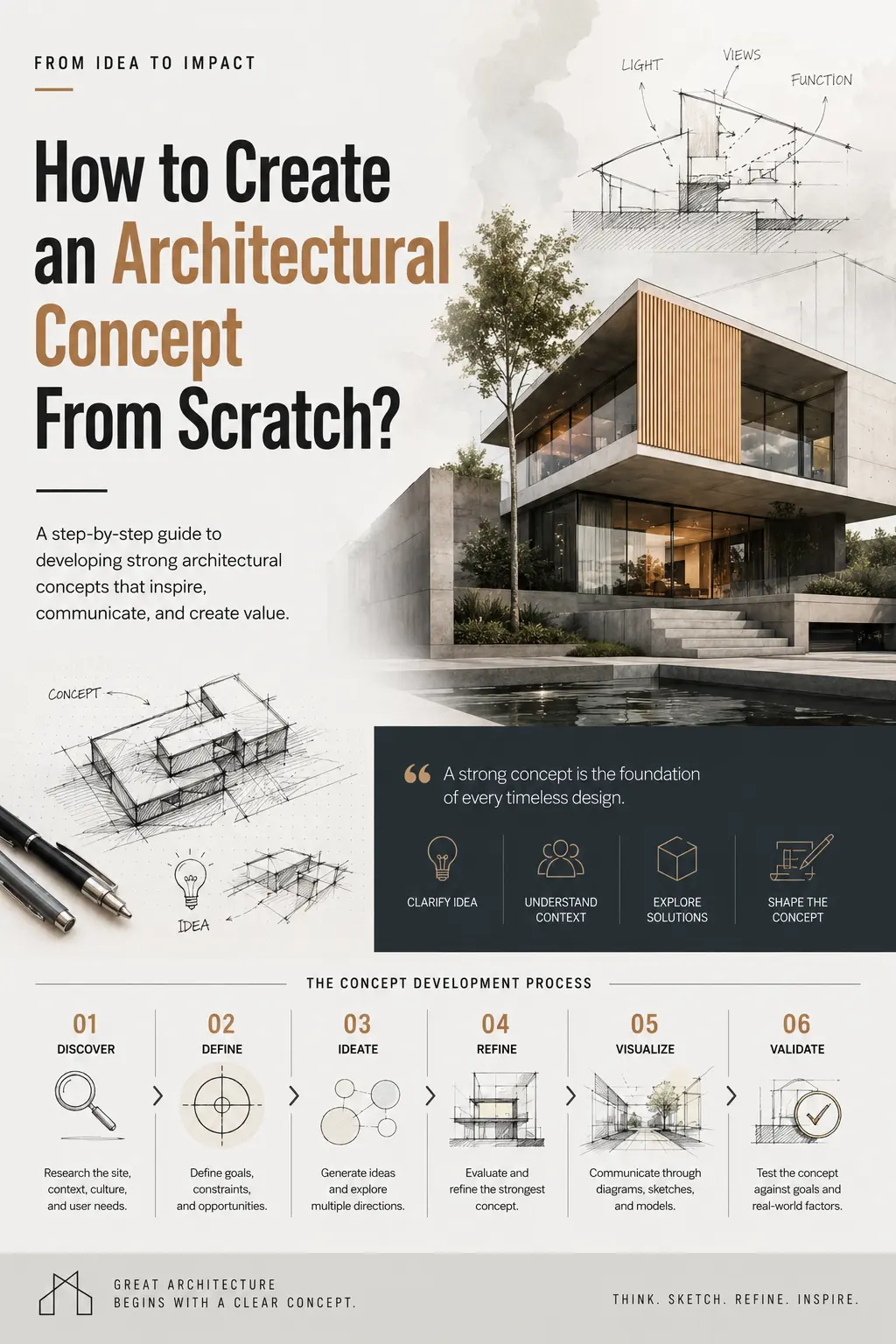
4. Convert Research Into Design Keywords
After collecting information, architects translate research findings into conceptual keywords.
Examples:
- Dense urban site → “Vertical Connectivity”
- Hot climate → “Passive Cooling”
- Cultural project → “Memory and Identity”
- Community space → “Social Interaction”
These keywords become the foundation for sketches, diagrams, zoning, and architectural language.
Architectural studios including https://www.fosterandpartners.com and https://www.big.dk often demonstrate how clear conceptual principles influence complex architectural outcomes.
5. Develop Conceptual Diagrams and Spatial Logic
A concept must evolve visually. Early architectural diagrams explain the relationship between research and design decisions.
Effective concept diagrams usually represent:
- Movement flow
- Public and private zones
- Environmental responses
- Structural ideas
- Spatial hierarchy
Tools like https://www.rhino3d.com and https://www.autodesk.com/products/revit are commonly used to transform conceptual studies into advanced digital models.
6. Test the Concept Against Real Conditions
A successful architectural concept must survive practical evaluation. Test every idea through:
- Functionality
- Cost efficiency
- Sustainability goals
- Construction possibilities
- User comfort
Design validation ensures that architecture remains both creative and realistic.
Organizations such as https://www.worldgbc.org provide valuable research on sustainable building strategies and performance-based design.
Conclusion: Architectural Concepts Begin With Research
Creating an architectural concept from scratch is a systematic process of observation, analysis, interpretation, and transformation. The strongest designs are rarely based only on aesthetics—they develop from understanding people, place, climate, culture, and future needs.
A well-developed architectural concept works as a decision-making framework that guides every stage of design, from the first sketch to the final built environment.
Great architecture starts when research becomes an idea, and an idea becomes a meaningful space.