
Introduction
Which wall material keeps a building cooler in summer and warmer in winter? The answer can significantly influence indoor comfort, energy consumption and long-term building performance.
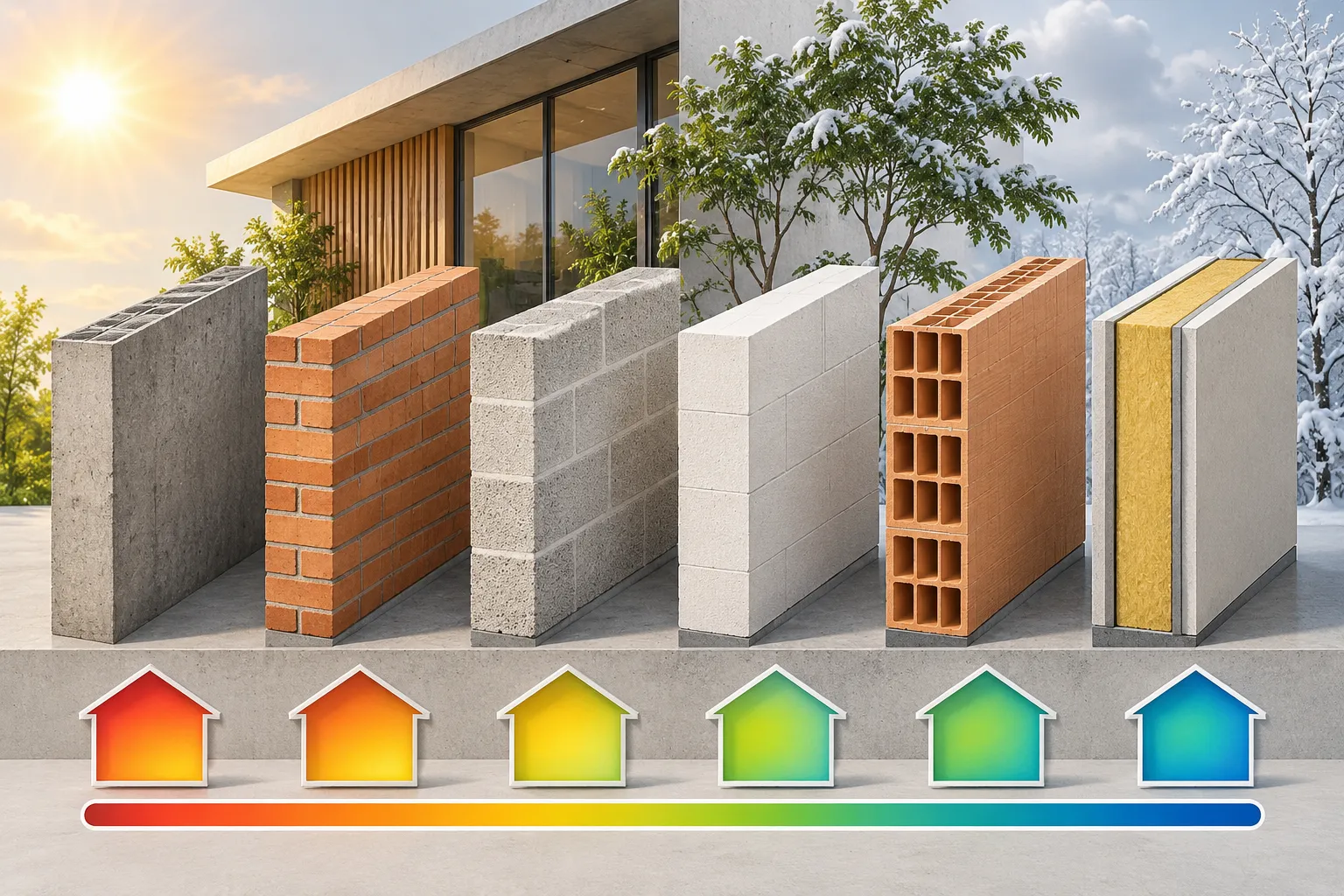
Walls are more than structural enclosures. They act as the first line of defence against external heat, making material selection an important part of energy-efficient architecture. From traditional burnt clay bricks to modern AAC blocks and insulated concrete systems, different wall materials offer varying levels of thermal resistance.
In this guide, we compare commonly used wall materials based on their thermal insulation properties, construction suitability and energy efficiency.
1. Understanding Thermal Insulation in Walls
Thermal insulation refers to a material’s ability to resist heat transfer. Two important parameters help architects evaluate wall performance:
- Thermal Conductivity (W/m·K): Lower values indicate better resistance to heat flow through a material.
- U-Value (W/m²·K): Measures heat transfer through the complete wall assembly. Lower U-values indicate better insulation.
It is important to remember that wall thickness, air cavities, insulation layers, plaster and surface finishes also influence overall thermal performance.
2. Thermal Performance Comparison of Common Wall Materials
The following table compares commonly used wall materials using indicative thermal conductivity values referenced in India’s Energy Conservation Building Code and Eco-Niwas Samhita 2024.
| Wall material | Thermal conductivity (W/m·K) | Insulation performance |
|---|---|---|
| AAC Blocks | 0.184 | Excellent |
| Hollow Clay Bricks | 0.631 | Good |
| Fly Ash Bricks | 0.856 | Moderate |
| Burnt Clay Bricks | 0.620–0.980 | Moderate |
| Solid Concrete Blocks | 1.396 | Low |
| Dense Concrete | 1.740 | Very low |
Source: Bureau of Energy Efficiency (BEE),
Values are indicative and vary with density, moisture content and manufacturing specifications.
3. Which Wall Material Performs Best?
AAC Blocks – A Strong Choice for Energy-Efficient Buildings
Autoclaved Aerated Concrete (AAC) blocks are among the most effective conventional masonry options for thermal insulation. Their lightweight cellular structure contains numerous tiny air pockets that restrict heat transfer. They also reduce structural dead loads and can accelerate construction.
Hollow Clay Bricks – Traditional Yet Efficient
Hollow clay bricks offer a practical combination of thermal performance, durability and familiar construction techniques. Their cavities reduce heat transfer compared with many solid masonry alternatives, making them suitable for residential and commercial buildings.
Fly Ash Bricks – An Alternative to Conventional Bricks
Manufactured using industrial by-products, fly ash bricks can reduce dependence on conventional clay bricks. However, their thermal insulation performance depends on density and composition, and they may benefit from additional insulation.
Concrete Blocks – Strength with Thermal Limitations
Solid concrete blocks offer structural robustness and durability but generally have higher thermal conductivity. In hot climates, additional insulation, cavity walls or appropriate external shading can improve their performance.
4. How Can Architects Improve Wall Thermal Performance?
Selecting an appropriate masonry material is only one part of designing an energy-efficient building. Architects can further improve wall performance through:
- Cavity Wall Construction: Introducing an air gap between wall layers to reduce heat transfer.
- External Wall Insulation: Adding insulation boards or suitable insulating materials to the building envelope.
- Reflective Finishes: Using appropriate light-coloured exterior finishes to reduce solar heat absorption.
- Thermal Mass: Using materials with suitable heat capacity and time-lag characteristics according to local climatic conditions.
- Passive Design: Combining wall construction with orientation, shading, natural ventilation and appropriate window-to-wall ratios.
5. Conclusion: Choosing the Right Wall Material
There is no universally perfect wall material for every climate. AAC blocks offer excellent insulation among commonly used masonry products, while hollow clay bricks provide a practical traditional alternative. Solid concrete and dense masonry generally require additional thermal protection in buildings exposed to high solar radiation.
For architects and building designers, the best approach is to evaluate the complete wall assembly rather than selecting materials solely on the basis of their individual thermal conductivity.
The future of sustainable architecture lies not just in constructing stronger walls, but in designing smarter building envelopes that minimise energy consumption while maximising occupant comfort.
Comparison of Different Wall Materials Based on Thermal Insulation
| Wall Material | Thermal Conductivity (W/m·K) | Thermal Insulation | Key Characteristics |
|---|---|---|---|
| AAC Blocks | 0.184 | Excellent | Lightweight, low heat transfer, energy-efficient |
| Hollow Clay Bricks | 0.631 | Good | Air cavities improve insulation |
| Burnt Clay Bricks | 0.620–0.980 | Moderate | Durable, traditional and widely available |
| Fly Ash Bricks | 0.856 | Moderate | Uses industrial by-products, consistent dimensions |
| Solid Concrete Blocks | 1.396 | Low | Strong and durable but conducts more heat |
| Dense Concrete | 1.740 | Very Low | High thermal conductivity, requires additional insulation |
Note: Values are indicative and vary with density, moisture content, composition and manufacturing process.
Key Findings
| Parameter | Best Performing Option |
|---|---|
| Lowest thermal conductivity | AAC Blocks |
| Best conventional insulation | AAC Blocks |
| Traditional masonry alternative | Hollow Clay Bricks |
| Industrial by-product utilisation | Fly Ash Bricks |
| Structural robustness | Concrete Blocks |
| Recommended approach for hot climates | Insulated wall assembly with passive cooling strategies |
Overall Conclusion: AAC blocks provide excellent thermal insulation among the commonly used masonry materials. However, the most energy-efficient wall solution depends on the local climate, wall thickness, insulation layers, orientation and overall building design.