Introduction
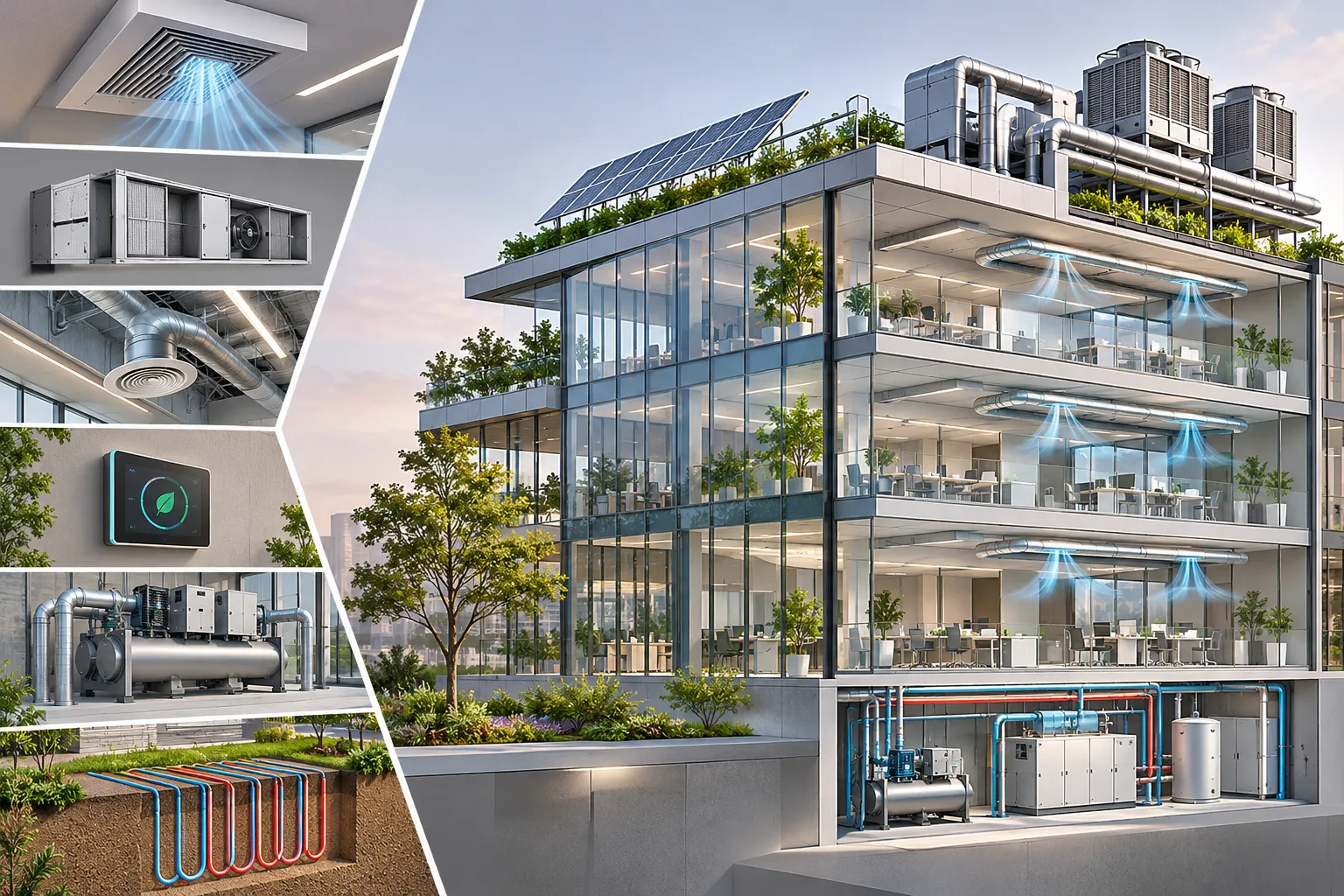
Heating, Ventilation and Air Conditioning (HVAC) systems account for a significant share of building energy consumption, making them one of the most important components in the transition towards energy-efficient and net-zero buildings. With rising temperatures, increasing electricity demand and stricter carbon-emission targets, conventional HVAC systems are rapidly evolving into intelligent, low-carbon and highly efficient building technologies.
The next generation of HVAC is not just about cooling and heating spaces; it is about creating healthier indoor environments while minimising energy consumption, operational costs and environmental impact.
Here are some of the most promising emerging HVAC technologies transforming sustainable architecture and green building design.
1. Emerging HVAC Technologies to Watch
1. AI-Powered HVAC and Smart Building Automation
Artificial Intelligence (AI), Internet of Things (IoT) and smart sensors are transforming conventional HVAC systems into intelligent climate-control networks. These technologies monitor occupancy, temperature, humidity, air quality and weather conditions to automatically optimise cooling and ventilation.
Key benefits:
- Predictive maintenance and early fault detection.
- Automated temperature and ventilation control.
- Reduced unnecessary energy consumption.
- Integration with Building Management Systems (BMS).
Explore: AI-Enabled HVAC Systems for Zero-Emission Buildings.
2. High-Efficiency Heat Pumps and VRF Systems
Heat pumps are emerging as a major alternative to conventional fossil-fuel-based heating and cooling systems. Air-source and ground-source heat pumps transfer heat rather than generating it directly, offering significantly improved energy efficiency.
Meanwhile, Variable Refrigerant Flow (VRF) technology allows multiple indoor units to operate independently, providing precise temperature control across different building zones.
Key benefits:
- Reduced operational carbon emissions.
- High seasonal energy efficiency.
- Individualised thermal comfort.
- Potential integration with solar photovoltaic systems.
Further reading: US Department of Energy – HVAC and Heat Pump Technologies.
3. Radiant Cooling and Heating Systems
Radiant cooling uses chilled water circulating through ceilings, floors or wall panels to absorb heat through radiation. Unlike conventional air-conditioning systems, it reduces dependence on high-volume conditioned air circulation.
When combined with a Dedicated Outdoor Air System (DOAS), radiant cooling can provide effective temperature and humidity control with improved energy performance.
Key benefits:
- Lower fan energy requirements.
- Improved thermal comfort.
- Reduced air movement and noise.
- Excellent potential for commercial buildings.
4. Energy Recovery Ventilation (ERV and HRV)
Modern airtight buildings require controlled fresh-air ventilation without losing excessive heating or cooling energy. Energy Recovery Ventilators (ERV) and Heat Recovery Ventilators (HRV) transfer energy between outgoing exhaust air and incoming fresh air.
ERV systems can also transfer moisture, making them particularly useful in humid climates such as eastern India.
Key benefits:
- Reduced ventilation-related cooling loads.
- Improved indoor air quality.
- Better humidity management.
- Lower HVAC operating costs.
5. Thermal Energy Storage (TES)
Thermal Energy Storage (TES) systems store cooling or heating energy for use when demand increases. Chilled-water tanks and Phase Change Materials (PCM) can store thermal energy during off-peak hours and release it during peak demand.
When integrated with rooftop solar PV and intelligent energy management, TES can reduce peak electricity consumption and improve renewable energy utilisation.
Key benefits:
- Peak-demand reduction.
- Better utilisation of renewable electricity.
- Improved HVAC operational flexibility.
- Potential reduction in electricity costs.
Research: Nature – Increasing the Sustainability of Buildings Using Thermal Energy Storage.
6. Solar-Powered HVAC and Hybrid Cooling
Solar-powered HVAC systems combine photovoltaic (PV) panels with high-efficiency heat pumps, chillers and energy storage. This approach helps buildings utilise locally generated renewable electricity for cooling and ventilation.
Hybrid systems can also combine evaporative cooling, conventional refrigeration and passive cooling techniques depending on outdoor conditions.
Key benefits:
- Reduced dependence on grid electricity.
- Lower operational carbon emissions.
- Integration with battery storage.
- Greater potential for net-zero energy buildings.
Explore: European Commission – Optimising HVAC Systems for Net-Zero Energy Buildings.
7. Digital Twins and Predictive HVAC Control
Digital Twin technology creates a virtual representation of a building and its mechanical systems. By integrating BIM, real-time sensor data and energy simulation, architects and facility managers can analyse HVAC performance and identify operational inefficiencies.
AI-powered predictive controls can adjust system operation according to occupancy patterns, weather forecasts and electricity demand.
Key benefits:
- Real-time energy performance monitoring.
- Predictive maintenance.
- HVAC optimisation throughout the building lifecycle.
- Improved coordination between BIM and building operations.
8. Dedicated Outdoor Air Systems (DOAS)
Dedicated Outdoor Air Systems (DOAS) are advanced ventilation systems designed to independently condition and supply fresh outdoor air to occupied spaces. Unlike conventional HVAC systems that handle ventilation and space cooling together, DOAS separates the ventilation load from the sensible cooling and heating requirements.
The system typically incorporates filtration, dehumidification, heat recovery and controlled fresh-air distribution. When integrated with VRF systems, radiant cooling or chilled-water systems, DOAS can significantly improve indoor air quality while reducing the energy burden on primary cooling equipment.
Key benefits:
- Independent control of ventilation and humidity.
- Improved indoor air quality through filtered fresh air.
- Reduced latent cooling load on conventional HVAC systems.
- Compatibility with radiant cooling and VRF systems.
- Potential for energy savings through heat and energy recovery.
Best applications: Commercial offices, hospitals, educational institutions, hotels, shopping malls and high-performance green buildings.
Explore further: ASHRAE – HVAC Design Standards and Resources.
Summary: Comparison of Emerging HVAC Technologies for Net-Zero Buildings
The following table summarises eight emerging HVAC technologies, their working principles, major advantages and their contribution towards energy-efficient and net-zero building design.
| HVAC Technology | Primary Function | Key Benefits | Application in Net-Zero Buildings |
|---|---|---|---|
| AI-Powered HVAC | Intelligent climate control using AI, IoT and sensors | Optimised energy use, predictive maintenance and automated control | Smart energy management |
| Heat Pumps | Transfer heat for efficient heating and cooling | High efficiency, reduced fossil fuel consumption | Low-carbon heating and cooling |
| VRF Systems | Independent temperature control across multiple zones | Flexible operation and improved part-load efficiency | Energy-efficient zonal cooling |
| Radiant Cooling & Heating | Uses chilled or heated surfaces for thermal comfort | Reduced fan energy and improved comfort | Low-energy space conditioning |
| ERV / HRV | Recovers energy from exhaust air | Reduced ventilation loads and improved indoor air quality | Energy-efficient fresh-air ventilation |
| Thermal Energy Storage (TES) | Stores cooling or heating energy for later use | Peak-load reduction and better energy management | Renewable energy integration |
| Solar-Powered HVAC | Uses solar electricity to operate HVAC equipment | Reduced grid dependency and operational emissions | Renewable-powered building systems |
| Digital Twins | Virtual modelling and real-time HVAC performance monitoring | Predictive maintenance and system optimisation | Lifecycle energy optimisation |
| Dedicated Outdoor Air System (DOAS) | Independently conditions and supplies fresh outdoor air | Improved ventilation, humidity control and reduced cooling loads on primary systems | High-performance ventilation and indoor air quality |
Note: Actual energy savings and carbon reductions depend on climate, building envelope, occupancy, system design, equipment efficiency and operational controls.