
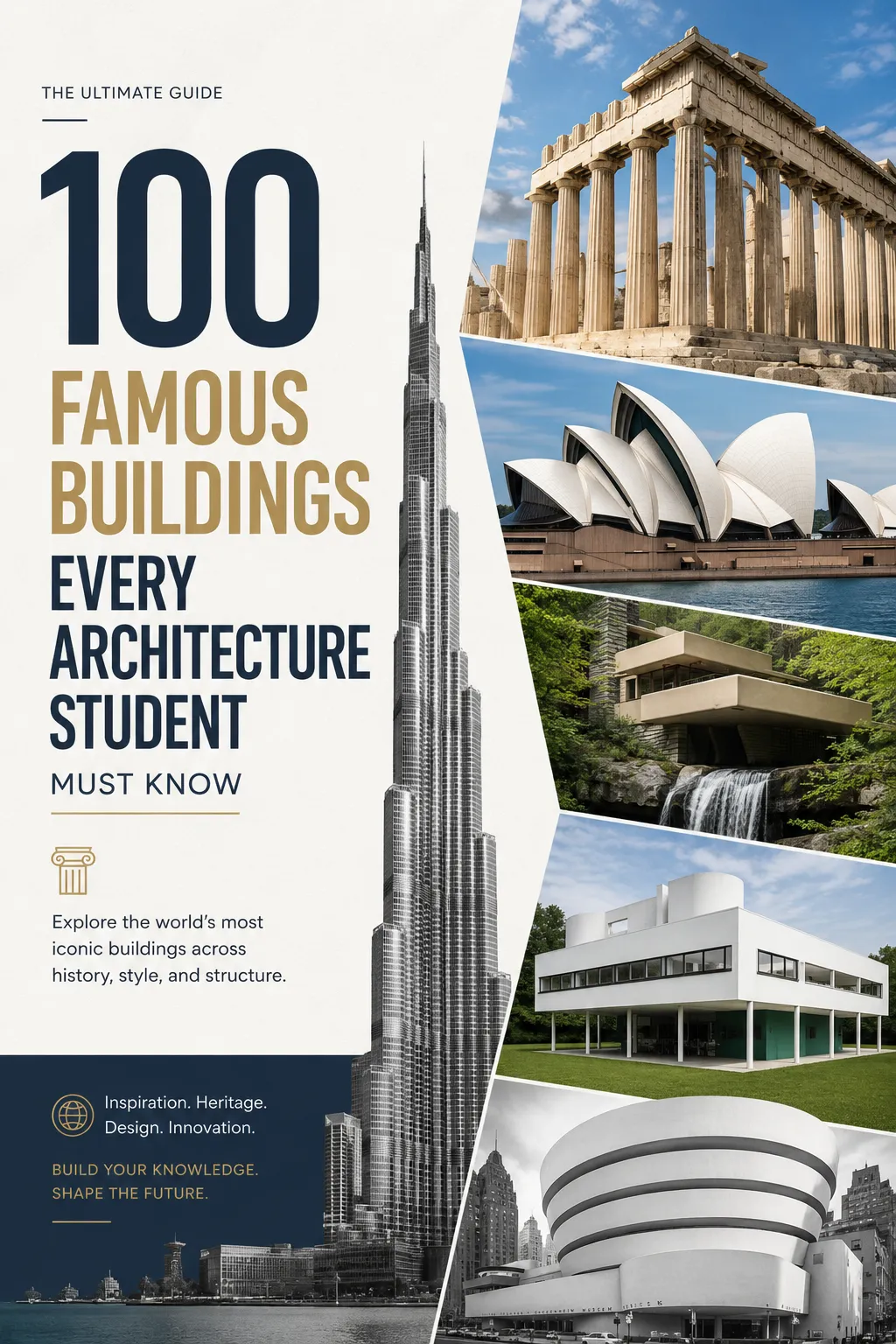
Architecture is not just the practice of designing buildings; it is the documentation of human civilization, technology, culture, climate response, and artistic evolution. For architecture students, studying globally significant buildings provides a deeper understanding of design principles, structural innovation, spatial planning, and historical transformation.
This research-based guide analyzes 100 famous buildings every architecture student must know, selected based on architectural influence, historical value, design innovation, technological contribution, and their impact on global architectural education.
Selection Methodology: How These 100 Buildings Were Chosen
The buildings listed below were evaluated using five parameters:
- Historical Influence – Contribution to architectural movements and civilization.
- Design Innovation – Introduction of new spatial concepts, materials, or construction methods.
- Cultural Significance – Influence on identity, heritage, and society.
- Academic Importance – Frequency of study in architectural education.
- Global Recognition – Inclusion in architectural research, heritage studies, and professional discussions.
Ancient & Classical Architecture
1. Great Pyramid of Giza – Egypt
The Great Pyramid remains one of the most important studies in ancient construction technology. Built with exceptional geometric precision, it demonstrates early knowledge of alignment, engineering, and monumental architecture.
Study reference: https://whc.unesco.org/en/list/86
2. Parthenon – Athens, Greece
The Parthenon represents the peak of Classical Greek architecture. Its proportional systems, Doric order, and optical refinements continue to influence architectural theory.
Reference: https://www.britishmuseum.org/collection/galleries/greece-parthenon
3. Colosseum – Rome, Italy
The Colosseum introduced advanced crowd circulation systems, structural arches, and large-scale public architecture principles that remain relevant in stadium design.
Reference: https://www.britannica.com/topic/Colosseum
4. Pantheon – Rome, Italy
Known for its revolutionary concrete dome and oculus, the Pantheon became a milestone in structural experimentation.
Reference: https://www.britannica.com/topic/Pantheon-building-Rome-Italy
5. Hagia Sophia – Istanbul, Turkey
Hagia Sophia represents the transition between Roman engineering and Byzantine spatial design through its innovative dome system.
Reference: https://whc.unesco.org/en/list/356
Medieval & Religious Architectural Icons
6. Notre-Dame Cathedral – Paris, France
A defining example of Gothic architecture, Notre-Dame introduced advanced flying buttress systems, vertical composition, and symbolic spatial planning.
Reference: https://www.notredamedeparis.fr/en/
7. Chartres Cathedral – France
Chartres Cathedral is widely studied for Gothic proportions, stained glass storytelling, and structural innovation.
8. Angkor Wat – Cambodia
Angkor Wat demonstrates advanced temple planning, astronomical alignment, hydraulic engineering, and symbolic architectural composition.
Reference: https://whc.unesco.org/en/list/668
9. Forbidden City – Beijing, China
This imperial complex reflects principles of hierarchy, axial planning, and traditional Chinese architectural philosophy.
Reference: https://en.dpm.org.cn/
10. Florence Cathedral – Italy
Filippo Brunelleschi’s dome represents one of history’s greatest breakthroughs in architectural engineering.
Renaissance to Industrial Revolution Masterpieces
11. St. Peter’s Basilica – Vatican City
Designed by architects including Michelangelo and Bramante, the basilica shaped Renaissance spatial concepts and religious architecture.
12. Villa Rotonda – Italy
Andrea Palladio’s Villa Rotonda became a foundation for symmetry, proportion, and classical revival architecture.
13. Palace of Versailles – France
Versailles influenced palace planning, landscape architecture, and concepts of architectural power.
14. Crystal Palace – London, United Kingdom
The Crystal Palace introduced prefabrication, modular construction, and industrial materials in architecture.
15. Eiffel Tower – Paris, France
Initially controversial, the Eiffel Tower became a landmark of structural expression and iron construction.
Reference: https://www.toureiffel.paris/en
Modern Architecture Every Student Should Study
16. Fallingwater – Pennsylvania, USA
Designed by Frank Lloyd Wright, Fallingwater is one of the strongest examples of organic architecture, integrating built form with landscape.
Reference: https://fallingwater.org/
17. Villa Savoye – France
Le Corbusier’s Villa Savoye demonstrates the “Five Points of Architecture” and became a foundation of modernist design theory.
Reference: https://www.fondationlecorbusier.fr/
18. Bauhaus Dessau – Germany
The Bauhaus building represents functionalism, industrial design integration, and modern architectural education.
Reference: https://www.bauhaus-dessau.de/
19. Barcelona Pavilion – Spain
Mies van der Rohe’s pavilion introduced open planning, material honesty, and minimalist architectural language.
20. Farnsworth House – USA
A landmark of minimalism and glass architecture exploring transparency and relationship with nature.
Contemporary Architecture & Structural Innovation
21. Sydney Opera House – Australia
Designed by Jørn Utzon, this building transformed architectural possibilities through computational geometry and shell structures.
Reference: https://www.sydneyoperahouse.com/
22. Centre Pompidou – Paris, France
Designed by Renzo Piano and Richard Rogers, Centre Pompidou challenged traditional building expression by exposing services and structure.
Reference: https://www.centrepompidou.fr/en/
23. Guggenheim Museum Bilbao – Spain
Frank Gehry’s design changed contemporary architecture through digital fabrication and complex forms.
Reference: https://www.guggenheim-bilbao.eus/en
24. Burj Khalifa – Dubai, UAE
The world’s tallest building demonstrates advancements in skyscraper engineering, vertical planning, and high-performance construction.
Reference: https://www.burjkhalifa.ae/
25. The Shard – London, United Kingdom
Renzo Piano’s skyscraper represents contemporary urban density and mixed-use vertical development.
Additional Essential Buildings Architecture Students Should Research
- Sagrada Família – Barcelona
- Casa Batlló – Barcelona
- Robie House – Chicago
- Johnson Wax Headquarters – USA
- Seagram Building – New York
- United Nations Headquarters – New York
- Chandigarh Capitol Complex – India
- Kimbell Art Museum – USA
- National Assembly Building – Bangladesh
- Solomon R. Guggenheim Museum – New York
- TWA Flight Center – New York
- Habitat 67 – Canada
- Lloyd’s Building – London
- CCTV Headquarters – Beijing
- Beijing National Stadium – China
- MAXXI Museum – Rome
- Heydar Aliyev Center – Azerbaijan
- Walt Disney Concert Hall – USA
- Louvre Pyramid – France
- Milwaukee Art Museum – USA
- Seattle Central Library – USA
- Rolex Learning Center – Switzerland
- Therme Vals – Switzerland
- Vitra Fire Station – Germany
- Casa da Música – Portugal
- Taj Mahal – India
- Humayun’s Tomb – India
- Lotus Temple – India
- IIM Ahmedabad Campus – India
- Gandhi Ashram – India
- Empire State Building – USA
- Chrysler Building – USA
- Flatiron Building – USA
- Marina Bay Sands – Singapore
- Gardens by the Bay – Singapore
- Petronas Towers – Malaysia
- Taipei 101 – Taiwan
- HSBC Building – Hong Kong
- Nakagin Capsule Tower – Japan
- Sendai Mediatheque – Japan
- Church of Light – Japan
- Kanchanjunga Apartments – India
- British Museum Great Court – UK
- Royal Ontario Museum Extension – Canada
- Denver Art Museum Extension – USA
- Jewish Museum Berlin – Germany
- Dancing House – Prague
- Turning Torso – Sweden
- CCTV Tower – China
- One World Trade Center – USA
- Apple Park – USA
- Bloomberg European Headquarters – UK
- Bosco Verticale – Italy
- The Edge – Netherlands
- National Museum of Qatar – Qatar
- Louvre Abu Dhabi – UAE
- Museum of Tomorrow – Brazil
- Elbphilharmonie – Germany
- Beijing Daxing Airport – China
- Jewel Changi Airport – Singapore
- Harpa Concert Hall – Iceland
- Metropol Parasol – Spain
- Fondation Louis Vuitton – France
- 30 St Mary Axe – London
- Aqua Tower – Chicago
- Absolute World Towers – Canada
- CCTV Cultural Center – China
- Yokohama International Passenger Terminal – Japan
- Serpentine Pavilion Projects – UK
- Neue Nationalgalerie – Germany
- Exeter Library – USA
- Glass House – USA
- Maison de Verre – France
- Vanna Venturi House – USA
- High Line Urban Renewal Project – New York
Conclusion: Why Architecture Students Must Study These Buildings
The world’s most famous buildings are not important because of appearance alone. Their value comes from how they solved architectural problems related to structure, society, technology, environment, and human experience.
For architecture students, analyzing these 100 buildings creates a foundation for understanding architectural history, modern innovation, sustainable thinking, and future design possibilities.



One thought on “100 Famous Buildings Every Architecture Student Must Know”