
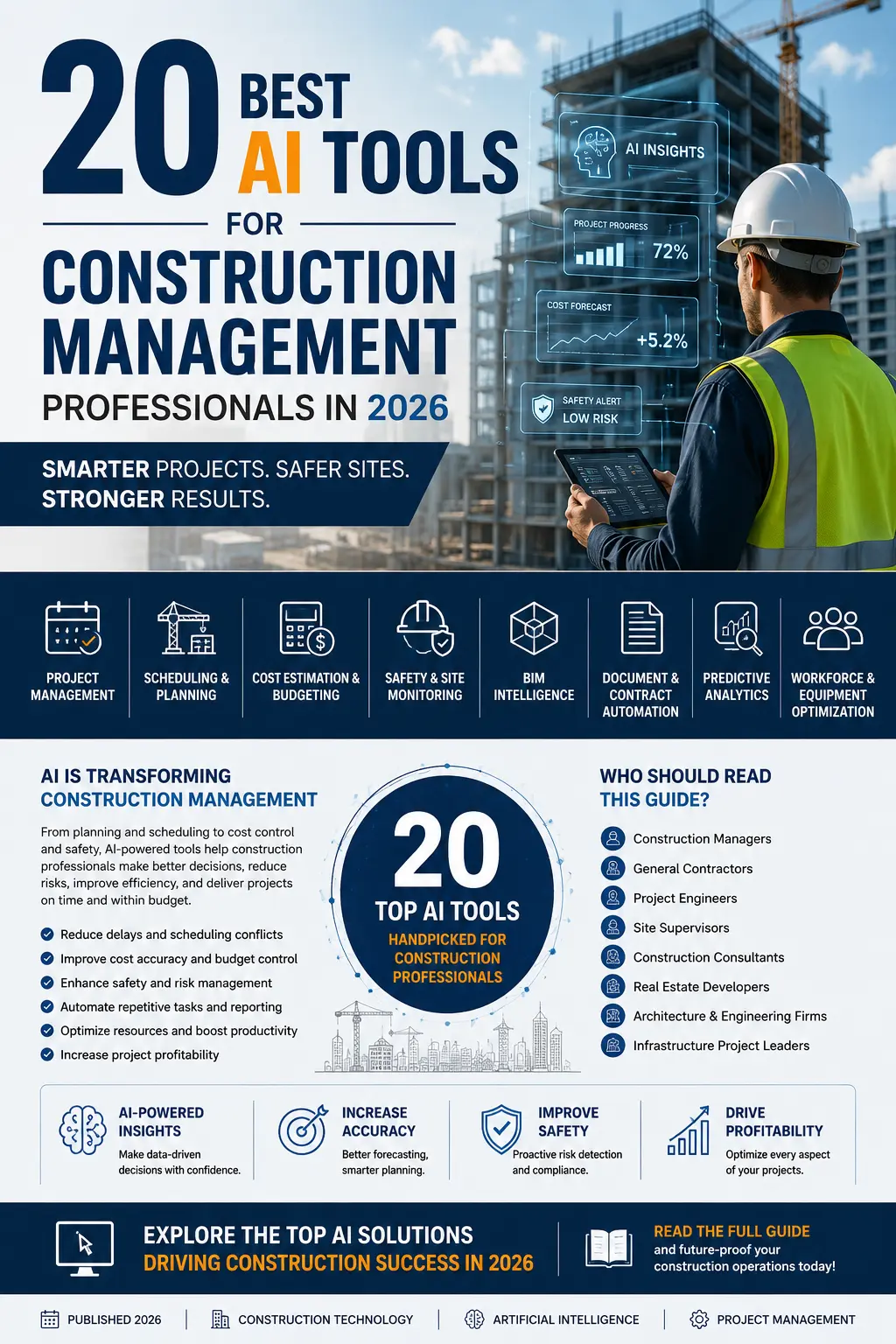
The construction industry is entering a new operational era driven by artificial intelligence, predictive analytics, automation, and real-time project intelligence. Construction management professionals are increasingly relying on AI-powered software to improve scheduling accuracy, reduce cost overruns, automate documentation, enhance field collaboration, and optimize resource allocation.
According to recent market projections, AI adoption in construction management is expected to grow substantially due to rising labor shortages, project complexity, and increasing demand for data-driven decision-making.
This research-driven analysis examines the top AI tools for construction management professionals based on:
- Workflow automation capability
- Predictive analytics performance
- Scheduling intelligence
- Cost management efficiency
- BIM integration
- Safety monitoring
- Document automation
- Field communication enhancement
- Enterprise scalability
- ROI potential
1. Procore
Website: https://www.procore.com/
Procore remains one of the most dominant AI-enabled construction management platforms globally. The platform integrates project management, financial tracking, quality control, safety management, and workforce coordination into a unified ecosystem.
Advantages
- AI-powered risk identification
- Predictive project forecasting
- Real-time financial visibility
- Smart construction document management
- Automated workflow approvals
Best Use Cases
- Large commercial construction firms
- Multi-site project coordination
- Enterprise-scale construction operations
2. Autodesk Construction Cloud
Website: https://construction.autodesk.com/
Autodesk Construction Cloud combines BIM intelligence with AI-driven project coordination. Its machine learning capabilities improve clash detection, construction sequencing, and field execution efficiency.
Advantages
- Advanced BIM integration
- Predictive issue detection
- AI-driven design coordination
- Cloud-based collaboration
- Real-time project visibility
Best Use Cases
- BIM-centric construction firms
- Infrastructure projects
- Architectural engineering firms
Strategic Insight
Organizations using BIM-integrated AI systems have reported measurable reductions in rework and coordination delays.
3. Oracle Primavera P6
Website: https://www.oracle.com/construction-engineering/primavera-p6/
Primavera P6 continues to dominate enterprise-level construction scheduling through advanced predictive analytics and portfolio-level planning intelligence.
Advantages
- AI-enhanced scheduling optimization
- Resource forecasting
- Risk analytics
- Enterprise portfolio management
- Critical path prediction
Best Use Cases
- Mega infrastructure projects
- Government construction contracts
- EPC contractors
4. Buildots
Website: https://buildots.com/
Buildots leverages computer vision and AI to automate construction progress tracking directly from site imagery.
Advantages
- Automated site monitoring
- Delay prediction algorithms
- Progress deviation analysis
- Real-time construction intelligence
- Performance benchmarking
Best Use Cases
- High-rise developments
- Complex commercial construction
- Time-sensitive projects
Industry Impact
AI-powered visual tracking is increasingly reducing manual reporting inefficiencies across construction sites.
5. OpenSpace
Website: https://www.openspace.ai/
OpenSpace uses AI and computer vision to create intelligent site documentation and digital construction twins.
Advantages
- AI-driven site capture
- Automated progress mapping
- Construction analytics dashboard
- Remote project visibility
- BIM synchronization
Best Use Cases
- Distributed construction teams
- Large-scale site documentation
- Quality assurance workflows
6. ALICE Technologies
Website: https://www.alicetechnologies.com/
ALICE Technologies specializes in AI-driven construction scheduling simulation and optimization.
Advantages
- Generative construction scheduling
- Schedule scenario simulations
- Resource optimization
- Cost-time balancing
- Predictive sequencing intelligence
Best Use Cases
- Complex infrastructure projects
- Heavy civil engineering
- Contractors managing schedule risks
7. PlanGrid
Website: https://www.plangrid.com/
PlanGrid improves field collaboration through AI-enhanced drawing management and issue tracking.
Advantages
- Smart blueprint management
- Automated issue tracking
- Field-team synchronization
- Mobile construction intelligence
- Version control automation
Best Use Cases
- Field engineers
- Site supervisors
- Mid-size construction firms
8. Fieldwire
Website: https://www.fieldwire.com/
Fieldwire is widely adopted for task management, field communication, and AI-assisted coordination.
Advantages
- Smart task assignment
- Construction workflow automation
- Mobile-first field collaboration
- Defect tracking
- Progress reporting
Best Use Cases
- Site operations teams
- General contractors
- Specialty subcontractors
9. Newmetrix
Website: https://www.newmetrix.com/
Newmetrix combines AI with construction safety intelligence and predictive risk analysis.
Advantages
- Predictive safety analytics
- Risk forecasting
- AI-driven incident prevention
- Safety scoring systems
- Insurance risk reduction
Best Use Cases
- Safety-focused contractors
- Industrial construction
- High-risk project environments
10. Togal.AI
Website: https://www.togal.ai/
Togal.AI automates quantity takeoffs using artificial intelligence and computer vision.
Advantages
- Automated blueprint analysis
- Fast quantity estimation
- Reduced manual takeoff errors
- AI-assisted cost estimation
- Bid preparation acceleration
Best Use Cases
- Estimators
- Preconstruction teams
- Quantity surveyors
11. Revizto
Website: https://revizto.com/
Revizto enhances BIM coordination through AI-assisted issue management and collaboration.
Advantages
- Intelligent clash management
- BIM issue tracking
- Real-time coordination
- Design conflict reduction
- Cloud collaboration
Best Use Cases
- BIM coordinators
- Architectural firms
- MEP engineering teams
12. ConstructConnect
Website: https://www.constructconnect.com/
ConstructConnect provides AI-enhanced bid management and construction market intelligence.
Advantages
- Smart bid discovery
- Market trend analytics
- Lead intelligence
- Construction forecasting
- Opportunity matching
Best Use Cases
- Business development teams
- General contractors
- Commercial builders
13. Smartvid.io
Website: https://smartvid.io/
Smartvid.io focuses on AI-driven safety analytics using image recognition and predictive modeling.
Advantages
- Visual safety monitoring
- PPE compliance tracking
- Hazard detection
- Safety intelligence automation
- Predictive incident analytics
Best Use Cases
- Safety managers
- Industrial projects
- Large workforce environments
14. eSUB
Website: https://esub.com/
eSUB is purpose-built for subcontractors requiring AI-enhanced project documentation and field productivity.
Advantages
- Smart subcontractor workflows
- Daily report automation
- Labor productivity analytics
- Field communication intelligence
- Document management
Best Use Cases
- Specialty subcontractors
- Electrical contractors
- Mechanical contractors
15. Bridgit Bench
Website: https://gobridgit.com/
Bridgit Bench delivers workforce planning intelligence powered by predictive analytics.
Advantages
- Labor forecasting
- Resource allocation intelligence
- Workforce utilization optimization
- Hiring demand prediction
- Staffing analytics
Best Use Cases
- HR managers
- Workforce planners
- Large construction enterprises
16. Dusty Robotics
Website: https://dustyrobotics.com/
Dusty Robotics combines robotics with AI-driven layout automation for construction sites.
Advantages
- Automated floor layout
- Precision site execution
- Reduced layout errors
- Robotics-enhanced workflows
- Construction automation
Best Use Cases
- Interior construction
- Large commercial projects
- Precision-driven layouts
17. Raken
Website: https://www.rakenapp.com/
Raken streamlines field reporting using AI-powered documentation and voice-enabled workflows.
Advantages
- Automated daily reports
- Voice-to-text field logging
- Construction analytics
- Productivity tracking
- Time-saving documentation
Best Use Cases
- Site supervisors
- Field engineers
- Construction reporting teams
18. Knowify
Website: https://knowify.com/
Knowify is optimized for small and mid-sized contractors seeking AI-powered operational management.
Advantages
- Job costing intelligence
- Invoice automation
- Financial forecasting
- Budget tracking
- Contractor workflow management
Best Use Cases
- SMB contractors
- Residential construction firms
- Trade contractors
19. ClickUp for Construction
Website: https://clickup.com/
ClickUp is increasingly adopted by construction teams for AI-assisted project collaboration and operational visibility.
Advantages
- AI-powered productivity workflows
- Smart task automation
- Team collaboration analytics
- Construction process customization
- Centralized project management
Best Use Cases
- Agile construction teams
- Remote project coordination
- Multi-team collaboration
20. monday.com Construction Management
Website: https://monday.com/
monday.com provides customizable AI-enhanced project management workflows for construction operations.
Advantages
- AI workflow automation
- Resource visualization
- Construction scheduling
- Team coordination
- Dashboard analytics
Best Use Cases
- Small-to-mid-size contractors
- Construction startups
- Collaborative project environments
Comparative Analysis of AI Construction Management Tools
| Tool | Primary Strength | Ideal User Segment |
|---|---|---|
| Procore | Enterprise project management | Large contractors |
| Autodesk Construction Cloud | BIM intelligence | Engineering firms |
| Primavera P6 | Scheduling analytics | Infrastructure firms |
| Buildots | Visual tracking AI | Commercial projects |
| OpenSpace | Site documentation | Distributed teams |
| ALICE Technologies | Predictive scheduling | Complex infrastructure |
| Fieldwire | Field coordination | Site operations |
| Newmetrix | Safety analytics | Industrial contractors |
| Togal.AI | AI takeoffs | Estimators |
| Revizto | BIM coordination | MEP teams |
2 thoughts on “20 Best AI Tools for Construction Management Professionals in 2026”