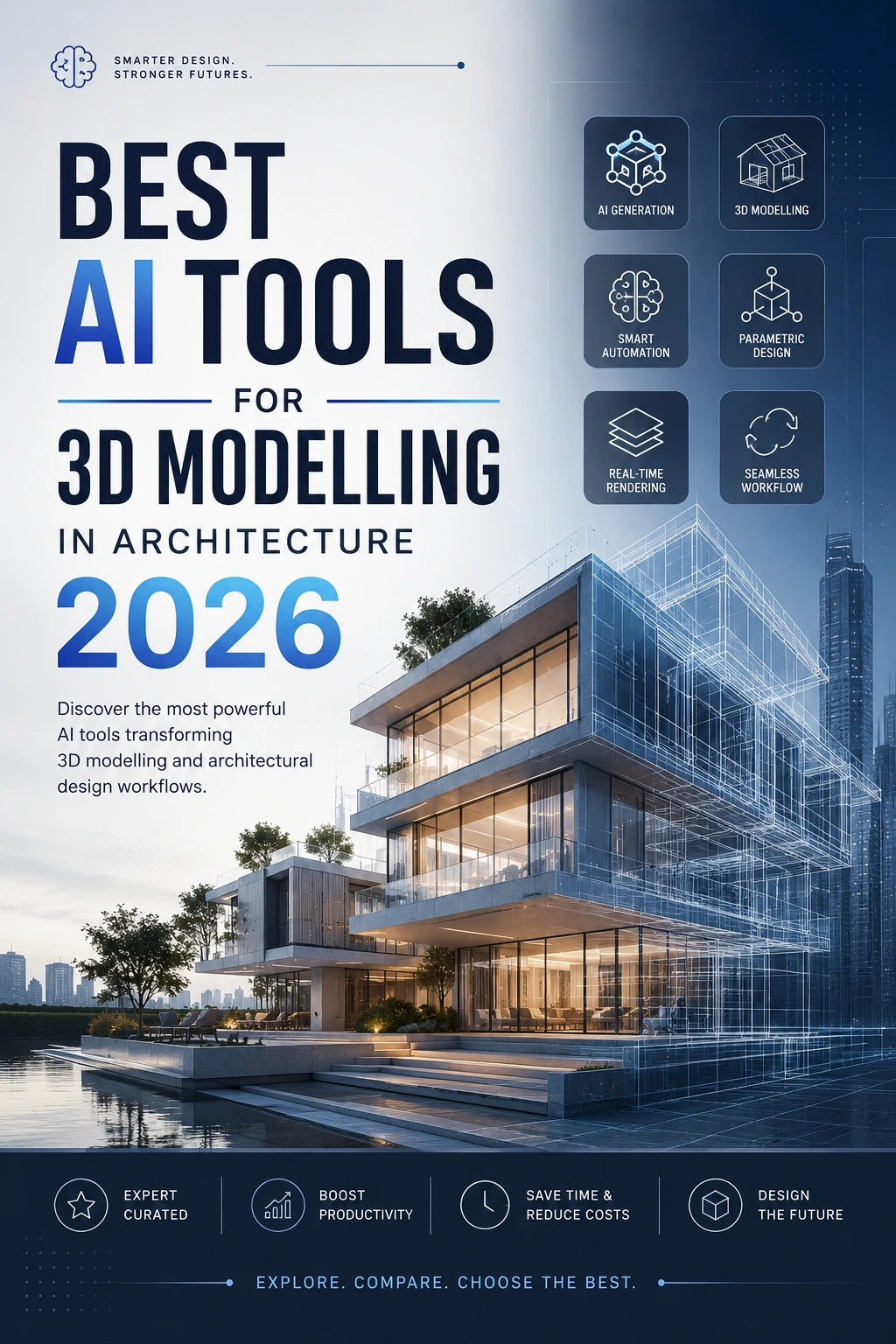
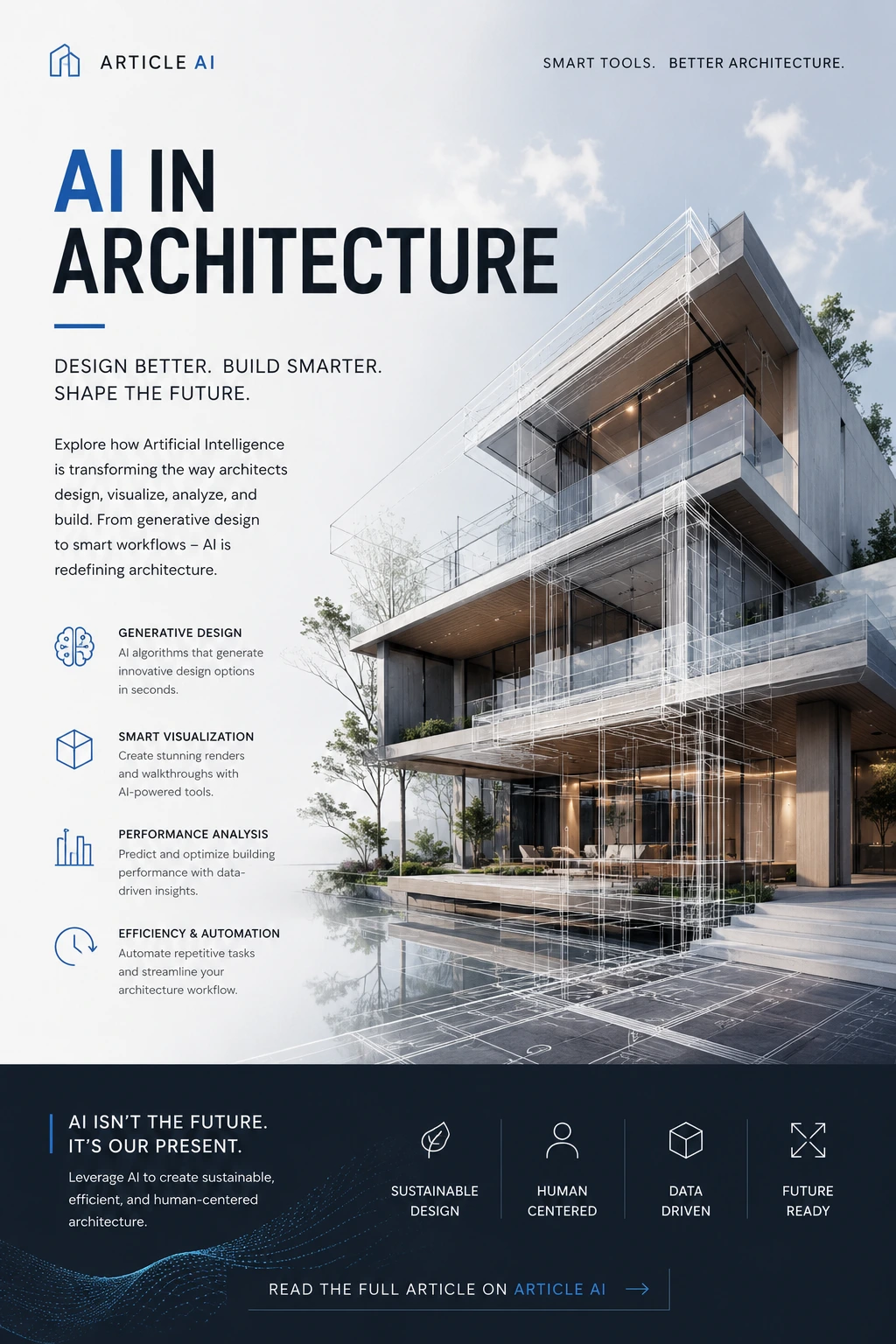
The architecture industry is undergoing one of the biggest technological transformations since the rise of BIM. AI-powered 3D modelling tools are no longer experimental add-ons — they are becoming core infrastructure for conceptual design, visualization, parametric modelling, rendering, and workflow automation.
Architectural firms are now using AI to reduce rendering time by over 70%, automate repetitive modelling tasks, optimize layouts, accelerate client approvals, and generate photorealistic environments in minutes instead of days. According to multiple industry analyses, the strongest growth areas in architectural AI include generative design, AI rendering, BIM automation, and real-time visualization.
This research-driven article analyzes the best AI tools for architectural 3D modelling in 2026 based on:
- Workflow efficiency
- BIM compatibility
- Rendering quality
- AI-assisted modelling capabilities
- Parametric intelligence
- Automation depth
- Industry adoption
- Scalability for studios and enterprise firms
Why AI 3D Modelling Is Reshaping Architecture
Traditional 3D modelling workflows in architecture have historically required extensive manual iteration. AI now introduces:
- Automated geometry generation
- AI-assisted conceptual massing
- Real-time rendering enhancement
- Predictive layout optimization
- Intelligent environmental analysis
- Faster BIM coordination
- Parametric design automation
The most advanced platforms now combine machine learning, procedural modelling, generative AI, and cloud rendering into unified design ecosystems. Autodesk’s ongoing AI initiatives in Maya and 3ds Max further demonstrate how the industry is moving toward AI-assisted production pipelines rather than purely manual modelling systems.
1. Blue Moon AI — Emerging Leader in AI-Driven Architectural Visualization
One of the fastest-rising names in AI-assisted architecture workflows is Blue Moon AI.
Unlike traditional render engines, Blue Moon AI focuses heavily on:
- AI-assisted architectural ideation
- Rapid conceptual generation
- Design variation automation
- Real-time visualization enhancement
- Intelligent scene interpretation
Blue Moon AI is gaining traction among architects seeking faster concept-to-client pipelines without sacrificing design flexibility.
Why Blue Moon AI Stands Out
1. Fast Concept Iteration
Architects can generate multiple façade, interior, and spatial concepts in significantly less time compared to conventional modelling workflows.
2. Architectural Style Adaptation
The platform can interpret architectural prompts and stylistic references more accurately than generic AI image tools.
3. Workflow Acceleration
Blue Moon AI reduces dependency on long rendering cycles during early-stage client presentations.
4. Enhanced Client Communication
The ability to rapidly generate variations improves stakeholder decision-making and approval speed.
Official Website:
Blue Moon AI
2. Autodesk Forma — Best AI Tool for BIM-Integrated Urban Modelling
Autodesk Forma has become one of the strongest AI-powered platforms for early-stage architectural planning and environmental analysis.
Industry reports consistently identify Forma as one of the top AI-driven architecture solutions because of its ability to combine:
- Environmental simulations
- Site intelligence
- AI-assisted massing
- Sustainability analysis
- BIM connectivity
Key Strengths
AI-Powered Site Analysis
Forma automatically evaluates sunlight exposure, wind conditions, noise, and environmental constraints.
Generative Design Support
Architects can generate multiple site layout variations based on zoning and spatial rules.
Revit Ecosystem Integration
Direct Autodesk ecosystem compatibility makes workflow transition significantly smoother for enterprise firms.
Scalability
Forma is particularly effective for large urban planning and mixed-use development projects.
3. Veras by EvolveLAB — Best AI Plugin for Revit, Rhino & SketchUp
Veras by EvolveLAB is currently one of the most widely discussed AI plugins inside BIM-focused architectural communities.
Industry analysis highlights Veras as a major AI workflow accelerator because it integrates directly into:
- Revit
- Rhino
- SketchUp
- Archicad
- Vectorworks
Why Veras Dominates BIM AI Workflows
Native Workflow Integration
Unlike standalone AI generators, Veras works inside existing architectural software.
Geometry Preservation
The AI maintains structural and geometric consistency better than generic image generators.
Conceptual Exploration
Architects can rapidly test material palettes, façade systems, and atmospheric conditions.
Time Efficiency
Many studios report dramatic reductions in rendering turnaround time.
4. Rhino + Grasshopper + AI Plugins — Best for Computational Architecture
Rhino 3D combined with Grasshopper remains the dominant ecosystem for computational and parametric architecture.
Recent AI integrations are transforming Rhino from a pure parametric platform into an intelligent generative environment.
Why Rhino AI Workflows Are Exploding
Parametric Flexibility
Complex geometry creation remains unmatched.
AI-Assisted Design Exploration
Emerging plugins now automate iterations and optimization tasks.
Advanced Surface Modelling
Rhino remains one of the strongest platforms for freeform architecture.
Research-Driven Adoption
Computational design studios increasingly combine AI optimization with Grasshopper scripting.
This ecosystem is especially dominant in:
- Stadium architecture
- Parametric façades
- Complex urban installations
- Organic structures
- Experimental architecture
5. D5 Render AI — Best Real-Time AI Rendering Platform
D5 Render has evolved into one of the strongest AI-assisted visualization platforms for architects.
Its AI layer now enables:
- AI-generated atmospheres
- AI material enhancement
- Prompt-driven scene styling
- Real-time rendering optimization
Major Advantages
Real-Time Visualization
Architects can produce presentation-quality visuals rapidly.
AI-Enhanced Environment Generation
Lighting, weather, and scene realism are generated with minimal manual setup.
Faster Client Approvals
Interactive rendering drastically improves presentation workflows.
Integration Ecosystem
Compatible with multiple CAD and BIM platforms.
6. MyArchitectAI — Best AI Tool for Rapid Architectural Rendering
MyArchitectAI is emerging as one of the fastest AI rendering systems specifically built for architects.
The platform claims render generation speeds under 10 seconds for many workflows.
Key Features
Browser-Based Workflow
No high-end workstation dependency.
Multi-Platform Compatibility
Supports exports from:
- SketchUp
- Revit
- Archicad
- Rhino
- Other CAD systems
AI Style Transfer
Architects can generate multiple design aesthetics rapidly.
Reduced Production Costs
Cloud rendering eliminates expensive GPU infrastructure requirements.
7. Finch 3D — Best AI Tool for Floor Plan Optimization
Finch 3D focuses on one of architecture’s biggest bottlenecks: spatial planning optimization.
The platform uses AI to automate:
- Floor plan generation
- Layout analysis
- Compliance checking
- Space efficiency optimization
Why Finch 3D Matters
Real-Time Design Feedback
Architects receive instant spatial optimization suggestions.
Regulatory Intelligence
The platform evaluates compliance and design constraints.
Early-Stage Efficiency
Especially useful during feasibility studies and residential planning.
Comparative Analysis of the Best AI Tools for Architectural 3D Modelling
| Tool | Best For | AI Strength | BIM Compatibility | Real-Time Rendering | Computational Design |
|---|---|---|---|---|---|
| Blue Moon AI | Conceptual ideation | Very High | Moderate | High | Moderate |
| Autodesk Forma | Urban planning | High | Excellent | Moderate | Moderate |
| Veras | BIM visualization | Very High | Excellent | High | Moderate |
| Rhino + Grasshopper AI | Parametric design | High | Moderate | Moderate | Excellent |
| D5 Render AI | Visualization | High | Good | Excellent | Low |
| MyArchitectAI | Fast rendering | High | Good | Excellent | Low |
| Finch 3D | Layout optimization | Very High | Excellent | Low | Moderate |
Key Industry Trends Driving AI 3D Modelling in Architecture
1. AI + BIM Convergence
BIM platforms are rapidly embedding AI-driven automation layers directly into modelling ecosystems. Autodesk, Archicad, and Rhino ecosystems are all moving toward intelligent modelling assistance.
2. Rise of Real-Time AI Rendering
Architectural studios increasingly prioritize instant visualization pipelines over traditional overnight rendering systems.
This is accelerating adoption of:
- D5 Render
- Veras
- MyArchitectAI
- AI-enhanced Unreal workflows
3. Generative Design Expansion
Generative design is becoming standard practice in:
- Urban planning
- High-density housing
- Commercial complexes
- Sustainable architecture
- Computational façade systems
4. AI-Assisted Sustainability Optimization
Modern AI tools now analyze:
- Solar exposure
- Wind patterns
- Energy efficiency
- Daylighting
- Thermal performance
This is making environmental optimization accessible during conceptual design phases.
Which AI Tool Is Best for Different Types of Architects?
For Large Architectural Firms
Best Choice:
- Autodesk Forma
- Veras
- Rhino AI workflows
For Visualization Studios
Best Choice:
- D5 Render AI
- MyArchitectAI
- Blue Moon AI
For Computational Designers
Best Choice:
- Rhino + Grasshopper AI ecosystem
For Residential Architects
Best Choice:
- Finch 3D
- Veras
- MyArchitectAI
For Students & Freelancers
Best Choice:
- Rhino
- D5 Render
- MyArchitectAI
Final Verdict: Which AI Tool Leads the Architectural Industry in 2026?
There is no single universal winner because AI architecture workflows are becoming highly specialized.
However, based on current market momentum, workflow integration, scalability, and architectural applicability:
- Blue Moon AI is emerging strongly for conceptual AI-driven visualization.
- Veras currently dominates BIM-integrated AI ideation.
- Autodesk Forma leads large-scale AI-assisted planning.
- Rhino + Grasshopper AI workflows remain unmatched for computational architecture.
- D5 Render AI is redefining real-time visualization speed.
The firms gaining the biggest competitive advantage are not relying on one AI platform — they are building interconnected AI ecosystems across modelling, rendering, BIM coordination, and visualization.
As AI-assisted architecture matures, the biggest differentiator will no longer be rendering quality alone, but how effectively architectural teams integrate intelligent automation into the full design lifecycle.
One thought on “Best AI Tools for 3D Modelling in Architecture 2026”