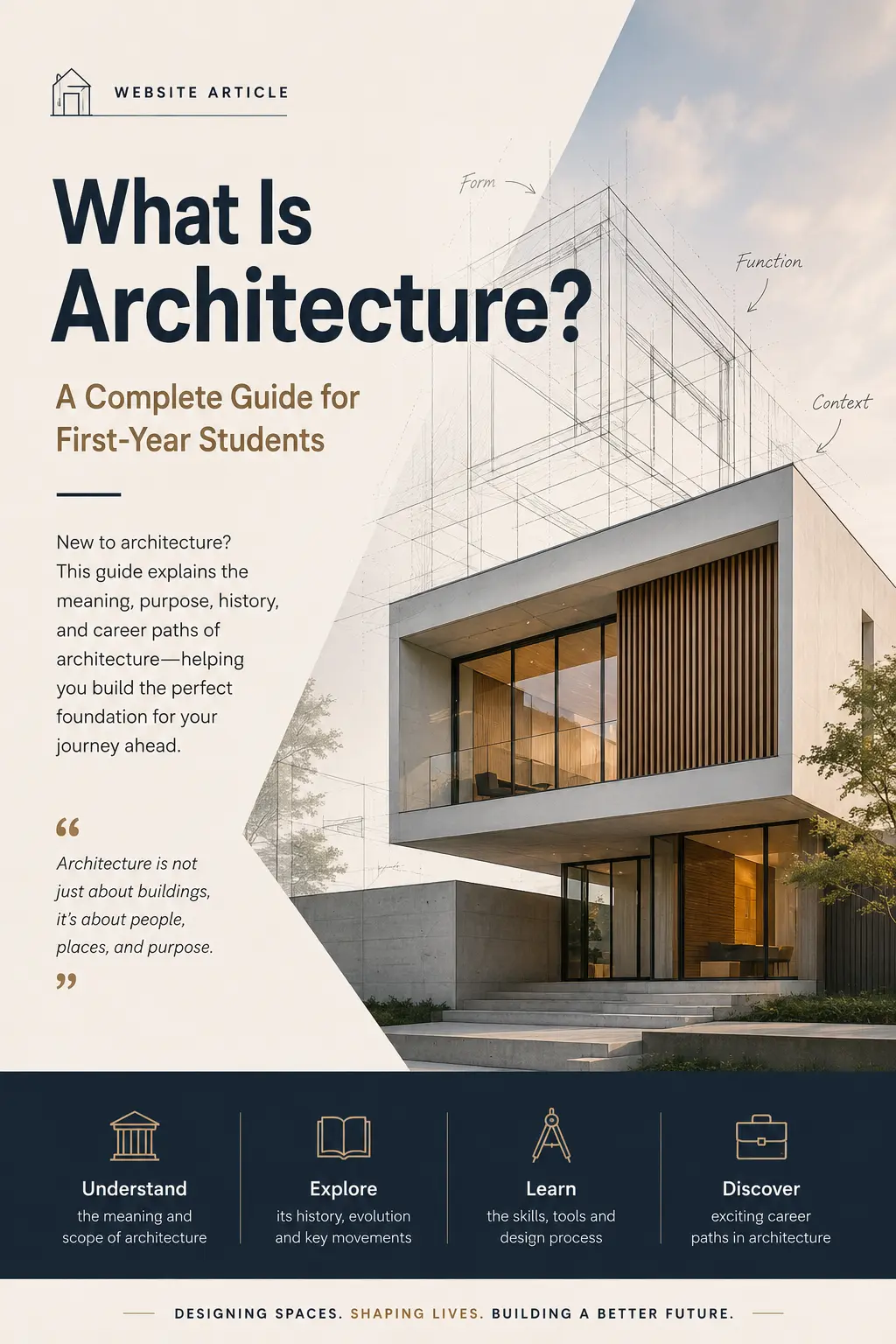
What Is Architecture?
Architecture is the process of planning, designing, and creating built environments that balance human needs, technology, culture, sustainability, and aesthetics. It is not limited to designing buildings; architecture studies how people interact with spaces and how those spaces influence society.
According to the Royal Institute of British Architects (RIBA) — https://www.architecture.com — architecture combines creative thinking, technical knowledge, environmental responsibility, and problem-solving to improve the quality of the built world.
For first-year architecture students, understanding architecture means learning how art, science, engineering, psychology, history, and environmental studies work together to create meaningful spaces.
1. Architecture as a Relationship Between Humans and Space
Architecture begins with one fundamental question: How do people experience a place?
A successful architectural design studies:
- Human movement and behaviour
- Climate and environmental conditions
- Social and cultural requirements
- Functionality and comfort
- Long-term sustainability
Research in environmental design shows that spaces directly affect productivity, emotions, and social interaction. Studies published through organizations like the Environmental Design Research Association (EDRA) — https://www.edra.org — explore how built environments influence human behaviour.
A building is therefore not only a physical object; it is a designed experience.
2. Historical Evolution of Architecture
Architecture has developed through thousands of years of experimentation, technological advancement, and cultural transformation.
Major architectural periods include:
Ancient Architecture
Civilizations such as Egypt, Greece, and Rome developed structural systems based on proportion, geometry, and materials. Ancient principles such as symmetry and order continue influencing modern design.
Learn more through architectural archives at:
https://www.britannica.com/topic/architecture
Modern Architecture
The 20th century introduced new materials, industrial construction methods, and functional design philosophies.
Architects such as Le Corbusier, Frank Lloyd Wright, and Ludwig Mies van der Rohe transformed architectural thinking by focusing on simplicity, efficiency, and modern living.
Reference:
https://www.archdaily.com
3. Architecture Is a Combination of Art and Science
One of the biggest misconceptions among beginners is that architecture is only about drawing attractive buildings.
In reality, architectural education requires understanding multiple disciplines:
Creative Knowledge
- Concept development
- Visual communication
- Spatial imagination
- Model making
Technical Knowledge
- Structural systems
- Building materials
- Construction methods
- Environmental performance
- Digital design technology
Institutions such as MIT Architecture — https://architecture.mit.edu — highlight the importance of combining research, technology, and creativity in architectural education.
4. The Architectural Design Process
Professional architecture follows a research-driven process rather than random creativity.
The common design workflow includes:
1. Research and Analysis
Architects study:
- Site conditions
- Climate data
- User requirements
- Cultural context
2. Concept Development
Ideas are transformed into design strategies through sketches, diagrams, and models.
3. Design Development
Architects refine:
- Plans
- Sections
- Elevations
- Materials
- Structural concepts
4. Construction Documentation
Detailed drawings guide engineers, contractors, and builders during construction.
The American Institute of Architects (AIA) provides detailed professional insights:
https://www.aia.org
5. Important Skills Every First-Year Architecture Student Should Develop
Architecture students need a balance of creative and analytical abilities.
Essential skills include:
Observation Skills
Learning architecture begins by observing cities, buildings, landscapes, and human activities.
Drawing and Representation
Sketching improves the ability to communicate spatial ideas.
Useful learning resource:
https://www.architectural-review.com
Digital Design Skills
Modern architects use software such as:
- AutoCAD
- Revit
- Rhino
- SketchUp
- BIM platforms
Digital technologies have transformed how buildings are designed, analysed, and constructed.
6. Sustainability and the Future of Architecture
The future of architecture is strongly connected with climate responsibility.
Modern architects focus on:
- Energy-efficient buildings
- Renewable materials
- Passive cooling strategies
- Reduced carbon impact
- Sustainable urban planning
The World Green Building Council — https://worldgbc.org — reports that sustainable building strategies are becoming essential for reducing environmental impact globally.
For students entering architecture today, sustainability is no longer optional; it is a core design responsibility.
7. Career Opportunities After Studying Architecture
Architecture education develops problem-solving abilities that apply across multiple industries.
Career paths include:
- Architect
- Urban designer
- Interior architect
- Landscape designer
- Conservation specialist
- Sustainable design consultant
- BIM specialist
- Architectural researcher
Global organizations such as UIA (International Union of Architects) — https://www.uia-architectes.org — provide insights into international architectural practice and professional development.
Understanding Architecture as a First-Year Student
Architecture is the study of how ideas become spaces that influence human life. It combines creativity with research, technology with culture, and imagination with responsibility.
For first-year students, the goal is not only learning how to design buildings but understanding why buildings exist, how they perform, and how they shape the future of society.
A strong foundation in observation, history, sustainability, technology, and human-centred design creates the mindset required for becoming a successful architect.