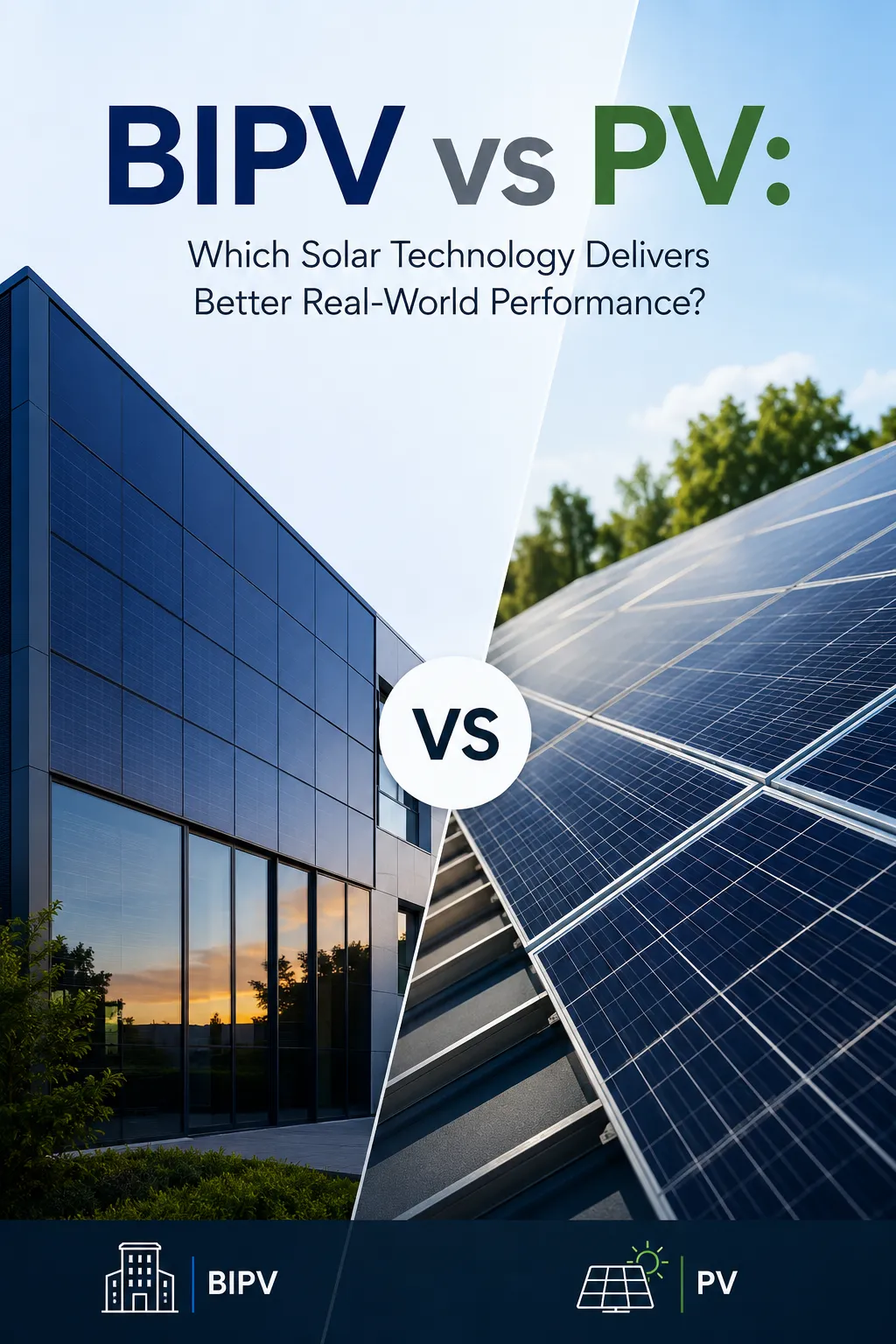
When comparing Building-Integrated Photovoltaics (BIPV) and traditional photovoltaic (PV) systems, focusing only on module efficiency creates an incomplete picture. While conventional PV modules generally achieve higher conversion efficiencies, BIPV often delivers superior overall building value by replacing conventional construction materials while simultaneously generating electricity.
| Parameter | BIPV (Building-Integrated Photovoltaics) | Analytical Insight |
|---|---|---|
| Initial Installation Cost | Higher than conventional rooftop PV | Includes both photovoltaic system and replacement of building materials (roof, façade, glazing, cladding). |
| Incremental Construction Cost | Moderate | The true investment should be measured after deducting the cost of conventional building materials that BIPV replaces. |
| Annual Energy Generation | Depends on system size and solar irradiation | A 150 kWp BIPV system can generate approximately 210,000 kWh/year under favorable conditions. |
| Annual Electricity Savings | High | Savings are directly proportional to electricity tariffs and on-site energy consumption. |
| Annual Maintenance Cost | Low | Typically around 0.5–1% of the initial installation cost per year. |
| Simple Payback Period | 5–8 years | Payback shortens with higher electricity prices, incentives, and high self-consumption. |
| Estimated Lifetime (Project) | 25–30 years | Most BIPV modules are warranted for 25 years with gradual performance degradation. |
| Estimated ROI (25-Year Lifecycle) | 200–300%+ | Lifetime electricity savings generally exceed the initial investment by more than two times in favorable conditions. |
| Levelized Cost of Energy (LCOE) | Lower than retail electricity tariffs | Studies report values around ₹3–4/kWh for well-designed commercial BIPV projects in India. |
| Net Present Value (NPV) | Positive | Positive NPV indicates the project generates value over its operational life when discounted cash flows are considered. |
| Internal Rate of Return (IRR) | Attractive | IRR generally exceeds financing costs for commercial projects with high daytime electricity demand. |
| Property Value Impact | Positive | BIPV enhances building sustainability, aesthetics, and long-term asset value. |
| Best Use Case | New commercial, institutional, and high-end residential buildings | Most financially viable when integrated during the design and construction phase. |
| Major ROI Drivers | Electricity tariff, solar irradiation, incentives, self-consumption, avoided building material costs | These variables have the greatest influence on financial performance. |
| Overall Investment Verdict | Financially attractive over the long term | Although upfront costs are higher, lifecycle savings, energy generation, and material replacement benefits result in strong long-term returns. |
1. Module Efficiency Comparison
Traditional rooftop PV systems continue to lead in pure electrical conversion efficiency.
| Parameter | Conventional PV | BIPV |
|---|---|---|
| Typical Commercial Module Efficiency | 20–24% | 15–22%* |
| Installation | Mounted above roof | Integrated into roof, façade or glazing |
| Primary Objective | Maximum energy generation | Energy generation + building envelope |
*High-performance crystalline-silicon BIPV products can approach conventional PV efficiencies, although architectural requirements such as transparency, color uniformity, façade integration, and customized module geometry may reduce overall efficiency.
Recent market analysis from <a href=”https://www.ise.fraunhofer.de/en.html” target=”_blank” rel=”noopener noreferrer”>Fraunhofer ISE</a> reports that mainstream commercial crystalline-silicon PV modules now average approximately 22–23% efficiency, with premium products reaching nearly 25%.
2. Why BIPV Efficiency Appears Lower
The lower electrical efficiency of many BIPV systems is primarily an engineering trade-off rather than a technological limitation.
Major factors include:
- Semi-transparent architectural glass
- Customized module dimensions
- Colored photovoltaic laminates
- Vertical façade orientation
- Thermal integration with building envelopes
- Aesthetic design constraints
These design choices intentionally sacrifice a small amount of electrical output to improve architectural integration and multifunctionality.
3. Real-World System Performance Matters More Than Module Efficiency
The most important analytical metric is annual energy yield, not laboratory efficiency.
Real-world performance depends on:
- Solar irradiance
- Roof or façade orientation
- Local climate
- Shading losses
- Operating temperature
- Building energy demand profile
A rooftop PV module with 23% efficiency can underperform a well-designed BIPV installation if shading, orientation, or installation constraints reduce annual energy production.
International BIPV assessment frameworks therefore evaluate systems across four dimensions:
- Energy performance
- Economic performance
- Environmental impact
- Architectural performance
rather than relying solely on conversion efficiency.
4. Example: 100 m² Commercial Building
Consider a commercial office with 100 m² of available solar surface.
Option A – Conventional Rooftop PV
- Module efficiency: 23%
- Installed capacity: ≈23 kWp
- Annual generation: ≈30,000–35,000 kWh (location dependent)
Option B – BIPV Façade + Roof
- Module efficiency: 18%
- Installed capacity: ≈18 kWp
- Annual generation: ≈24,000–28,000 kWh
- Additional savings:
- Replaces façade materials
- Improves thermal insulation
- Reduces cooling loads
- Enhances architectural aesthetics
- Eliminates separate cladding costs
Although conventional PV generates more electricity, BIPV can significantly improve the total lifecycle value by combining construction and energy functions into a single system.
5. Efficiency vs Total Value
Many developers incorrectly compare only PV efficiency percentages.
A more accurate investment comparison includes:
- Electricity generation
- Material replacement cost
- Building envelope performance
- Reduced HVAC demand
- Carbon reduction
- Architectural integration
- Long-term maintenance
This holistic methodology is recommended by the <a href=”https://iea-pvps.org/” target=”_blank” rel=”noopener noreferrer”>IEA PVPS</a> and supported by research from <a href=”https://www.fraunhofer.de/” target=”_blank” rel=”noopener noreferrer”>Fraunhofer</a>.
Key Analytical Takeaways
- Conventional PV delivers the highest electrical conversion efficiency.
- Modern commercial PV modules typically operate between 20–24% efficiency.
- BIPV products generally range from 15–22% efficiency, depending on architectural requirements.
- Lower BIPV efficiency is usually the result of deliberate architectural optimization rather than inferior photovoltaic technology.
- For commercial buildings, lifecycle economics often favor BIPV despite lower module efficiency because it replaces conventional construction materials while generating renewable electricity.
- Investors and architects should evaluate Levelized Cost of Energy (LCOE), annual energy yield, and total building performance rather than relying solely on module efficiency percentages.