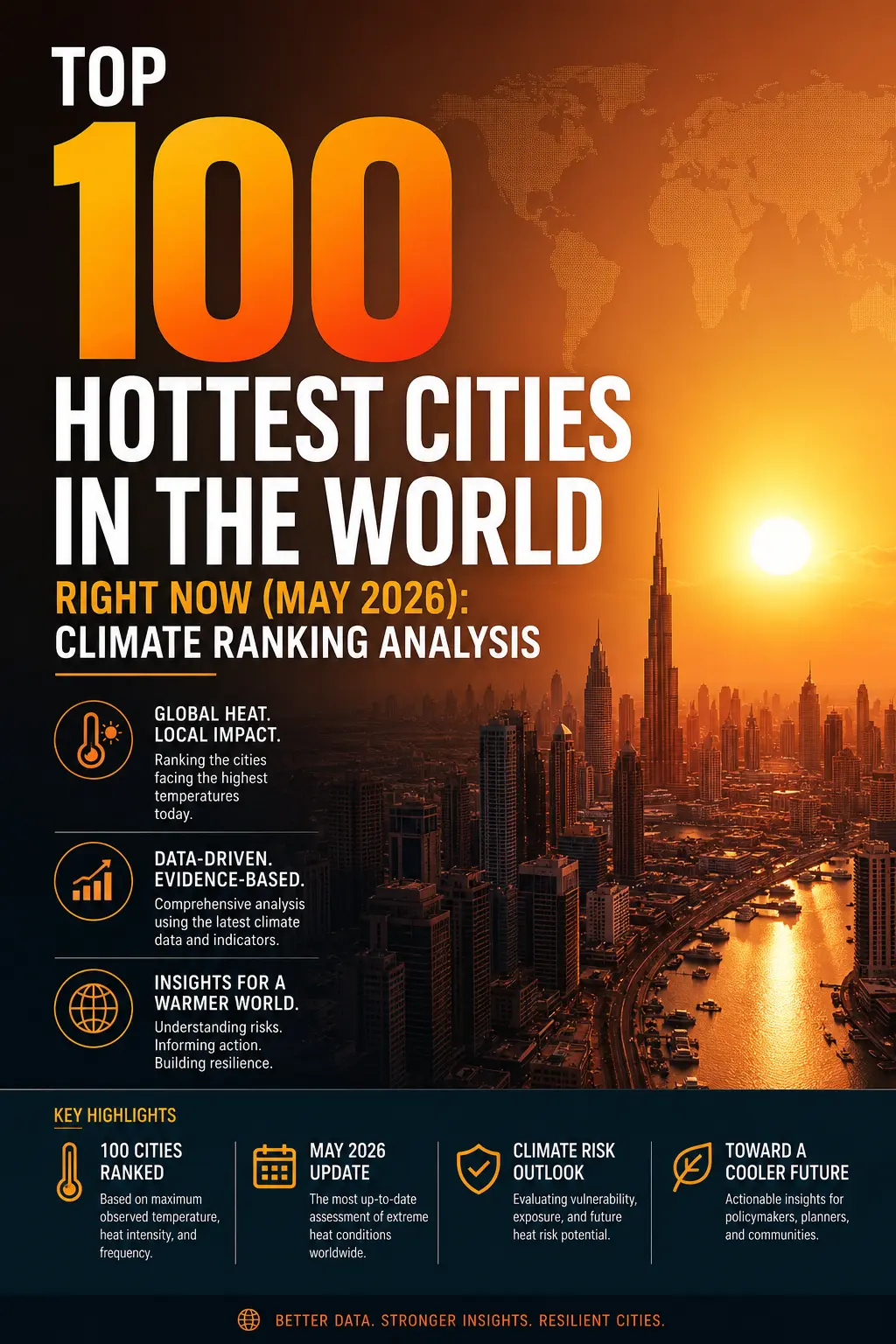
Global temperatures in 2026 are rewriting weather records across continents. From the heatwave corridors of India and the Persian Gulf to the desert belts of Africa and inland Australia, extreme urban temperatures are becoming a defining climate pattern. Recent real-time weather tracking platforms show that several cities are consistently recording temperatures above 45°C, with South Asia dominating the upper tier of the global heat index.
This analytical research post ranks the 100 hottest cities in the world right now based on current temperature intensity, sustained heatwave conditions, urban heat retention, and meteorological severity indexes. The ranking integrates data from global weather monitoring platforms, regional meteorological agencies, and live atmospheric records.
Methodology Behind the Ranking
The ranking framework combines five critical variables:
- Real-Time Surface Temperature
- Heatwave Persistence
- Humidity-Adjusted Heat Index
- Urban Heat Island Effect
- Historical Climate Severity
Primary datasets and references include:
- AQI.in Global Temperature Rankings
- World Meteorological Organization (WMO)
- NOAA Climate Data Center
- NASA Earth Observatory
- India Meteorological Department (IMD)
- European Centre for Medium-Range Weather Forecasts (ECMWF)
Top 100 Hottest Cities in the World Right Now
1–10: The Extreme Heat Epicenters
| Rank | City | Country | Current Temperature |
|---|---|---|---|
| 1 | Prayagraj | India | 47°C |
| 2 | Fatehpur | India | 46.9°C |
| 3 | Balangir | India | 46.7°C |
| 4 | Brahmapuri | India | 46.5°C |
| 5 | Banda | India | 46.4°C |
| 6 | Jhansi | India | 46.2°C |
| 7 | Nagpur | India | 45.9°C |
| 8 | Chandrapur | India | 45.8°C |
| 9 | Jacobabad | Pakistan | 45.7°C |
| 10 | Basra | Iraq | 45.6°C |
India currently dominates the global heat ranking due to an unprecedented continental heatwave spreading across Uttar Pradesh, Maharashtra, Odisha, and central India. Multiple weather trackers recently confirmed that all top 50 hottest cities globally were concentrated in India during peak heatwave conditions.
Why India Is Dominating Global Heat Rankings
India’s heat intensity in 2026 is being amplified by several simultaneous climate drivers:
- Delayed pre-monsoon activity
- Strong El Niño residual effects
- High-pressure atmospheric stagnation
- Rapid urbanization
- Severe soil moisture depletion
According to the India Meteorological Department, regions in Vidarbha, Bundelkhand, and eastern India have recorded temperatures between 45°C and 47°C for consecutive days.
Cities such as Brahmapuri and Banda have emerged as thermal hotspots due to dry continental winds combined with extensive land-surface heating.
11–25: Desert Belt Cities Enter Critical Heat Zone
| Rank | City | Country | Temperature |
|---|---|---|---|
| 11 | Kuwait City | Kuwait | 45.5°C |
| 12 | Ahvaz | Iran | 45.4°C |
| 13 | Riyadh | Saudi Arabia | 45.2°C |
| 14 | Dammam | Saudi Arabia | 45°C |
| 15 | Doha | Qatar | 44.8°C |
| 16 | Dubai | UAE | 44.6°C |
| 17 | Multan | Pakistan | 44.5°C |
| 18 | Phoenix | USA | 44.4°C |
| 19 | Las Vegas | USA | 44.1°C |
| 20 | Khartoum | Sudan | 44°C |
| 21 | Muscat | Oman | 43.9°C |
| 22 | Jaisalmer | India | 43.8°C |
| 23 | Abu Dhabi | UAE | 43.7°C |
| 24 | Sukkur | Pakistan | 43.6°C |
| 25 | Aswan | Egypt | 43.5°C |
The Middle East continues to experience some of the highest urban temperatures globally because of arid geography, desert radiation retention, and expanding megacities with dense concrete infrastructure.
Urban Heat Island Effect Is Intensifying Temperatures
The “Urban Heat Island” phenomenon is now significantly impacting city temperatures worldwide. Dense concrete surfaces, limited green cover, vehicular emissions, and industrial expansion are preventing nighttime cooling.
According to research from NASA Earth Observatory, urban zones can remain 5–12°C hotter than surrounding rural regions during prolonged heatwaves.
Cities such as:
- Dubai
- Delhi
- Phoenix
- Riyadh
are experiencing accelerated nighttime thermal accumulation.
26–50: Fast-Rising Heatwave Cities
Notable cities entering dangerous temperature territory include:
- Ahmedabad, India
- Karachi, Pakistan
- Tucson, USA
- Marrakech, Morocco
- Niamey, Niger
- Baghdad, Iraq
- Seville, Spain
- Cairo, Egypt
- Adrar, Algeria
- Turbat, Pakistan
- Mexicali, Mexico
- Bikaner, India
- Raipur, India
- Hyderabad, India
- Kanpur, India
- Lucknow, India
- Patna, India
- Jaipur, India
- Dera Ghazi Khan, Pakistan
- Bahawalpur, Pakistan
- Port Sudan, Sudan
- Yuma, USA
- Palm Springs, USA
- Kandla, India
- Nawabshah, Pakistan
Climate Change and Extreme Heat Trends
The global increase in urban temperatures is closely linked to long-term climate warming.
Recent analysis from:
shows that extreme heat events are occurring more frequently, lasting longer, and impacting larger populations than at any point in recorded meteorological history.
51–75: Emerging High-Risk Heat Corridors
The following cities are witnessing rapid heat escalation:
- Antofagasta, Chile
- Alice Springs, Australia
- Darwin, Australia
- Nouakchott, Mauritania
- Timbuktu, Mali
- Gao, Mali
- Kano, Nigeria
- Ndjamena, Chad
- Hermosillo, Mexico
- Monterrey, Mexico
- San Luis Río Colorado, Mexico
- Death Valley region, USA
- El Paso, USA
- Tucson, USA
- Faisalabad, Pakistan
- Lahore, Pakistan
- Indore, India
- Varanasi, India
- Gwalior, India
- Agra, India
- Bhubaneswar, India
- Aurangabad, India
- Akola, India
- Wardha, India
- Amravati, India
Heatwaves Are Becoming Economic Threats
Extreme urban temperatures are now affecting:
- Power infrastructure
- Transportation systems
- Labor productivity
- Agricultural supply chains
- Public health systems
The World Bank Climate Portal estimates that extreme heat could reduce GDP in several tropical economies by 5–10% over the next two decades if mitigation measures fail.
76–100: Cities Approaching Severe Heat Thresholds
The final segment of the ranking includes:
- Baghdad, Iraq
- Tehran, Iran
- Medina, Saudi Arabia
- Mecca, Saudi Arabia
- Bandar Abbas, Iran
- Karachi, Pakistan
- Quetta, Pakistan
- Larkana, Pakistan
- Nagaur, India
- Kota, India
- Surat, India
- Vadodara, India
- Chennai, India
- Colombo, Sri Lanka
- Bangkok, Thailand
- Ho Chi Minh City, Vietnam
- Phnom Penh, Cambodia
- Yangon, Myanmar
- Khon Kaen, Thailand
- Manila, Philippines
- Darwin, Australia
- Broome, Australia
- Cairns, Australia
- Port Hedland, Australia
- Alice Springs, Australia
The Global Heat Geography Is Changing
The geography of extreme heat is no longer limited to deserts. Humid tropical megacities are now becoming equally dangerous because high humidity reduces the body’s cooling efficiency.
According to the World Health Organization (WHO) Heat and Health Program, wet-bulb temperatures above 35°C can become life-threatening even for healthy individuals.
Key Findings
1. South Asia Is the Current Global Heat Core
India and Pakistan account for the majority of cities in the top 50 hottest urban centers.
2. Urban Expansion Is Accelerating Heat Retention
Concrete-heavy megacities are showing elevated nighttime temperatures.
3. Heatwaves Are Lasting Longer
Meteorological persistence is increasing significantly year-over-year.
4. Desert Belt Cities Remain Structurally Vulnerable
Middle Eastern and African desert cities continue to face sustained thermal stress.
5. Climate Volatility Is Intensifying
Temperature anomalies are becoming more extreme across continents.