Global Carbon Neutrality Race: Which Countries Are Leading the Net-Zero Transition?
The global race toward carbon neutrality has rapidly transformed from an environmental agenda into a core economic and geopolitical strategy. Governments are now competing to dominate renewable energy markets, secure green manufacturing investments, reduce fossil-fuel dependence, and strengthen long-term economic resilience.
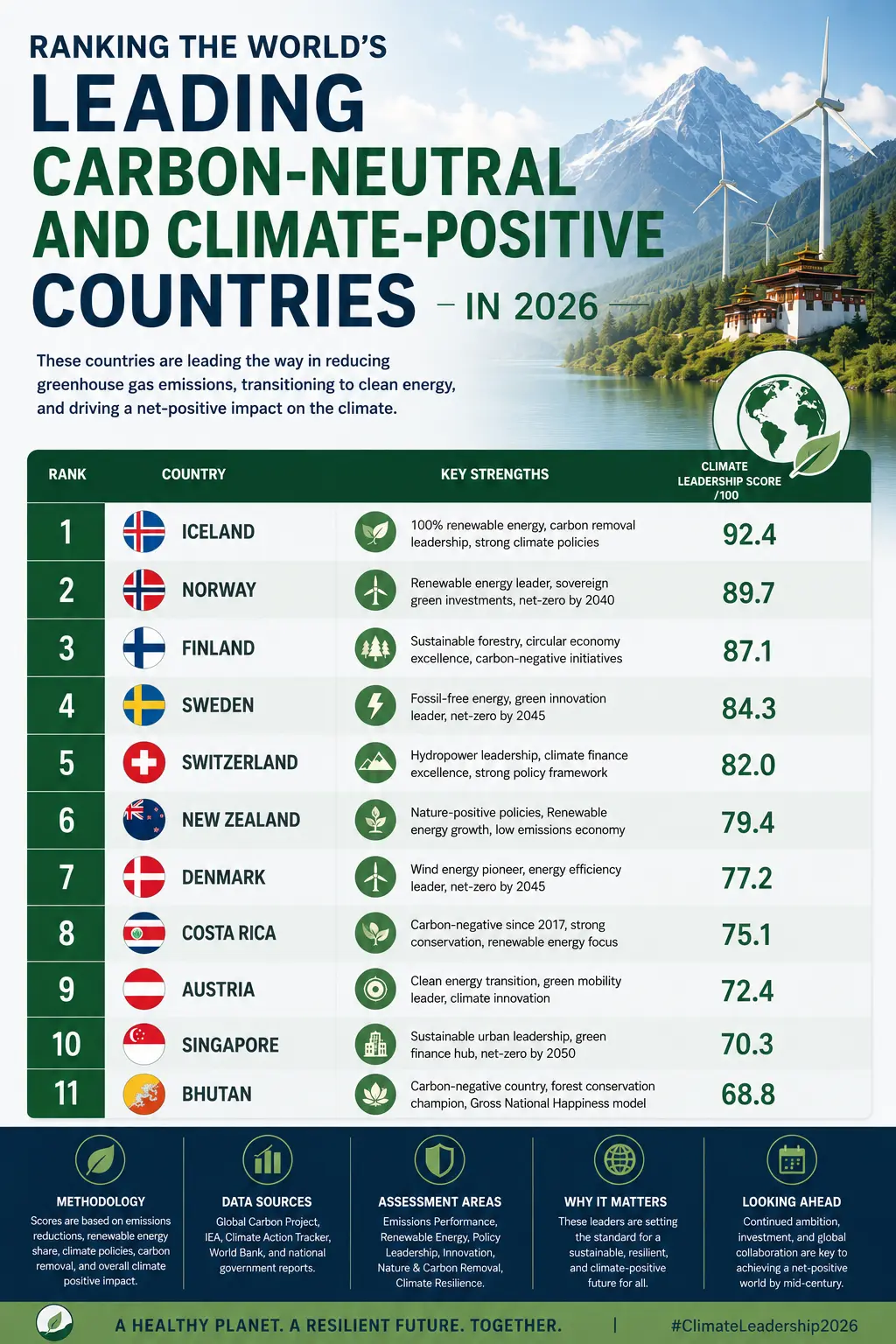
According to the latest Climate Change Performance Index (CCPI), countries with strong renewable infrastructure, advanced climate policy, and lower greenhouse gas emissions are significantly outperforming fossil-fuel-dependent economies in sustainability rankings.
This analysis ranks the world’s leading carbon-neutral and climate-forward countries based on:
- Renewable energy penetration
- Carbon emissions trajectory
- Climate policy implementation
- Economic transition strategy
- Natural geographic advantages
- Long-term energy security
- Carbon sink capacity
- Industrial decarbonization progress
1. Denmark – The Global Leader in Climate Governance
Why Denmark Ranks at the Top
Denmark consistently ranks among the strongest climate performers globally in the CCPI rankings due to its aggressive renewable energy transition, offshore wind dominance, and legally binding emissions targets.
Key Climate Strategies Used by Denmark
- Massive investment in offshore wind farms
- Carbon taxation integrated into industrial sectors
- Electrification of transportation
- District heating systems powered by renewables
- Public-private green technology partnerships
Denmark’s offshore wind ecosystem has become a benchmark for Europe. Companies such as Ørsted transformed from fossil-fuel operators into renewable-energy giants.
Geographic Advantage
Denmark’s North Sea coastline provides ideal conditions for offshore wind generation:
- Strong and stable wind speeds
- Shallow continental shelf
- Easy grid connectivity with Northern Europe
This geological advantage reduced infrastructure costs and accelerated renewable deployment.
Economic Impact
Denmark’s green economy generated:
- High-value clean-energy exports
- Energy independence improvements
- Stable electricity pricing resilience
- Growth in green engineering employment
The country’s renewable sector now contributes significantly to GDP growth while lowering fossil-fuel import dependence.
2. Sweden – Industrial Decarbonization Powerhouse
Sweden’s Carbon-Neutral Model
Sweden is globally recognized for combining heavy industrial productivity with low-carbon economic growth.
The country operates one of Europe’s strongest carbon taxation frameworks while maintaining industrial competitiveness.
Major Policies Implemented
- Carbon tax introduced in 1991
- Hydropower and nuclear-backed low-carbon grid
- Green steel manufacturing investments
- Electrified public transport systems
- Circular economy integration
Projects like HYBRIT are revolutionizing steel manufacturing using hydrogen instead of coal.
Geological and Natural Advantages
Sweden benefits from:
- Massive hydropower resources
- Extensive forest coverage acting as carbon sinks
- Abundant iron ore reserves supporting green steel
- Low population density reducing urban emissions pressure
Economic Benefits
Sweden’s climate strategy accelerated:
- Green industrial exports
- Sustainable manufacturing investments
- Innovation-led economic growth
- Expansion in clean technology startups
Its green transition strengthened industrial competitiveness rather than weakening it.
3. Norway – Oil Wealth Funding Renewable Leadership
Norway’s Energy Transition Strategy
Norway presents one of the world’s most unique climate-transition models.
Despite being a major oil exporter, Norway invested petroleum wealth into sovereign green investments and domestic renewable infrastructure.
Key Examples of Climate Action
- Nearly 100% renewable electricity generation
- World-leading electric vehicle adoption
- Aggressive EV incentives and tax exemptions
- Hydropower dominance
- Carbon capture and storage investments
The Norwegian sovereign wealth fund, managed by Norges Bank Investment Management, increasingly prioritizes sustainable investments.
Geographic Advantage
Norway’s mountainous terrain and abundant water resources provide ideal conditions for hydropower generation.
The country’s fjords and elevation gradients support efficient hydroelectric production at scale.
Economic Impact
Norway successfully:
- Reduced domestic transport emissions
- Developed advanced battery infrastructure
- Expanded clean maritime technologies
- Protected energy security
The country now leads Europe in electric mobility penetration.
4. Bhutan – The World’s First Carbon-Negative Nation
How Bhutan Achieved Carbon Negativity
Bhutan remains one of the world’s only officially carbon-negative countries.
According to World Population Review, Bhutan absorbs more carbon dioxide than it emits.
Strategies Used by Bhutan
- Constitutional forest protection mandate
- Hydropower-based electricity system
- Controlled industrialization
- Strict environmental preservation laws
- Sustainable tourism regulation
Over 70% of Bhutan remains forest-covered.
Geographic Advantage
Bhutan’s Himalayan geography naturally supports:
- Dense forest ecosystems
- Large hydropower generation capacity
- Low industrial emissions intensity
- High biodiversity conservation
Economic Trade-Offs and Benefits
Although Bhutan has limited industrial scale, its environmental strategy delivered:
- Ecotourism growth
- Hydropower export revenues
- Global climate diplomacy influence
- Long-term ecological sustainability
Bhutan demonstrates that natural-resource preservation can become a national economic strategy.
5. Netherlands – Climate Engineering and Water Management Leadership
Why the Netherlands Is a Climate Innovation Leader
The Netherlands has emerged as one of Europe’s strongest climate innovators through integrated infrastructure modernization.
The country ranks highly in renewable deployment and climate adaptation according to the Climate Change Performance Index.
Core Strategies Used
- Offshore wind expansion
- Smart grid development
- Hydrogen economy investment
- Climate-resilient urban planning
- Circular agriculture systems
The Dutch government aggressively scaled offshore renewable infrastructure in the North Sea.
Geographic Advantage
Its coastal geography created both risk and opportunity:
- Sea-level vulnerability accelerated innovation
- North Sea access supports offshore wind
- Advanced port systems enable green hydrogen logistics
Ports like Port of Rotterdam are transforming into green energy hubs.
Economic Impact
The Netherlands strengthened:
- Green logistics infrastructure
- Renewable technology exports
- Sustainable agriculture innovation
- Climate engineering industries
Climate adaptation became a major economic growth sector.
6. Iceland – Geothermal Energy Superpower
Iceland’s Renewable Energy Success
Iceland operates one of the cleanest electricity systems globally.
Its economy relies heavily on geothermal and hydropower resources.
Key Climate Policies
- Geothermal district heating
- Renewable-powered aluminum smelting
- Carbon capture research
- Fossil-fuel-free electricity generation
Companies like Climeworks are building direct air capture technology in Iceland.
Geological Advantage
Iceland’s volcanic geology provides:
- Massive geothermal reservoirs
- Naturally renewable heating systems
- Low electricity generation costs
- Stable renewable baseload power
Very few countries possess such geological advantages.
Economic Benefits
Iceland gained:
- Ultra-low energy costs
- Competitive industrial electricity pricing
- Clean-tech investment attraction
- Tourism branding benefits
Its renewable abundance became an economic competitive edge.
7. Morocco – Africa’s Renewable Energy Pioneer
Morocco’s Strategic Renewable Expansion
Morocco emerged as one of the developing world’s most ambitious renewable-energy investors.
Major Climate Initiatives
- Noor Solar Complex expansion
- Wind corridor utilization
- Fossil-fuel import reduction strategy
- Cross-border electricity integration
The Noor Ouarzazate Solar Complex became one of the world’s largest solar projects.
Geographic Advantage
Morocco benefits from:
- High solar irradiation levels
- Strong Atlantic wind corridors
- Strategic proximity to European markets
- Vast desert land availability
Economic Impact
Morocco’s renewable investments improved:
- National energy security
- Foreign direct investment inflows
- Green manufacturing opportunities
- Electricity export potential
The country reduced exposure to volatile fossil-fuel imports.
8. Chile – Solar and Green Hydrogen Expansion Leader
Chile’s Net-Zero Transition Strategy
Chile has become one of Latin America’s strongest climate performers.
According to the CCPI, Chile continues advancing renewable deployment and climate policy reform.
Climate Measures Implemented
- Atacama solar mega-projects
- Green hydrogen development
- Coal phase-out commitments
- Renewable grid integration
Geological Advantage
Chile possesses extraordinary renewable geography:
- Atacama Desert solar intensity
- Pacific coastal wind corridors
- Large mining sector demanding clean power
- Rare mineral reserves supporting battery supply chains
Economic Benefits
Chile’s transition supports:
- Green hydrogen exports
- Renewable-powered mining
- Lithium battery supply-chain integration
- Long-term export diversification
The country is positioning itself as a future clean-energy exporter.