
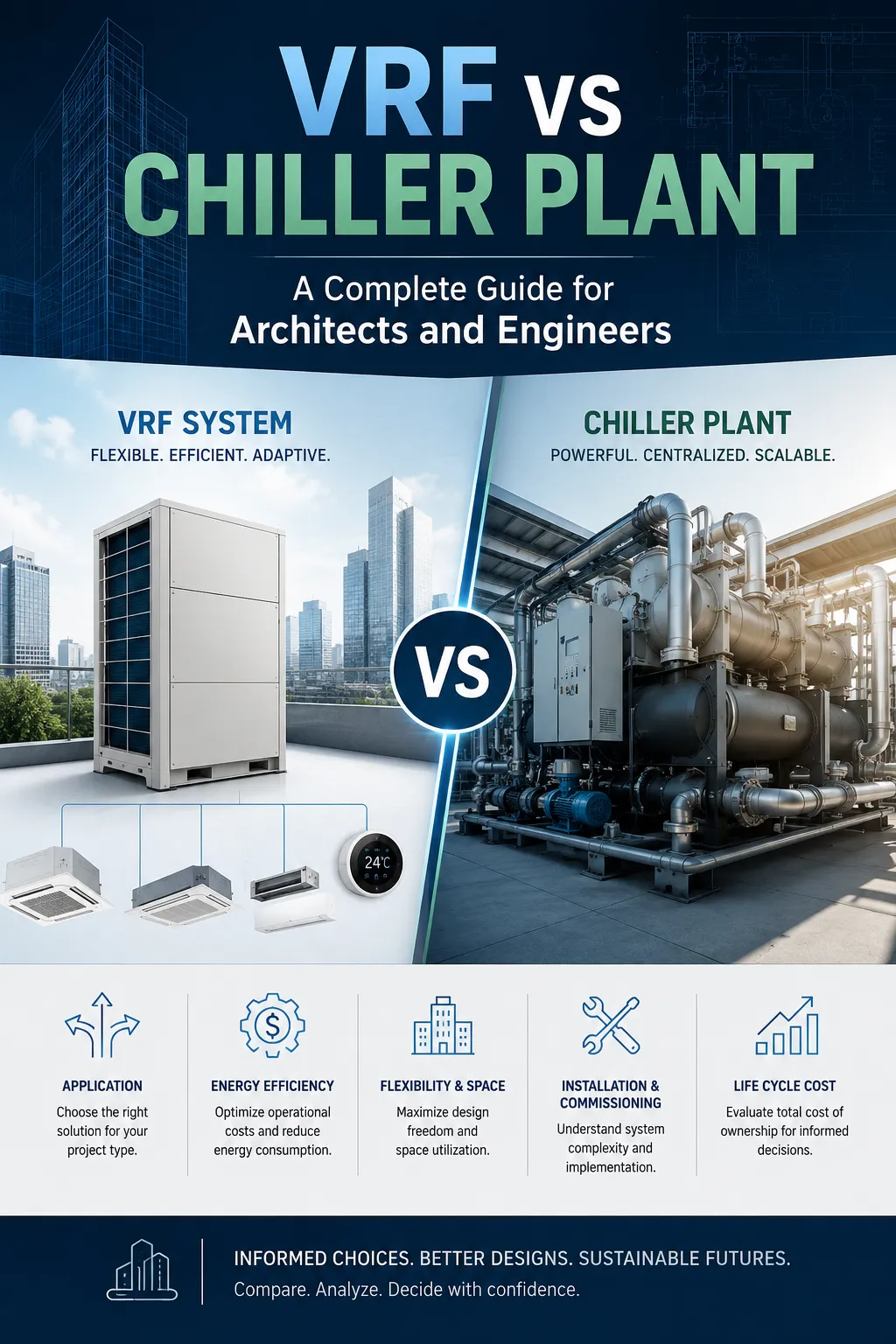
Selecting the right HVAC system is one of the most critical engineering decisions during building design. Variable Refrigerant Flow (VRF) systems and Chiller Plants dominate the commercial HVAC market, but each serves fundamentally different project requirements.
This guide presents a comparison of VRF vs Chiller Plant systems using measurable engineering parameters including capital expenditure (CAPEX), operational expenditure (OPEX), installation time, energy efficiency, maintenance complexity, scalability, and lifecycle cost.
| Parameter | VRF (Variable Refrigerant Flow) | Chiller Plant (Centralized Chilled Water System) | Preferred Choice |
|---|
| Building Size | Small to Medium (up to ~10,000 m²) | Medium to Large (>10,000 m²) | Depends on project scale |
| Cooling Capacity | Up to ~300 TR (project dependent) | Virtually unlimited (modular expansion) | Chiller Plant |
| Initial Cost (CAPEX) | Lower | Higher | VRF |
| Operational Cost (OPEX) | Lower for intermittent and variable loads | Lower for continuous high-load operation | Depends on usage pattern |
| Life Cycle Cost (LCC) | Higher over long-term for large buildings | Lower for large buildings with long service life | Chiller Plant |
| Installation Time | 4–12 weeks | 4–8 months | VRF |
| Commissioning Time | Fast | Longer due to system balancing | VRF |
| Energy Efficiency (Part Load) | Excellent (Inverter-based) | Very Good to Excellent (High IPLV Chillers) | VRF |
| Energy Efficiency (Full Load) | Moderate | Excellent | Chiller Plant |
| Design Flexibility | High | Moderate | VRF |
| Zoning Capability | Excellent (Individual Room Control) | Good (AHU/FCU Based) | VRF |
| Scalability | Limited | Excellent | Chiller Plant |
| Future Expansion | Moderate | Easy through additional chillers | Chiller Plant |
| Mechanical Space Requirement | Minimal | Large Plant Room Required | VRF |
| Roof Requirement | Outdoor Units Only | Cooling Towers (Water-Cooled Systems) | VRF |
| Piping System | Refrigerant Copper Piping | Chilled Water + Condenser Water Piping | VRF (Simpler) |
| Maintenance Requirement | Moderate | High | VRF |
| Maintenance Complexity | Refrigerant & Electronics | Pumps, Cooling Towers, Water Treatment | VRF |
| Service Life | 15–20 Years | 25–35 Years | Chiller Plant |
| Redundancy | Limited | Excellent (N+1 Configurations Possible) | Chiller Plant |
| Reliability for Critical Facilities | Moderate | Very High | Chiller Plant |
| Noise Level | Low | Moderate | VRF |
| Indoor Comfort Control | Individual Temperature Control | Zone-Based Control | VRF |
| Water Consumption | None | Required (Water-Cooled Chillers) | VRF |
| Environmental Risk | Refrigerant Leakage | Water Treatment & Cooling Tower Management | Depends on design |
| Best for Hotels | Excellent | Excellent (Large Luxury Hotels) | Depends on size |
| Best for Offices | Excellent | Excellent (Large Campuses) | Depends on size |
| Best for Shopping Malls | Suitable for Small Malls | Highly Recommended | Chiller Plant |
| Best for Hospitals | Suitable for Non-Critical Areas | Highly Recommended | Chiller Plant |
| Best for Airports | Not Recommended | Industry Standard | Chiller Plant |
| Best for Data Centers | Limited | Highly Recommended | Chiller Plant |
| Best for Residential Towers | Excellent | Suitable for Large Mixed-Use Projects | VRF |
| Best for Industrial Facilities | Limited | Highly Recommended | Chiller Plant |
| Overall Strength | Lower CAPEX, faster installation, superior zoning, excellent part-load efficiency | Lower lifecycle cost, high capacity, scalability, redundancy, long-term performance | Depends on project objectives |
| Overall Weakness | Limited scalability, shorter lifespan, refrigerant limitations | Higher upfront cost, larger footprint, longer construction schedule | Project-specific |
What is a VRF System?
Variable Refrigerant Flow (VRF) is a direct expansion (DX) air-conditioning system where refrigerant is circulated directly between outdoor condensing units and multiple indoor units. Through inverter compressor technology, refrigerant flow is continuously adjusted according to building load.
VRF systems are particularly suitable for:
- Office buildings
- Hotels
- Educational institutions
- Retail spaces
- Hospitals (non-critical areas)
- Residential high-rise buildings
What is a Chiller Plant?
A Chiller Plant produces chilled water centrally and distributes it throughout the building using pumps, insulated piping, Air Handling Units (AHUs), and Fan Coil Units (FCUs).
Chiller systems generally include:
- Water-cooled chillers
- Air-cooled chillers
- Cooling towers (for water-cooled systems)
- Primary and secondary pumps
- Expansion tanks
- AHUs
- BMS Integration
Chiller plants remain the preferred solution for large commercial and industrial developments.
Comparison: VRF vs Chiller Plant
| Parameter | VRF | Chiller Plant |
|---|---|---|
| Initial Cost | Lower | Higher |
| Installation Time | Fast | Long |
| Energy Efficiency (Partial Load) | Excellent | Good to Excellent |
| Energy Efficiency (Large Base Load) | Moderate | Excellent |
| Maintenance | Moderate | High |
| Redundancy | Limited | High |
| Building Size | Small to Medium | Medium to Very Large |
| Scalability | Limited | Excellent |
| Space Requirement | Low | High |
| Plant Room Required | No | Yes |
| Cooling Capacity | Limited | Virtually Unlimited |
| Lifecycle | 15–20 Years | 25–35 Years |
Capital Cost (CAPEX)
For projects below approximately 8,000–10,000 m², VRF systems generally offer a lower upfront investment due to minimal civil work, reduced piping infrastructure, and the absence of a dedicated plant room.
However, as project size increases, the economics gradually shift in favor of centralized chiller plants.
Typical Trend
Small Buildings
VRF < Chiller
Medium Buildings
VRF ≈ Chiller
Large Buildings
Chiller < VRF (per TR installed)
For airports, IT parks, hospitals, shopping malls, and convention centers, centralized chilled water systems usually deliver better cost optimization.
Operational Cost (OPEX)
Operational expenditure depends on:
- Annual operating hours
- Occupancy profile
- Electricity tariff
- Climate zone
- Diversity factor
- Part-load performance
VRF Advantages
- Excellent inverter modulation
- High seasonal efficiency
- Low standby consumption
- Individual zone control
Chiller Advantages
- Better efficiency under continuous heavy loads
- Superior plant optimization using Variable Frequency Drives (VFDs)
- Thermal storage integration
- Heat recovery opportunities
For buildings operating more than 14–16 hours daily, modern high-efficiency chillers frequently outperform VRF systems in long-term operating costs.
Installation Time
Installation duration significantly impacts project schedules.
VRF
- No central plant
- Minimal structural modifications
- Faster commissioning
- Reduced coordination
Typical Duration
4–12 weeks
Chiller Plant
- Plant room construction
- Cooling tower installation
- Pump rooms
- Piping insulation
- Water balancing
- BMS integration
Typical Duration
4–8 months
Winner: VRF
Energy Efficiency
Energy efficiency should be evaluated under Integrated Part Load Value (IPLV) rather than full-load COP alone.
VRF
Strengths
- Excellent part-load efficiency
- Superior zoning
- Minimal energy wastage
- Independent room operation
Weaknesses
- Efficiency decreases with long refrigerant piping
- Performance affected by outdoor temperature
Chiller Plant
Strengths
- High efficiency at constant large loads
- Better plant optimization
- Advanced sequencing
- Superior annual energy performance for campuses
Weaknesses
- Pumping energy
- Cooling tower water treatment
- Larger auxiliary loads
Maintenance Comparison
VRF
Advantages
- Minimal daily maintenance
- No cooling tower
- No condenser water treatment
Disadvantages
- Refrigerant leak detection
- Specialized technicians
- Expensive PCB replacements
Chiller Plant
Advantages
- Modular maintenance
- Long equipment life
- High reliability
Disadvantages
- Cooling tower maintenance
- Water treatment
- Pump servicing
- Skilled operators required
Space Requirements
VRF
Requires only outdoor units and refrigerant piping.
Ideal where:
- Roof space is available
- Basement space is limited
- No mechanical plant room exists
Chiller Plant
Requires:
- Mechanical room
- Cooling towers
- Pump rooms
- Service access
- Water storage (where applicable)
Winner:
VRF for constrained buildings.
Lifecycle Cost Analysis
Although VRF often reduces initial investment, lifecycle costing frequently favors chiller plants in continuously occupied facilities.
Approximate Design Life
VRF
15–20 Years
Air-Cooled Chiller
20–25 Years
Water-Cooled Chiller
25–35 Years
For institutional buildings exceeding 30 years of expected service life, chillers typically offer a lower total cost of ownership.
Advantages of VRF
- Lower first cost
- Rapid installation
- Excellent zoning
- Quiet operation
- Minimal plant space
- High part-load efficiency
- Individual room temperature control
- Flexible expansion
Disadvantages of VRF
- Refrigerant quantity limitations
- Limited capacity for mega projects
- Complex refrigerant piping
- Higher repair cost for electronics
- Lower redundancy
Advantages of Chiller Plants
- Ideal for large developments
- Longer operational life
- Better centralized control
- Superior redundancy
- Excellent for hospitals, airports, malls, and campuses
- Easier future expansion
- Better energy optimization at scale
Disadvantages of Chiller Plants
- Higher capital investment
- Longer installation duration
- Plant room requirement
- Cooling tower maintenance
- Greater engineering coordination
Recommended Building Applications
Choose VRF If
- Building area is below 10,000 m²
- Fast-track construction is required
- Individual room control is essential
- Space is limited
- Occupancy is variable
Examples
- Boutique hotels
- Schools
- Clinics
- Offices
- Residential towers
Choose Chiller Plant If
- Building exceeds 10,000–15,000 m²
- Cooling demand exceeds approximately 300 TR
- Continuous operation is expected
- Future expansion is planned
- Centralized maintenance is preferred
Examples
- Airports
- Data centers
- Hospitals
- Shopping malls
- Industrial facilities
- Large commercial campuses
Final Verdict
There is no universally superior HVAC solution. The optimal choice on VRF vs Chiller Plant depends on project scale, operating profile, lifecycle expectations, available space, energy strategy, and maintenance capabilities.
VRF systems provide the best value for small and medium-sized commercial developments requiring rapid installation, zoning flexibility, and lower initial investment.
Chiller plants become increasingly economical as building size, operating hours, and cooling demand increase. Their superior scalability, redundancy, and lifecycle economics make them the preferred solution for major commercial, healthcare, industrial, and institutional developments.