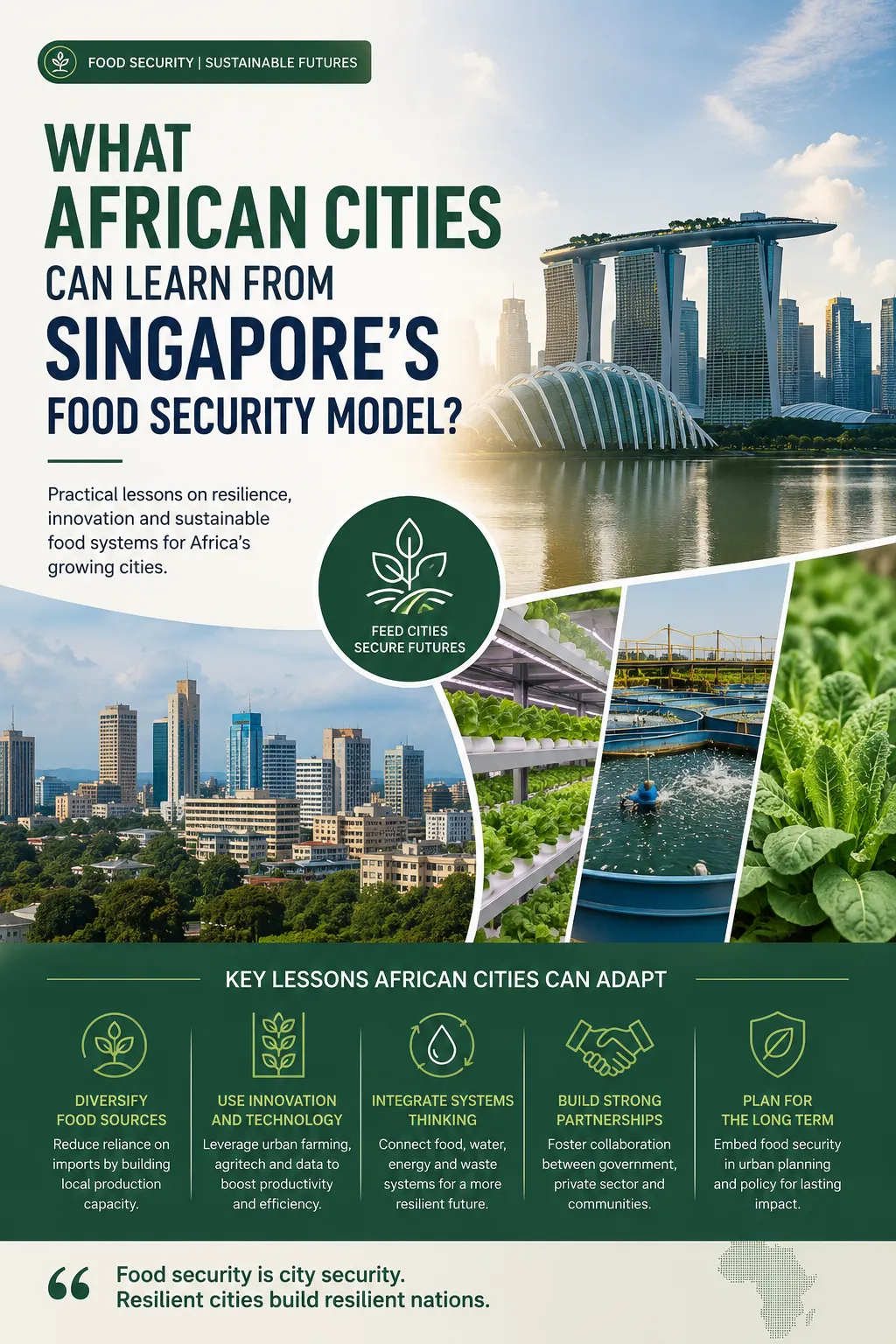
| Theme | Singapore’s Food Security Model | Key Lesson for African Cities |
|---|
| Overall Approach | Focuses on resilience rather than complete food self-sufficiency. | Build resilient and diversified food systems suited to local conditions. |
| Import Diversification | Imports food from over 170 countries and regions to reduce supply risks. | Source food from multiple regions and strengthen regional trade networks. |
| Urban Agriculture | Uses vertical farms, rooftop gardens, and high-tech greenhouses. | Promote affordable urban farming such as rooftop gardens, community gardens, hydroponics, and peri-urban agriculture. |
| Technology & Innovation | Invests in precision farming, aquaculture, and alternative proteins. | Adopt cost-effective technologies like drip irrigation, improved seeds, solar irrigation, and digital farming tools. |
| Food Storage & Supply Chains | Maintains strategic food reserves and efficient logistics. | Develop cold storage, modern transport, warehouses, and emergency food reserves. |
| Reducing Food Loss | Efficient food distribution minimizes waste. | Reduce post-harvest losses through better storage, packaging, refrigeration, and transportation. |
| Governance | Strong government planning, regulation, and food safety systems. | Improve urban food policies, institutional coordination, and regulatory frameworks. |
| Private Sector Support | Encourages investment in agritech and food innovation. | Promote public-private partnerships and support agritech startups and food businesses. |
| Emergency Preparedness | Uses stockpiles and diversified supply chains to manage disruptions. | Establish early-warning systems, strategic grain reserves, and contingency plans for climate and supply shocks. |
| Challenges to Replication | High-income economy with advanced infrastructure and strong institutions. | Adapt Singapore’s principles using affordable, locally appropriate solutions rather than replicating its high-tech model. |
| Examples in Africa | Serves as a model for resilience and innovation. | Cities such as Kigali, Nairobi, Accra, and Cape Town are already implementing urban agriculture and climate-smart farming practices. |
| Key Takeaway | Food security is achieved through diversification, innovation, planning, and resilience. | African cities should prioritize resilient food systems, improved governance, urban agriculture, and sustainable investments to enhance food security. |
frican cities can learn a great deal from Singapore’s food security model, but they cannot simply copy it. Singapore’s approach works because it is tailored to its unique geography, economy, and governance. The real lesson is how to adapt the underlying principles to local conditions.
Why Singapore is a useful case study

Singapore imports around 90% of its food, making it one of the world’s most import-dependent countries. Rather than trying to become fully self-sufficient, it has built a food system that is resilient through diversification, technology, and strategic planning.
Key pillars include:
- Import diversification: Food comes from more than 170 countries and regions, reducing dependence on any single supplier.
- Local production: Singapore encourages production of vegetables, eggs, and fish through intensive, technology-driven farming.
- Innovation: Investments in vertical farming, precision agriculture, aquaculture, and alternative proteins.
- Food reserves: Strategic stockpiles help cushion temporary supply disruptions.
- Strong food safety regulation: Efficient monitoring builds consumer confidence.
- Research and development: Government agencies, universities, and private companies collaborate to improve productivity.
Lessons for African cities
1. Promote urban agriculture

Photo Credit: Varsity graduate reaping big from urban farming – The New Times
Many African cities have unused rooftops, vacant lots, school compounds, and peri-urban land that can produce food.
Possible initiatives include:
- Rooftop gardens
- Community gardens
- Hydroponics
- Container farms
- School farms
- Household vegetable production
Unlike Singapore’s expensive vertical farms, lower-cost technologies may provide greater returns in many African cities.
2. Diversify food supply chains
Many African cities depend heavily on food transported from one agricultural region.
A disruption—such as drought, flooding, conflict, or road closures—can quickly cause shortages.
Cities can improve resilience by:
- Sourcing from multiple regions
- Encouraging regional trade
- Investing in wholesale markets
- Developing better cold-chain logistics
- Improving road and rail connections
3. Reduce post-harvest losses
In many African countries, a substantial share of harvested food is lost before reaching consumers due to inadequate storage, transportation, and refrigeration.
Investments in:
- Cold storage
- Refrigerated transport
- Better packaging
- Modern wholesale markets
- Digital supply chain management
can increase food availability without increasing production.
4. Invest in agricultural technology
Technology does not necessarily mean expensive automation.
Examples include:
- Drip irrigation
- Weather forecasting
- Mobile advisory services
- Solar-powered irrigation
- Improved seed varieties
- Digital marketplaces connecting farmers to buyers
These innovations can significantly increase productivity.
5. Build emergency food resilience
Cities should prepare for disruptions caused by:
- Climate change
- Pandemics
- Political instability
- Supply chain disruptions
- Fuel shortages
Measures may include:
- Emergency grain reserves
- Strategic food warehouses
- Early-warning systems
- Diverse import routes where applicable
6. Strengthen governance
One of Singapore’s greatest strengths is long-term planning and effective institutional coordination.
African cities can benefit from:
- Clear urban food policies
- Better coordination among municipal agencies
- Reliable food market data
- Public-private partnerships
- Transparent regulations
7. Encourage private investment
Singapore’s government actively supports private innovation.
African cities can similarly encourage:
- Agritech startups
- Food logistics companies
- Cold storage providers
- Greenhouse developers
- Food processing businesses
through incentives, financing, and streamlined regulations.
Challenges unique to African cities
Some aspects of Singapore’s model are difficult to replicate because conditions differ substantially.
| Singapore | Many African cities |
|---|---|
| High income | Lower average incomes |
| Advanced infrastructure | Infrastructure gaps |
| Small land area | Larger peri-urban areas |
| Strong institutions | Varying institutional capacity |
| High-tech farming | Greater need for affordable technologies |
| Reliable electricity | Power supply may be inconsistent |
This means African cities may gain more from combining modern innovations with practical, low-cost solutions.
Cities already applying similar ideas

Photo Credit: The changing face of urban farming in Accra Ghana – Lensational
Several African cities are already implementing elements that align with Singapore’s principles:
- Kigali has promoted urban agriculture and integrated food production into aspects of city planning.
- Nairobi has seen growth in greenhouse farming, hydroponics, and digital agricultural services.
- Accra supports urban vegetable production that supplies local markets.
- Cape Town has adopted water-efficient farming methods in response to drought.