
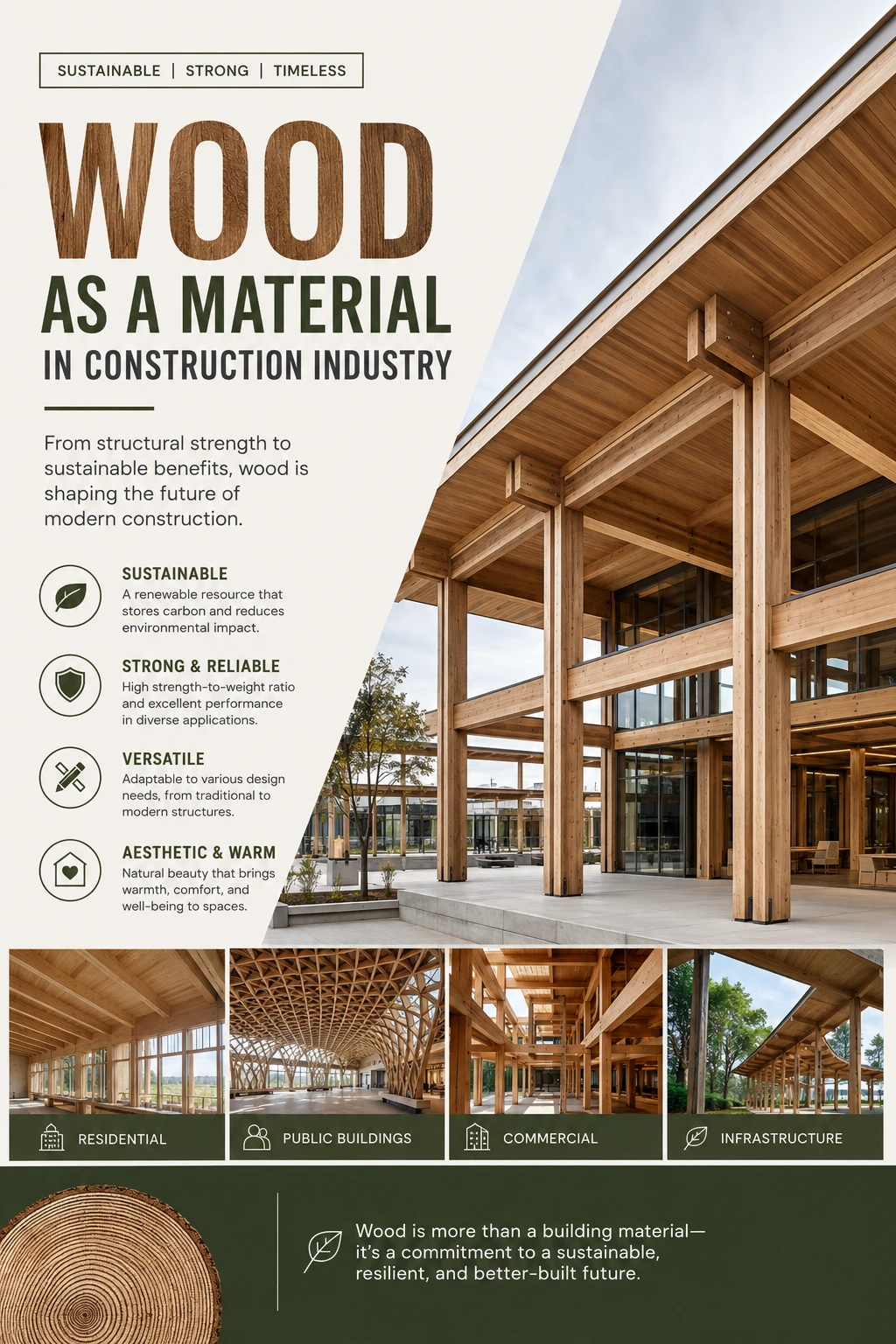
| Aspect | Summary |
|---|---|
| Aesthetic | Warm, natural, and visually appealing. |
| Sustainability | Renewable, biodegradable, and stores carbon. |
| Versatility | Used for structure, finishes, and décor. |
| Structure | CLT, Glulam, and timber framing. |
| Advantages | Strong, lightweight, insulating, and quick to build. |
| Challenges | Prone to moisture, pests, fire, and needs maintenance. |
| Examples | T3 Building, The Smile, Tamedia Office. |
| Sustainable Use | Supports biophilic and eco-friendly design. |
🪵 Why Wood?
1. Natural Aesthetic
Wood is considered as Warm, tactile, and beautiful.
Offers a range of textures, grains, and tones depending on the species.
Creates a sense of comfort and calmness in interior and exterior spaces.
2. Sustainability
Renewable and biodegradable (when sourced responsibly).
Stores carbon, making it environmentally favorable compared to concrete and steel.
FSC-certified or reclaimed wood enhances green credentials.
3. Versatility
Can be used for structural (mass timber, glulam, CLT), finishing (panels, floors), and decorative purposes.
Easily shaped, cut, and joined.
Works well with other materials like glass, steel, and stone.
🏗️ Structural Applications
Mass Timber (like CLT and Glulam)
Strong enough for mid- and even high-rise buildings (e.g., Mjøstårnet in Norway, 85.4 m).
Prefabricated for efficiency.
Seismically and thermally performant.
Traditional Timber Framing
Seen in historical and vernacular architecture across the globe.
Modern timber frame homes still use these principles, often exposed for visual appeal.
🔧 Pros of Using Wood
Lightweight but strong.
High thermal insulation (reduces energy costs).
Quick and clean construction (especially prefab).
Absorbs sound and regulates humidity.
⚠️ Cons and Challenges
Susceptible to rot, termites, and moisture if not treated.
Fire risk (though mass timber chars and self-insulates).
Requires maintenance.
Sourcing must be done responsibly to avoid deforestation.
🌍 Contemporary Wood Architecture Examples
T3 Building (Minneapolis, USA) – One of the largest modern timber office buildings.
The Smile (London, UK) – A curved CLT pavilion demonstrating wood’s flexibility.
Tamedia Office Building (Zurich, Switzerland) – Designed by Shigeru Ban, all-wood load-bearing system.
🌱 Wood in Sustainable Architecture
Integral to biophilic design – promoting well-being by connecting occupants to nature.
Often paired with passive solar strategies and natural ventilation.
Can be recycled or reused at end of life.
See also:
One thought on “Wood as a material in construction industry”