Introduction: Why Architecture Vocabulary Matters in Design Education
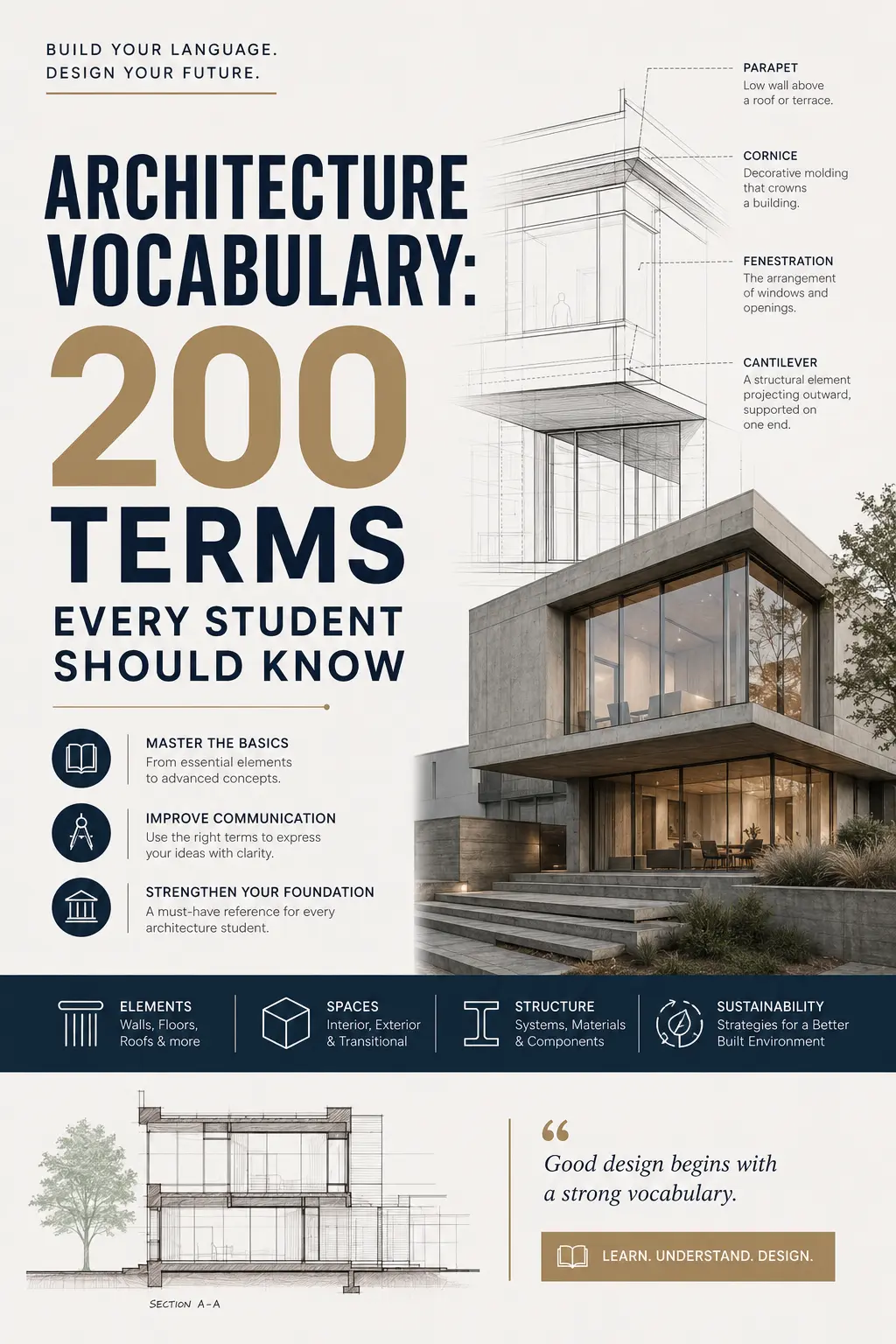
Architecture is not only the practice of designing buildings; it is a structured language of space, materials, history, technology, and human experience. Research in architectural education shows that students with strong command over architectural vocabulary communicate ideas more effectively during design reviews, architectural presentations, construction documentation, and professional practice.
From understanding spatial organization to interpreting building technology, architectural terminology creates a common framework between architects, engineers, designers, and clients. This carefully categorized list of 200 architecture terms every student should know provides a foundation for academic learning and professional development.
For beginners, exploring resources like architecture design principles, architectural drawing standards, and history of architecture studies helps connect vocabulary with practical application.
1. Fundamental Architecture Design Vocabulary
The foundation of architectural learning begins with concepts related to form, space, proportion, and visual composition.
- Architecture – The art and science of designing buildings and built environments.
- Design Concept – The central idea guiding an architectural project.
- Form – The physical shape and structure of a building.
- Function – The practical purpose a space serves.
- Space – The area experienced and occupied by users.
- Scale – Relationship between architectural elements and human dimensions.
- Proportion – Comparative relationship between sizes of building components.
- Balance – Visual stability created through design elements.
- Symmetry – Equal arrangement around an axis.
- Asymmetry – Balanced composition without identical arrangement.
- Rhythm – Repetition of architectural elements.
- Hierarchy – Arrangement based on importance.
- Axis – A reference line organizing spaces.
- Datum – An organizing architectural reference element.
- Order – Logical arrangement of design components.
- Composition – Arrangement of architectural elements.
- Context – Environmental and cultural surroundings influencing design.
- Aesthetics – Study of beauty and visual qualities.
- Minimalism – Design approach focused on simplicity.
- Architectural Expression – Communication of ideas through built form.
Recommended Reading: Learn more through detailed guides on architectural design concepts, design thinking in architecture, and space planning principles.
2. Architectural Drawing & Representation Terms
Architectural communication depends heavily on technical drawings and visual documentation.
- Architectural Drawing – Visual representation of design information.
- Plan – Horizontal view showing spatial arrangement.
- Floor Plan – Drawing displaying room layouts and circulation.
- Section – Vertical cut showing internal relationships.
- Elevation – Exterior face representation of a building.
- Site Plan – Drawing showing building placement within surroundings.
- Master Plan – Large-scale development strategy.
- Detail Drawing – Enlarged explanation of construction elements.
- Working Drawing – Technical document used for construction.
- Blueprint – Traditional architectural reproduction drawing.
- Sketch – Quick visual exploration of ideas.
- Rendering – Realistic architectural visualization.
- Perspective Drawing – Representation showing depth.
- Isometric Drawing – Three-dimensional technical representation.
- Axonometric Drawing – Parallel projection drawing method.
- Diagram – Simplified explanation of architectural concepts.
- Model Making – Physical representation of design.
- Digital Model – Computer-generated building representation.
- BIM (Building Information Modeling) – Intelligent digital building documentation process.
- CAD (Computer-Aided Design) – Software-based drafting system.
Related resources: AutoCAD architecture tutorials, BIM workflow guides, and architectural presentation techniques.
3. Building Construction Vocabulary
Understanding construction terminology allows architects to transform ideas into physical structures.
- Foundation – Structural base transferring loads to the ground.
- Footing – Supporting component beneath foundations.
- Column – Vertical structural support.
- Beam – Horizontal load-carrying member.
- Slab – Flat structural floor or roof element.
- Wall – Vertical enclosure or partition.
- Load-Bearing Wall – Wall carrying structural loads.
- Curtain Wall – Non-structural external building skin.
- Facade – Exterior appearance of a building.
- Envelope – External protective building layer.
- Frame Structure – Structural skeleton system.
- Masonry – Construction using bricks or stone units.
- Concrete – Composite construction material.
- Reinforced Concrete – Concrete strengthened with steel.
- Steel Structure – Framework using steel components.
- Timber Construction – Building method using wood.
- Prefabrication – Off-site manufacturing process.
- Modular Construction – Assembly using repeated building units.
- Cladding – Exterior protective covering.
- Insulation – Material reducing heat transfer.
Explore more: building construction methods, structural systems in architecture, and modern construction materials.
4. Architectural History & Style Terms
Architectural vocabulary is deeply connected with historical movements and cultural evolution.
- Classical Architecture
- Gothic Architecture
- Renaissance Architecture
- Baroque Architecture
- Neoclassical Architecture
- Modern Architecture
- Postmodern Architecture
- Brutalism
- Deconstructivism
- Parametric Architecture
- Vernacular Architecture
- Sustainable Architecture
- Organic Architecture
- Contemporary Architecture
- High-Tech Architecture
- International Style
- Art Deco
- Bauhaus
- Futurism
- Critical Regionalism
Students should study architectural history timelines and famous architectural movements to understand how design philosophies evolved.
5. Interior Architecture & Spatial Terms
Interior architecture focuses on human interaction with built environments.
- Interior Design
- Spatial Planning
- Circulation
- Zoning
- Open Plan
- Partition
- Ceiling Design
- Flooring
- Furniture Layout
- Ergonomics
- Human Scale
- Accessibility
- Universal Design
- Lighting Design
- Natural Lighting
- Artificial Lighting
- Color Theory
- Texture
- Material Palette
- Interior Atmosphere
6. Urban Design & Planning Vocabulary
Cities require architectural knowledge beyond individual buildings.
- Urban Planning
- Urban Design
- City Fabric
- Public Space
- Streetscape
- Landscape Architecture
- Green Infrastructure
- Mixed-Use Development
- Transit-Oriented Development
- Smart City
- Density
- Zoning Regulation
- Master Planning
- Urban Renewal
- Walkability
- Placemaking
- Community Design
- Urban Morphology
- Infrastructure
- Sustainable Development
7. Sustainability & Environmental Architecture Terms
Modern architectural research increasingly focuses on climate-responsive solutions.
- Sustainability
- Green Building
- Passive Design
- Active Design Systems
- Carbon Footprint
- Net-Zero Building
- Renewable Energy
- Solar Orientation
- Thermal Comfort
- Natural Ventilation
- Energy Efficiency
- Rainwater Harvesting
- Recycling
- Adaptive Reuse
- Life Cycle Assessment
- Biophilic Design
- Green Roof
- Climate Responsive Design
- Environmental Analysis
- LEED Certification
Further study: green architecture strategies, energy-efficient building design, and sustainable architecture research.
8. Professional Architecture Practice Terms
Professional vocabulary prepares students for real-world architecture careers.
- Architect
- Client Brief
- Design Proposal
- Feasibility Study
- Concept Development
- Schematic Design
- Design Development
- Construction Documents
- Building Code
- Permit Approval
- Tender Document
- Contract Administration
- Project Management
- Site Inspection
- Quality Control
- Cost Estimation
- Specifications
- Bill of Quantities
- Project Timeline
- Post-Occupancy Evaluation
9. Advanced Digital Architecture Vocabulary
Technology has transformed architectural research and design processes.
- Computational Design
- Algorithmic Design
- Parametric Modeling
- Generative Design
- Artificial Intelligence in Design
- Digital Fabrication
- 3D Printing
- Virtual Reality
- Augmented Reality
- Digital Twin
- Simulation
- Environmental Modeling
- Data-Driven Design
- Smart Materials
- Robotic Construction
- Automation
- Building Performance Analysis
- Visualization Software
- Photogrammetry
- Reality Capture
10. Architectural Theory & Research Vocabulary
Advanced architectural thinking requires theoretical understanding.
- Phenomenology
- Semiotics
- Typology
- Morphology
- Spatial Theory
- Critical Theory
- Design Research
- Architectural Narrative
- Place Identity
- Cultural Context
- Social Sustainability
- Human Behavior Studies
- Environmental Psychology
- Architectural Criticism
- Design Philosophy
- Theory of Proportion
- Spatial Experience
- Design Methodology
- Architectural Innovation
- Future Architecture