Introduction: Understanding the Role of Design Principles in Architecture
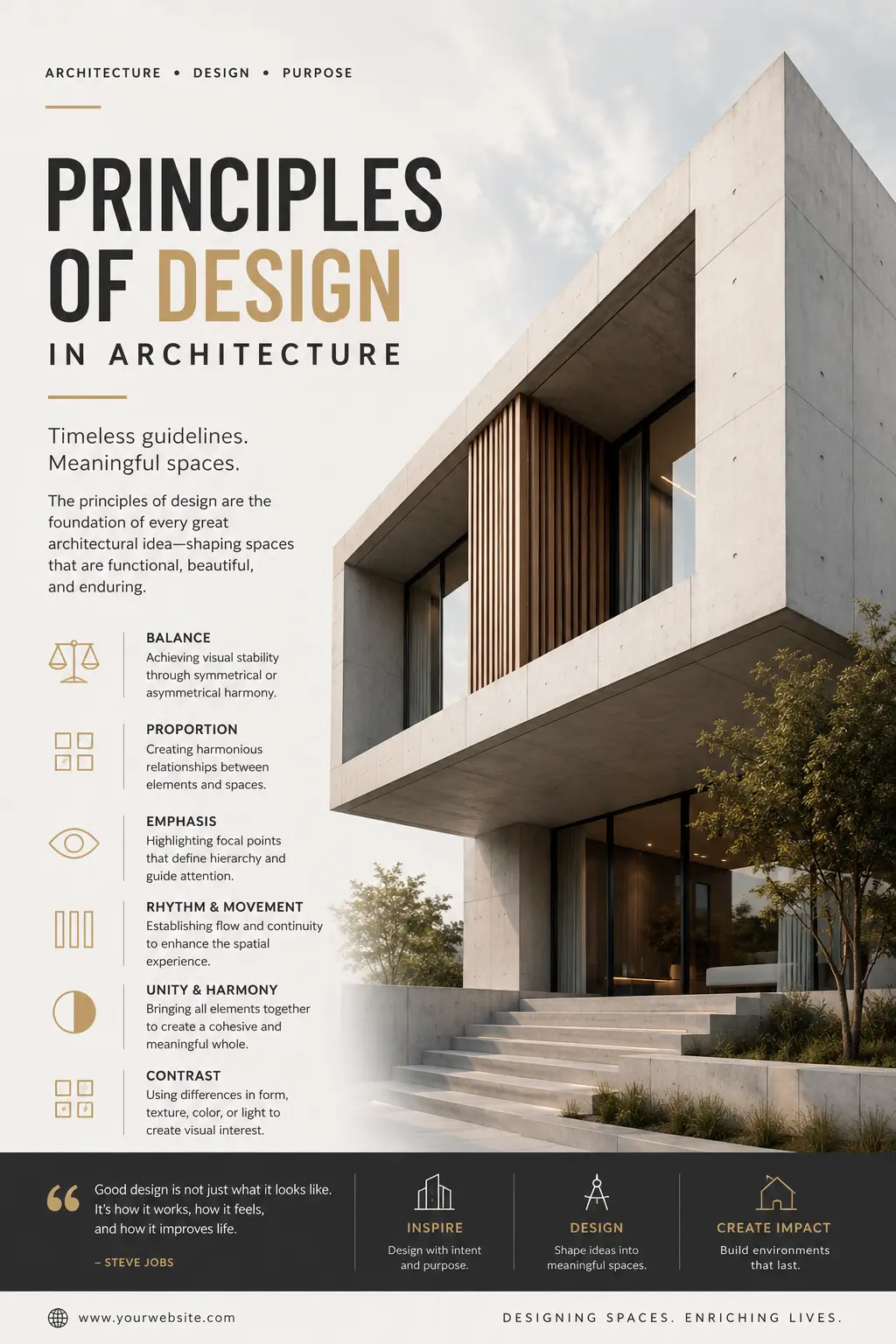
Architecture is not merely the creation of buildings; it is the systematic organization of space, form, function, proportion, and human experience. Behind every successful architectural composition lies a set of fundamental principles of design in architecture that control visual order, spatial relationships, movement patterns, and emotional response.
From ancient monuments to contemporary urban structures, architectural design principles have shaped the way humans perceive built environments. Whether studying classical structures such as the Taj Mahal, modern masterpieces like Fallingwater by Frank Lloyd Wright, or theoretical frameworks described in Architecture: Form, Space and Order by Francis D.K. Ching, these principles establish the foundation of architectural thinking.
The major principles — Unity, Axis, Symmetry, Hierarchy, Datum, Rhythm, Repetition, Balance, and Transformation — work collectively to convert architectural ideas into meaningful spatial experiences.
1. Unity: Creating Visual and Spatial Wholeness
Definition
Unity in architecture refers to the relationship between individual architectural elements that allows them to function as a complete and organized composition. It creates a sense of belonging between form, materials, scale, structure, and surrounding environment.
A building achieves unity when no element feels isolated or disconnected. Walls, openings, structural systems, textures, landscapes, and circulation patterns contribute toward a single architectural identity.
Key Factors Creating Unity
1. Consistency of Material Language
Material selection strongly influences architectural unity. Repeated use of similar textures, colors, and construction materials creates visual connection.
For example, Frank Lloyd Wright’s Fallingwater demonstrates unity through the integration of natural stone, reinforced concrete, water, and landscape. The building does not dominate nature but becomes a continuation of it.
2. Relationship Between Form and Function
Unity also emerges when architectural form directly supports the purpose of a space.
In successful architectural compositions:
- structural systems support visual concepts,
- circulation follows functional requirements,
- exterior expression reflects interior organization.
Importance of Unity
Unity prevents architectural disorder. Without unity, a building may contain attractive individual components but fail as a complete composition.
2. Axis: Establishing Direction and Spatial Organization
Definition and Concept
An axis is an imaginary organizing line that connects spaces, elements, or forms. It provides direction, movement, and visual control within architectural composition.
The concept of axis has existed since ancient civilizations and remains one of the strongest tools for architectural planning.
Characteristics of Architectural Axis
An axis usually contains:
- a starting point,
- directional movement,
- important elements placed along the path,
- a visual termination point.
Historical Example: Taj Mahal
The Taj Mahal complex is one of the finest examples of axial planning.
The central axis organizes:
- entrance gateway,
- gardens,
- water channels,
- main mausoleum.
The visitor’s movement is carefully controlled through a powerful linear experience.
Modern Architectural Application
Modern museums, government buildings, universities, and cultural centers frequently use axial organization to establish importance and orientation.
Axis helps users understand:
- where to move,
- what to observe,
- which element has significance.
3. Symmetry: Achieving Order Through Reflection
Definition
Symmetry refers to the balanced arrangement of architectural elements around a central point, line, or plane.
It creates:
- stability,
- visual clarity,
- monumentality,
- formal character.
Types of Architectural Symmetry
1. Bilateral Symmetry
Elements are mirrored on opposite sides of a central axis.
Examples include:
- religious buildings,
- classical monuments,
- institutional architecture.
The Parthenon in Athens demonstrates how symmetry creates mathematical proportion and visual harmony.
2. Radial Symmetry
Elements extend outward from a central point.
It is commonly observed in:
- domes,
- circular temples,
- public gathering spaces.
Importance
Symmetry reduces visual complexity. Human perception naturally recognizes symmetrical arrangements faster, making buildings easier to understand.
However, excessive symmetry may create rigidity; therefore, contemporary architecture often combines symmetry with controlled variation.
4. Hierarchy: Creating Levels of Importance
Meaning of Hierarchy
Hierarchy is the principle through which architects establish dominance among different architectural elements.
Not every space or form should receive equal attention. Hierarchy helps users identify primary and secondary components.
Methods of Creating Hierarchy
1. Hierarchy by Size
Large elements naturally attract attention.
Example:
A cathedral dome or skyscraper tower becomes dominant because of its scale.
2. Hierarchy by Shape
A unique form among regular forms immediately creates importance.
3. Hierarchy by Placement
Central positioning often creates architectural significance.
For example, the Solomon R. Guggenheim Museum by Frank Lloyd Wright establishes hierarchy through its distinctive spiral form.
Functional Importance
Hierarchy improves:
- navigation,
- spatial understanding,
- user experience,
- architectural storytelling.
5. Datum: Creating Reference and Organization
Definition of Datum
A datum is an organizing architectural element that connects different components into a structured relationship.
It acts as a reference system.
A datum may appear as:
- a line,
- plane,
- grid,
- structural system,
- circulation path.
Architectural Application
A continuous wall, corridor, landscape feature, or structural framework can become a datum that organizes surrounding spaces.
The concept is widely discussed in architectural composition theories such as Francis D.K. Ching’s architectural studies.
Importance of Datum
Datum creates unity among different forms.
Complex buildings such as:
- airports,
- campuses,
- museums,
- urban developments
depend heavily on datum systems to maintain order.
6. Rhythm: Creating Movement Through Design
Definition
Rhythm refers to the visual movement created by repeated architectural elements at controlled intervals.
Just as rhythm organizes music through repeated beats, architectural rhythm organizes visual experience.
Elements Creating Rhythm
Rhythm can be produced through:
- columns,
- windows,
- structural bays,
- lighting patterns,
- façade systems.
Example
Classical architecture frequently uses column arrangements to establish rhythm.
Modern façade designs also depend on rhythmic patterns to balance complexity and order.
Psychological Effect
Rhythm guides human perception.
It influences:
- walking speed,
- visual direction,
- emotional experience of space.
7. Repetition: Strengthening Design Identity
Definition
Repetition is the repeated use of architectural elements to create consistency and recognition.
Although closely related to rhythm, repetition focuses more on recurrence while rhythm focuses on movement.
Common Repeated Elements
Architects repeat:
- shapes,
- materials,
- colors,
- structural modules,
- openings.
Example: Modular Architecture
Modern modular buildings rely heavily on repetition because repeated units improve:
- construction efficiency,
- cost control,
- structural clarity.
Architectural movements such as Bauhaus design extensively explored repetition, simplicity, and functional order.
Design
Effective repetition requires variation. Pure repetition can become monotonous, while controlled variation maintains interest.
8. Balance: Achieving Visual Stability
Meaning of Balance
Balance refers to the distribution of visual weight within architectural composition.
Architectural elements carry visual weight depending on:
- size,
- color,
- material,
- texture,
- location.
Types of Balance
1. Symmetrical Balance
Equal distribution around a central axis.
Common in:
- temples,
- monuments,
- government buildings.
2. Asymmetrical Balance
Different elements create visual equilibrium without being identical.
Many contemporary buildings use asymmetrical balance to create dynamic compositions.
Example
Modern architects such as Zaha Hadid Architects frequently explored dynamic balance through fluid geometry and unconventional forms.
Importance
Balance determines whether a building feels stable, uncomfortable, peaceful, or visually active.
9. Transformation: Evolution of Form and Space
Definition
Transformation refers to controlled modification of architectural forms while maintaining their original identity.
Architecture continuously transforms because of:
- technology,
- culture,
- climate,
- materials,
- human requirements.
Types of Architectural Transformation
1. Dimensional Transformation
Changing size or proportion while maintaining basic identity.
2. Additive Transformation
New forms are added to an existing composition.
3. Subtractive Transformation
Parts of a form are removed to create new spatial experiences.
Example
Contemporary adaptive reuse projects transform historic structures into new functional spaces while preserving architectural memory.
The work documented by organizations such as Getty Conservation Institute demonstrates the importance of transformation in preserving architectural heritage.
Importance
Transformation allows architecture to remain relevant across generations.
A successful transformation balances:
- innovation,
- continuity,
- cultural identity.
Conclusion: Why Principles of Design Define Successful Architecture
The principles of design in architecture — Unity, Axis, Symmetry, Hierarchy, Datum, Rhythm, Repetition, Balance, and Transformation — are not decorative theories. They are systems that determine how buildings function, communicate, and influence human experience.
Great architecture emerges when these principles interact rather than operate independently.
Unity creates completeness. Axis creates direction. Symmetry establishes order. Hierarchy communicates importance. Datum organizes complexity. Rhythm and repetition generate continuity. Balance creates stability. Transformation allows architectural evolution.
Understanding these principles provides architects, designers, and students with a foundation for creating spaces that are not only visually meaningful but also functionally and culturally significant.