Buildings are among the world’s largest consumers of energy, accounting for nearly 30% of global final energy consumption and approximately 26% of global energy-related CO₂ emissions from operations, according to the International Energy Agency (IEA). With urbanization accelerating and energy costs continuing to fluctuate, improving building energy performance has become a strategic priority for architects, developers, engineers, facility managers, and policymakers.
Modern energy-efficient buildings no longer rely on a single technology. Instead, they combine high-performance architectural design, advanced mechanical systems, intelligent controls, renewable energy, and continuous performance monitoring to reduce operational costs while maintaining occupant comfort.
This guide examines the most effective strategies used across residential, commercial, institutional, and industrial buildings, supported by industry research and internationally recognized standards.
KEY METRIX
| Strategy | Objective | Key Measures | Primary Benefits | Impact on Energy Efficiency |
|---|---|---|---|---|
| Why Energy Efficiency Matters | Reduce energy consumption while maintaining performance | Improve building systems instead of relying on behavioral changes | Lower operating costs, reduced emissions, improved comfort, higher property value | Forms the foundation for sustainable building operations |
| Building Envelope Optimization | Minimize heat transfer between indoor and outdoor environments | High-performance insulation, airtight construction, Low-E glazing, thermal bridge elimination | Reduced heating and cooling demand, smaller HVAC systems, improved durability | High – significantly lowers baseline energy demand |
| High-Performance Insulation | Reduce conductive heat loss and gain | Mineral wool, spray foam, EPS/XPS, cellulose insulation | Stable indoor temperatures, lower HVAC workload | High |
| Airtight Construction | Prevent uncontrolled air leakage | Air barriers, sealed penetrations, weather membranes, blower door testing | Improved thermal comfort, reduced infiltration losses | High |
| High-Performance Windows | Improve thermal and solar performance | Triple glazing, Low-E coatings, argon/krypton gas fills, thermally broken frames | Lower heat gain/loss, increased daylight | Medium to High |
| Thermal Bridge Elimination | Reduce heat flow through structural elements | Insulated balcony connections, optimized framing, insulated window frames | Reduced condensation, improved insulation performance | Medium |
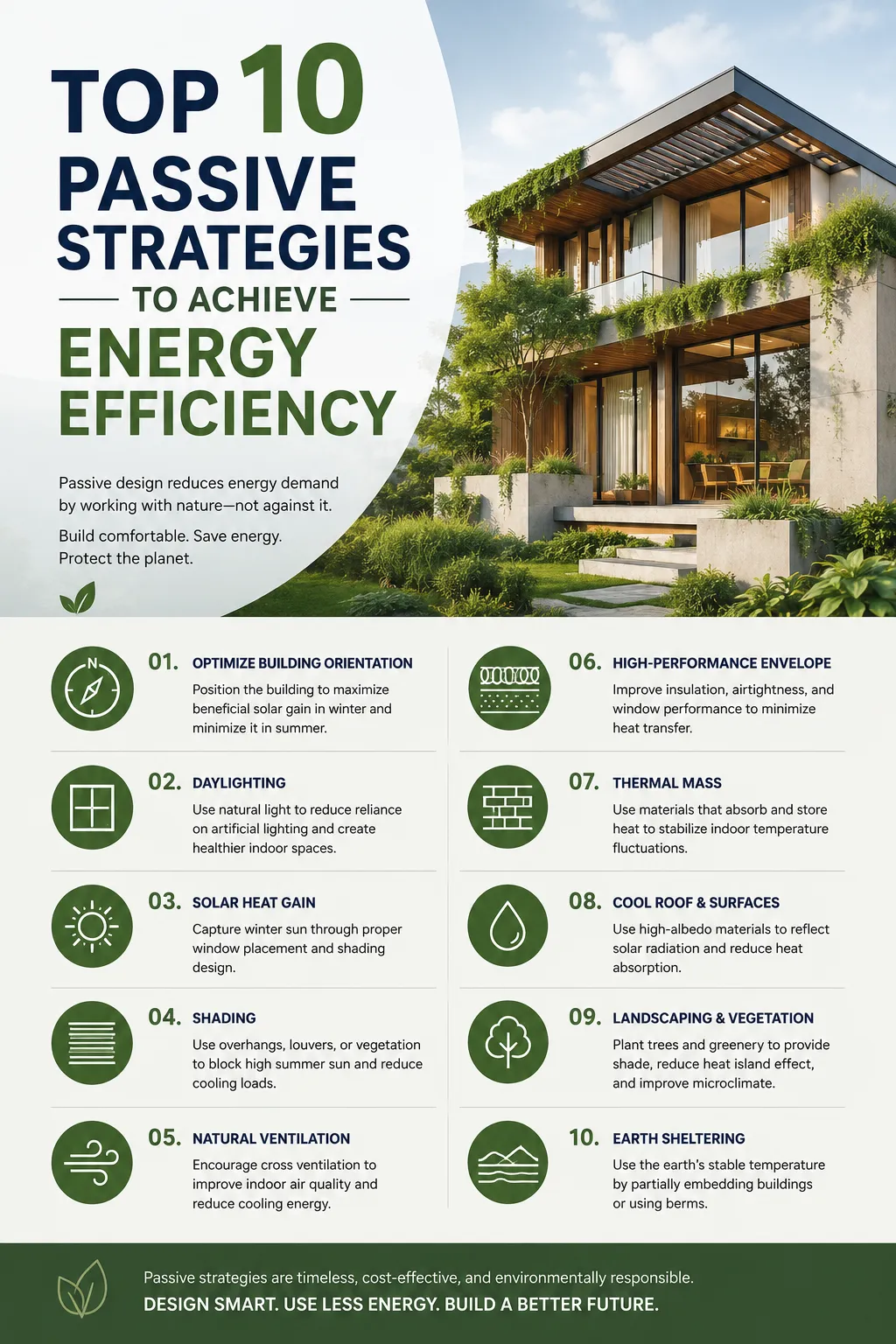
| Passive Building Design | Reduce energy demand through architectural design | Building orientation, daylighting, natural ventilation, solar shading, thermal mass | Lower dependence on mechanical systems | Very High |
| Building Orientation | Optimize solar exposure | Align building to maximize winter sun and minimize summer heat | Reduced HVAC demand | Medium to High |
| Natural Ventilation | Reduce mechanical cooling requirements | Cross ventilation, stack effect, ventilation shafts | Better indoor air quality and reduced cooling energy | Medium |
| Daylighting | Reduce artificial lighting demand | Skylights, clerestory windows, light shelves, reflective interiors | Lower lighting energy, improved occupant productivity | Medium |
| Solar Shading | Minimize unwanted solar heat gain | Louvers, overhangs, exterior blinds, vegetation | Reduced cooling loads | High (especially in warm climates) |
| Thermal Mass | Stabilize indoor temperatures | Concrete, brick, stone, rammed earth | Lower HVAC cycling and peak loads | Medium |
| High-Efficiency HVAC Systems | Improve heating and cooling efficiency | VRF systems, heat pumps, ERVs, demand-controlled ventilation, VFDs | Lower operational energy use and improved comfort | Very High |
| Variable Refrigerant Flow (VRF) | Match cooling/heating to actual demand | Zoned refrigerant control | Higher part-load efficiency and occupant comfort | High |
| High-Efficiency Heat Pumps | Provide efficient heating and cooling | Electrified heat pump systems with high COP | Lower emissions and energy consumption | High |
| Demand-Controlled Ventilation (DCV) | Ventilate based on occupancy | CO₂ sensors, occupancy monitoring | Reduced fan, heating, and cooling energy | Medium to High |
| Energy Recovery Ventilators (ERVs) | Recover energy from exhaust air | Heat and moisture exchange between incoming and outgoing air | Reduced HVAC load and improved ventilation efficiency | High |
| Variable Frequency Drives (VFDs) | Optimize motor performance | Speed control for pumps, fans, and air handling units | Significant electricity savings under partial loads | High |
| Integrated HVAC Optimization | Maximize overall system efficiency | Combine efficient HVAC with insulation, airtightness, smart controls, and predictive maintenance | Reduced lifecycle costs, optimized equipment sizing, improved operational performance | Very High – highest overall energy-saving potential |
Key Takeaways
| Priority | Recommendation | Reason |
|---|---|---|
| 1 | Optimize the building envelope first | Reduces baseline energy demand before investing in mechanical systems. |
| 2 | Implement passive design strategies | Delivers long-term energy savings with minimal maintenance. |
| 3 | Upgrade to high-efficiency HVAC systems | HVAC is typically the largest energy consumer in buildings. |
| 4 | Integrate smart controls with HVAC | Ensures systems operate only when and where needed. |
| 5 | Design building systems as an integrated whole | Combined strategies consistently outperform isolated upgrades. |
Overall Impact Ranking
| Strategy | Estimated Energy-Saving Potential |
|---|---|
| Building Envelope Optimization | ⭐⭐⭐⭐⭐ |
| Passive Building Design | ⭐⭐⭐⭐⭐ |
| High-Efficiency HVAC Systems | ⭐⭐⭐⭐⭐ |
| Integrated HVAC Optimization | ⭐⭐⭐⭐⭐ |
| Solar Shading | ⭐⭐⭐⭐☆ |
| High-Performance Windows | ⭐⭐⭐⭐☆ |
| Energy Recovery Ventilators | ⭐⭐⭐⭐☆ |
| Variable Refrigerant Flow (VRF) | ⭐⭐⭐⭐☆ |
| High-Efficiency Heat Pumps | ⭐⭐⭐⭐☆ |
| Airtight Construction | ⭐⭐⭐⭐☆ |
| Demand-Controlled Ventilation | ⭐⭐⭐☆☆ |
| Daylighting | ⭐⭐⭐☆☆ |
| Thermal Mass | ⭐⭐⭐☆☆ |
| Variable Frequency Drives | ⭐⭐⭐☆☆ |
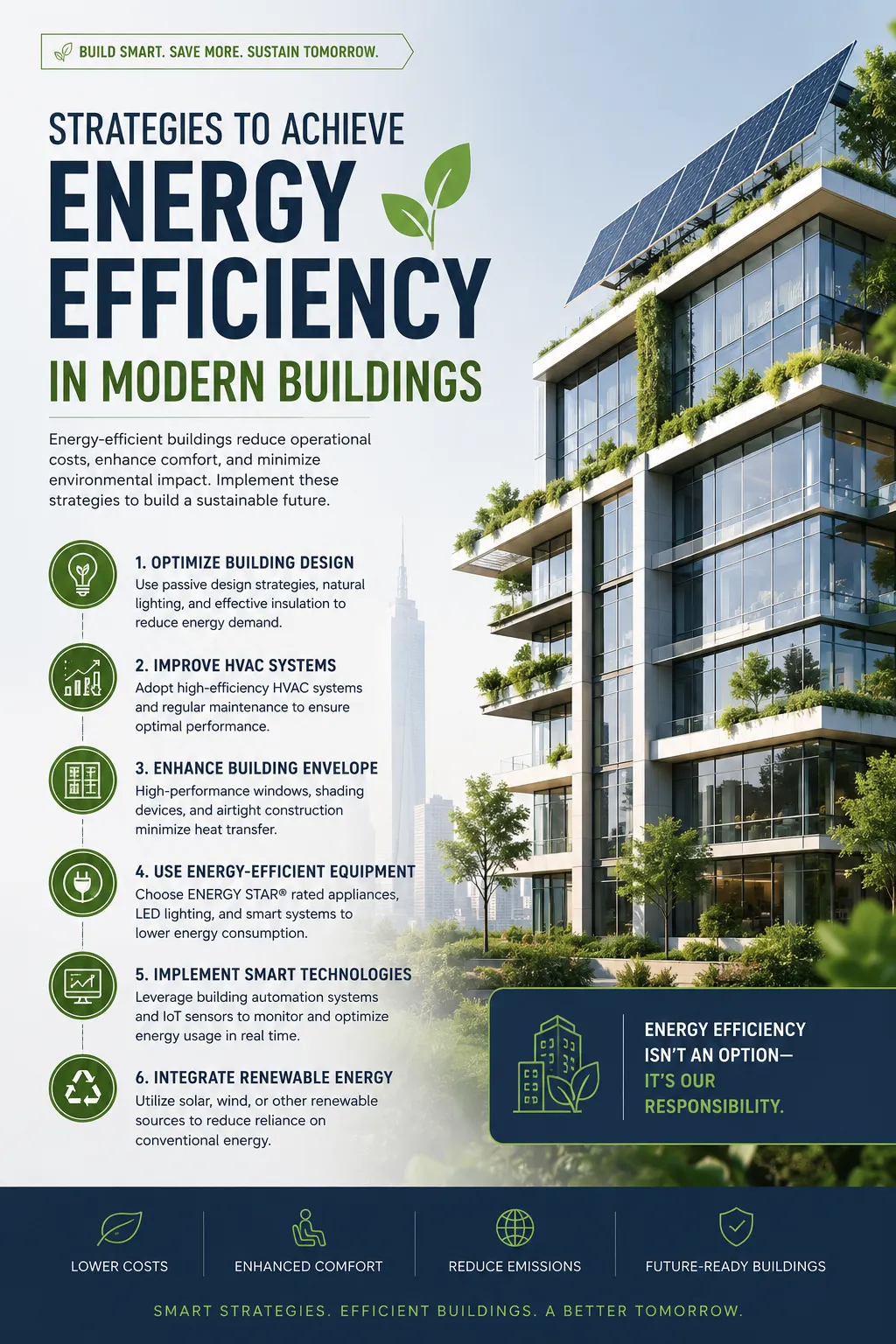
1. Building Envelope Optimization
A high-performance building envelope minimizes heat gain and loss through better insulation, airtight construction, energy-efficient windows, and reduced thermal bridging, lowering HVAC energy demand.
Reference:
- https://www.ashrae.org/technical-resources/high-performing-buildings/passive-building-on-the-rise
- https://www.unido.org/sites/default/files/2009-02/Module18_0.pdf
2. Passive Building Design
Passive design uses natural resources such as sunlight, ventilation, and thermal mass to maintain indoor comfort while reducing dependence on mechanical heating and cooling systems.
Reference:
https://www.civilengineeringjournals.com/ijceae/article/70/6-2-4-505.pdf
3. High-Performance HVAC Systems
Efficient HVAC technologies, including VRF systems, heat pumps, energy recovery ventilators, and demand-controlled ventilation, significantly reduce heating and cooling energy consumption.
Reference:
https://www.unido.org/sites/default/files/2009-02/Module18_0.pdf
4. Smart Building Automation
Building Management Systems (BMS), IoT sensors, and automated controls continuously monitor and optimize building operations, reducing energy waste and improving system performance.
5. Energy-Efficient Lighting
Replacing conventional lighting with LED fixtures and integrating occupancy sensors and daylight controls reduces electricity use and maintenance costs.
6. Renewable Energy Integration
On-site renewable energy systems, such as solar photovoltaic panels, help offset electricity consumption after the building’s energy demand has been optimized.
7. Energy Storage and Demand Management
Battery storage and demand-response strategies improve energy resilience, lower peak electricity demand, and maximize the use of renewable energy.
8. Water-Energy Efficiency
Water-saving fixtures, rainwater harvesting, and efficient pumping systems reduce both water consumption and the energy required for water treatment and distribution.
9. Sustainable Building Materials
Using recycled, locally sourced, and low-carbon materials reduces embodied energy while improving the overall environmental performance of buildings.
10. Building Energy Modeling (BEM)
Energy modeling software evaluates building performance during the design stage, helping identify the most cost-effective energy efficiency measures before construction.
11. Commissioning and Retro-Commissioning
Regular commissioning ensures that building systems operate as designed, while retro-commissioning restores efficiency in existing buildings by correcting operational issues.
12. Predictive Maintenance
Data-driven maintenance identifies equipment issues before failure, improving reliability, extending equipment life, and preventing unnecessary energy losses.
13. Net-Zero Energy Buildings
Net-zero buildings combine highly efficient design with renewable energy generation to produce as much energy annually as they consume.
14. Green Building Certifications
Certification systems such as LEED, BREEAM, WELL, and Passive House provide recognized frameworks for improving building performance, sustainability, and energy efficiency.
15. Cost-Benefit Analysis
Prioritizing high-impact upgrades such as insulation, HVAC optimization, and smart controls delivers faster returns on investment through lower operating costs and reduced energy bills.
Common Implementation Challenges
Initial capital costs, aging infrastructure, technical complexity, and occupant behavior can affect implementation, but long-term savings generally outweigh these challenges.
Future Trends
Emerging technologies, including artificial intelligence, digital twins, smart grids, and grid-interactive buildings, are enabling more intelligent and adaptive energy management.
References
- International Energy Agency (IEA): https://www.iea.org/energy-system/buildings
- ASHRAE Passive Building Resources: https://www.ashrae.org/technical-resources/high-performing-buildings/passive-building-on-the-rise
- UNIDO Energy Efficiency in Buildings Manual: https://www.unido.org/sites/default/files/2009-02/Module18_0.pdf
- MDPI Buildings Journal: https://www.mdpi.com/2075-5309/14/6/1839
- NetZeroCities Knowledge Platform: https://netzerocities.app/resource-3557
- Passive House Institute: https://passivehouse.com/
- U.S. Green Building Council (LEED): https://www.usgbc.org/leed
- BREEAM: https://www.breeam.com/
- WELL Building Standard: https://www.wellcertified.com/
- The Energy Performance Index (EPI) in a Building?